
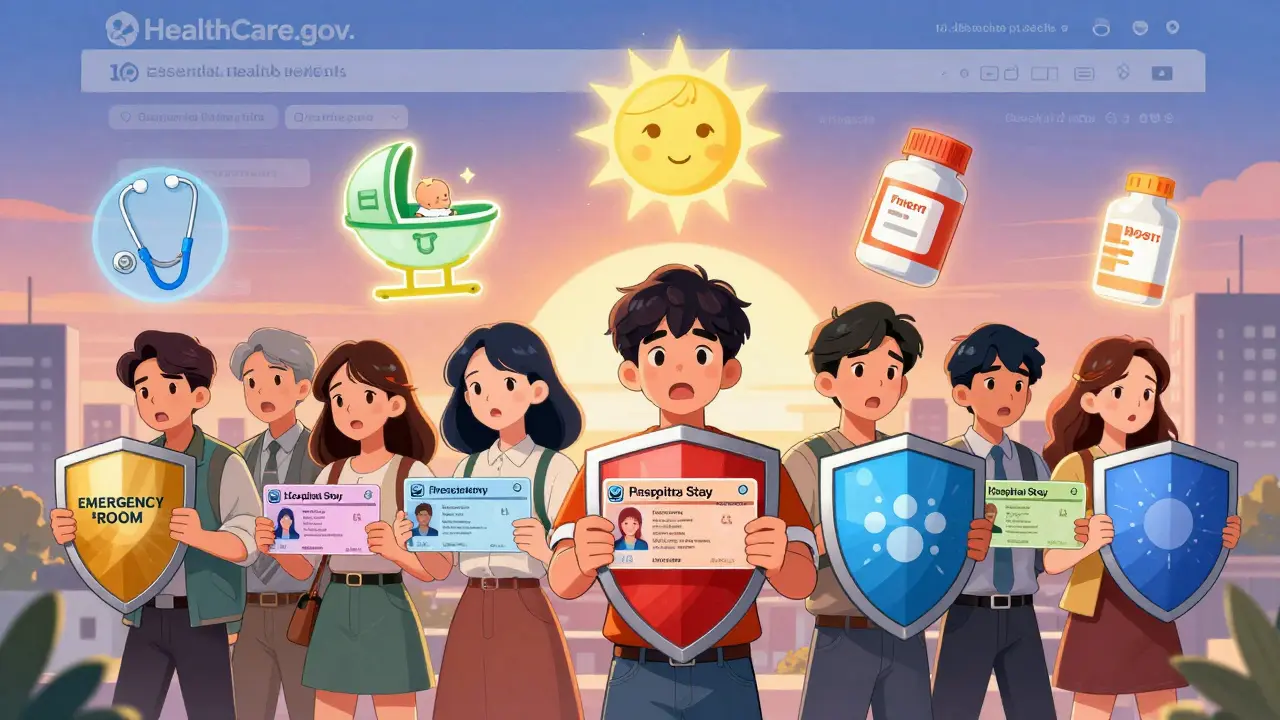
When you hear "ACA plan," you might think of cheap health insurance. But the truth is more complicated. The Affordable Care Act didn’t just make insurance cheaper-it changed what insurance even means. If you’re signing up for a plan on HealthCare.gov or your state’s marketplace, you’re not just picking a price. You’re choosing what care you can actually get when you need it.
What’s Really Covered? The 10 Essential Health Benefits
ACA plans don’t get to pick and choose what they cover. By law, every plan sold on the Marketplace must include ten essential health benefits. These aren’t optional extras. They’re the baseline. If your plan says it’s ACA-compliant, it must cover:- Ambulatory patient services (outpatient doctor visits)
- Emergency services
- Hospitalization
- Maternity and newborn care
- Mental health and substance use disorder services
- Prescription drugs
- Rehabilitative and habilitative services
- Laboratory services
- Preventive and wellness services
- Pediatric services, including dental and vision care for kids
That last one matters. Before the ACA, many plans didn’t cover kids’ dental or vision. Now, they have to. If your child needs braces or an eye exam, that’s covered-no hidden fine print.
And here’s the kicker: no annual or lifetime limits. Before 2010, if you had cancer and your plan had a $1 million cap, you were out of luck once you hit it. That doesn’t happen anymore. Your plan can’t cap how much it pays for your care over your lifetime.
Pre-Existing Conditions? No More Exclusions
This is the biggest win for millions. Before the ACA, insurers could deny you coverage if you had diabetes, asthma, depression, or even a past surgery. They could charge you more. Or they could exclude your condition from coverage entirely.That’s illegal now. If you have a chronic illness, your ACA plan can’t refuse to cover it. No waiting periods. No loopholes. That’s why 92% of enrollees with chronic conditions say this rule alone makes the ACA worth it.
It’s not just about being accepted. It’s about being treated fairly. If you’re on insulin, your plan must cover it. If you need therapy for anxiety, they can’t say "we don’t cover that." The law forces them to treat your condition like any other.
How Premium Tax Credits Actually Work (And Why They’re Disappearing)
Most people don’t pay full price for ACA plans. That’s because of premium tax credits. These are government subsidies that lower your monthly bill. But here’s the catch: they’re temporary.Thanks to the American Rescue Plan and the Inflation Reduction Act, those credits were boosted. For 2024, a 40-year-old earning $50,000 paid about $247 a month for a Silver plan. Without the credits? $534. That’s a $287 monthly savings.
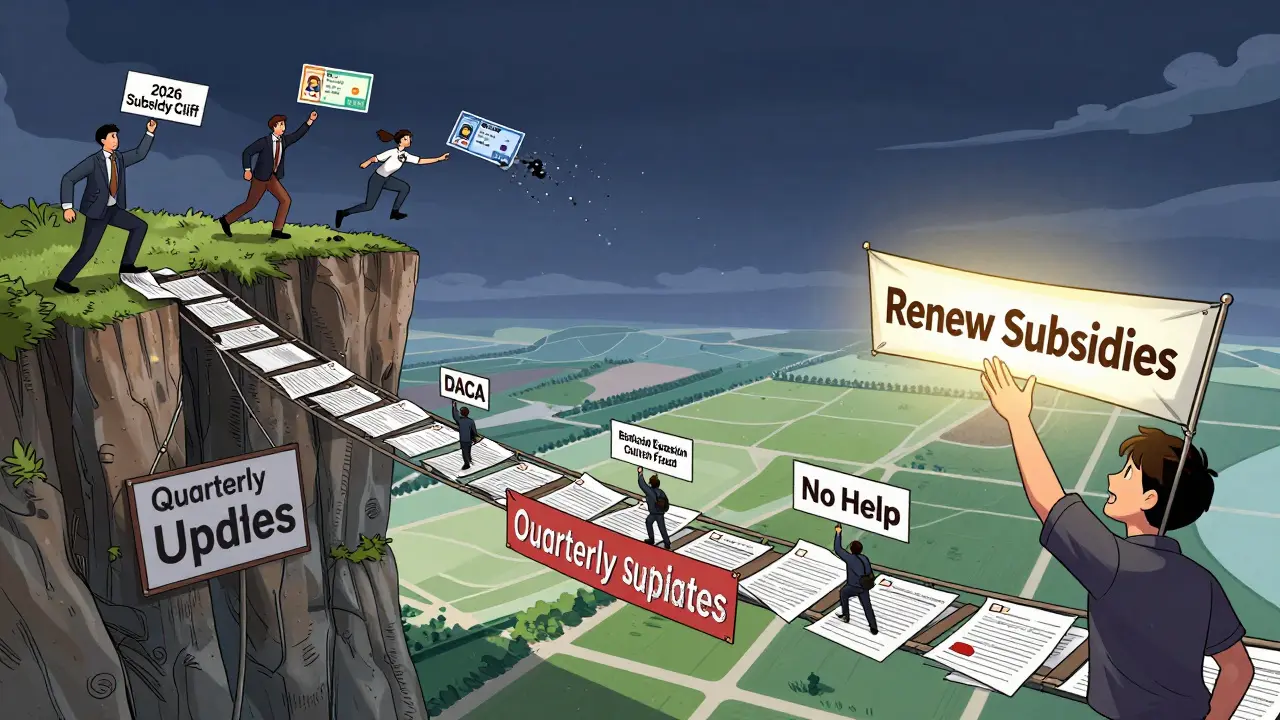
But those enhanced credits expire at the end of 2025. Starting January 1, 2026, those same people will pay the full price again. For some, that means premiums jumping 114%-over $1,000 more per year. For a 60-year-old in some states? Up to 192% higher.
And it’s not just about income. The credits are based on your Modified Adjusted Gross Income (MAGI). If you’re self-employed, your income fluctuates. You estimate it when you enroll. If you make more than you predicted, you owe money at tax time. If you make less, you get a refund. That’s why so many people end up filing amended tax returns. One Reddit user, u/HealthyInTX, said they had to file three corrected returns just to get their subsidy right.

Choosing Your Metal Tier: Bronze, Silver, Gold, Platinum
ACA plans are grouped into four metal tiers. Each one tells you how much the plan pays vs. how much you pay out of pocket.| Tier | Actuarial Value | What It Means for You |
|---|---|---|
| Bronze | 60% | Plan pays 60% of costs. You pay 40%. Lowest monthly premium, highest out-of-pocket. |
| Silver | 70% | Plan pays 70%. You pay 30%. Most people qualify for cost-sharing reductions here. |
| Gold | 80% | Plan pays 80%. You pay 20%. Higher premium, lower bills when you need care. |
| Platinum | 90% | Plan pays 90%. You pay 10%. Highest premium, lowest out-of-pocket. |
Most people who get subsidies pick Silver plans. Why? Because if your income is under 250% of the Federal Poverty Level, you get extra help with deductibles and copays. That’s called Cost-Sharing Reductions (CSR). It makes your Silver plan act like a Gold plan-lower out-of-pocket costs without the higher premium.
But here’s the problem: only 42% of enrollees understand they even qualify for CSR. Many think they’re stuck with Bronze because it’s cheap. They don’t realize Silver with CSR might cost the same-and save them thousands when they get sick.
Who Gets Left Out? The Coverage Gaps
The ACA didn’t fix everything. There are still big holes.First, if you make more than 400% of the Federal Poverty Level, you don’t qualify for subsidies anymore. For a single person in 2025, that’s $60,240. If you earn $65,000 and have no employer coverage, you’re on your own. No help. Full price.
Second, DACA recipients lost eligibility under the November 2025 CMS Final Rule. About 550,000 people who had coverage through the Marketplace will lose it by 2026. No warning. No grace period.
Third, Medicaid expansion isn’t universal. In states that didn’t expand Medicaid, people earning below the poverty line still can’t get help. They’re stuck in the "coverage gap"-too poor for subsidies, too rich for Medicaid.
And then there’s the "family glitch." Before 2023, if your employer offered you affordable coverage, your spouse and kids couldn’t get subsidies-even if the family plan was unaffordable. That’s fixed now. But many people still don’t know it.
Real Stories: What People Actually Experience
Sarah K. from Ohio is a freelance writer making $32,000 a year. She got a $0 premium Silver plan with full cost-sharing reductions. She pays nothing for doctor visits. Her prescriptions cost $5. She says it’s the only reason she can afford to work for herself. Then there’s u/ACA_Warrior on Reddit. Their income dropped 30% mid-year. They couldn’t adjust their subsidy until tax season. By then, they’d racked up $2,800 in medical bills they couldn’t pay. That’s the system’s flaw: it’s reactive, not responsive.People love the coverage. They hate the paperwork. The average application takes 45 minutes. For self-employed folks? Six to eight hours of digging through pay stubs, bank statements, and tax forms. CMS reports a 32% error rate in subsidy estimates for freelancers. That’s not user error-it’s a system designed for W-2 workers.
What Comes Next? The 2026 Cliff
The ACA’s biggest strength-subsidies-is also its biggest weakness. They’re political. They can vanish overnight.If Congress doesn’t act before December 31, 2025, the enhanced tax credits disappear. Premiums will spike. Enrollment will drop. Experts predict 3 to 4 million people will lose coverage by 2027.
Insurers are already preparing. UnitedHealthcare, Elevance Health, and Molina are adjusting their 2026 rates. Some plans will drop out of certain counties. Others will raise premiums to cover the loss of subsidy payments.
The CMS 2025 Final Rule is trying to fix the system by requiring quarterly income updates starting in 2026. That could cut reconciliation errors by 40%. But it also means more paperwork. More stress. More calls to customer service.
And here’s the irony: the ACA made insurance better. But it made it dependent on government support. Without it, the whole structure wobbles.
What Should You Do Right Now?
If you’re on an ACA plan:- Check your 2025 subsidy. If you’re getting help, make sure your income estimate is accurate. Overestimate? You’ll owe taxes. Underestimate? You’ll get a refund.
- Don’t assume your plan stays the same in 2026. Compare options during open enrollment. Premiums may jump.
- If you’re self-employed, track your income monthly. Use the IRS’s MAGI calculator. Don’t wait until tax season.
- If you’re near the 400% FPL cutoff, consider whether switching to a higher-tier plan (Gold or Platinum) makes sense. You might pay more monthly but save more when you need care.
- If you’re under 30 or have a hardship exemption, you can still get a catastrophic plan. It’s cheap, but only covers emergencies and three primary care visits a year.
The ACA didn’t create perfect health insurance. But it created something better than what came before. It forced insurers to cover real care. It protected people with chronic illness. It gave millions access to medicine they couldn’t afford before.
What’s at risk now isn’t just a subsidy. It’s the promise that no one should go broke because they got sick.
Do all ACA plans cover prescription drugs?
Yes. All ACA-compliant plans must include coverage for prescription drugs as part of the ten essential health benefits. However, each plan has its own formulary-a list of drugs it covers. Some plans cover brand-name drugs with high copays, while others favor generics. Always check your plan’s formulary before enrolling, especially if you take specific medications.
Can I switch my ACA plan mid-year?
Only if you have a qualifying life event: losing other coverage, getting married, having a baby, moving to a new state, or a change in income that affects your subsidy. Otherwise, you must wait for open enrollment. The 2025 CMS Final Rule eliminated the monthly Special Enrollment Period for those below 150% FPL, making it harder for low-income people to adjust coverage during the year.
What happens if my income changes during the year?
You can report changes to HealthCare.gov, but updates aren’t instant. If your income drops, you might qualify for higher subsidies-but you may not get them until you file your taxes. If your income rises, you may owe money back. Starting in 2026, quarterly income updates will be required to reduce these surprises.
Are ACA plans the same as Medicaid?
No. Medicaid is government-run health coverage for low-income people, funded by federal and state dollars. ACA plans are private insurance sold through the Marketplace, often with government subsidies. Medicaid has lower or no premiums and lower out-of-pocket costs. If you qualify for Medicaid, you don’t need an ACA plan.
Why do ACA premiums vary so much by state?
Premiums depend on local healthcare costs, insurer competition, and state regulations. States that expanded Medicaid have more enrollees, which helps spread risk and keeps prices lower. States with fewer insurers or higher medical costs have higher premiums. For example, a Silver plan in Wyoming costs nearly double what it does in Minnesota.
Bryan Coleman
February 1, 2026 AT 13:50Man, I’ve been on an ACA plan since 2021. Got a Silver with CSR, pay $12 a month, prescriptions are $5. No complaints. But yeah, the portal is a nightmare-half the time it says my income is wrong even when I paste my W-2. CMS needs to fix the interface, not add more forms.
vivian papadatu
February 3, 2026 AT 03:59This is one of the clearest breakdowns I’ve read. The metal tiers alone should be pinned. So many people think Bronze = good deal, but if you have any chronic condition, Silver with CSR is the real win. I’m a nurse, and I see patients lose coverage every year because they don’t understand CSR. Please, share this with someone who’s confused.
Melissa Melville
February 3, 2026 AT 20:41So basically, the government gives you a discount if you’re poor, but if you make a little more, you’re screwed? Classic. 😅
Angel Fitzpatrick
February 5, 2026 AT 12:07They don’t want you to know this, but the ACA was designed by Big Pharma to lock you into their pricing. The "essential benefits"? All drugs they control. The subsidies? Just to keep you hooked. Look at the CEOs of UnitedHealth and Elevance-they made $1.2B last year off this. The real crisis isn’t premiums-it’s corporate greed disguised as policy.
Lilliana Lowe
February 5, 2026 AT 23:37The assertion that "ACA plans changed what insurance even means" is semantically imprecise. Insurance, by definition, is risk-pooling. The ACA mandated minimum actuarial value and prohibited rescission-both regulatory interventions, not ontological transformations. Furthermore, the phrase "no annual or lifetime limits" is misleading; it’s not that limits disappeared-they were restructured into out-of-pocket maximums, which remain capped under 45 CFR §156.230.
Bob Cohen
February 6, 2026 AT 21:23LOL, I saw someone in the comments say "the ACA is a scam." Bro, you’re not getting a $0 premium plan because of a scam. You’re getting it because Congress didn’t let the subsidies expire. You’re welcome.
Naomi Walsh
February 7, 2026 AT 00:05It’s laughable that Americans think this is "healthcare." This is insurance with bureaucratic gymnastics. In Ireland, we have a single-payer system with universal access. No formularies. No metal tiers. No MAGI calculations. Just care. You people are fighting over subsidies while the rest of the developed world moved on.
Aditya Gupta
February 8, 2026 AT 17:40My cousin in Delhi just got a $10/month plan with 24/7 telehealth. No formulary drama. No 45-min applications. Why are we still doing this the hard way? 🤷♂️
June Richards
February 9, 2026 AT 06:23Anyone else notice how the article ignores that 70% of ACA enrollees are on Medicaid expansion? This whole post is just a PR piece for private insurers. The real story is the 12 states that still refuse to expand. That’s where the crisis is.
Jaden Green
February 9, 2026 AT 14:45Let’s be real-this whole system is a house of cards built on temporary political goodwill. The fact that your coverage depends on whether Congress likes you this year is a feature, not a bug. They don’t want you stable-they want you anxious, signing up every year, paying attention, hoping you don’t get penalized. It’s behavioral control disguised as social policy. And the people who benefit? The actuaries and the lobbyists. Not you.
Lu Gao
February 10, 2026 AT 11:32Actually, the family glitch fix was in 2023, but it only applies to new enrollments. If you’re still on a plan from 2022? Too bad. Also, "catastrophic plans" aren’t just for under-30s-they’re for people who’ve been denied hardship exemptions. And yes, that’s a loophole. But it’s still better than nothing. 😊
Deep Rank
February 12, 2026 AT 09:28Okay so let me get this straight-you're telling me if I make $65k and have asthma and my employer doesn't offer insurance I'm just supposed to pay $1200/month? And if I make $59k I get a subsidy? So the system is punishing me for working harder? And then they say "you're responsible for your health"? Bro, I'm not a statistic, I'm a person who works 60 hours a week and still can't breathe without my inhaler. And now they want me to update my income every quarter? I don't even have time to shower. This isn't healthcare. This is a tax audit with a stethoscope.