

LDL Reduction Calculator for Alternate-Day Statin Dosing
Calculate your potential LDL cholesterol reduction with alternate-day dosing versus daily dosing. Based on evidence that alternate-day dosing of atorvastatin or rosuvastatin provides 35-45% LDL reduction (compared to 50-60% with daily dosing).
Results will appear here after calculation
What if you could cut your statin dose in half - not by taking a smaller pill, but by taking it every other day - and still keep your LDL cholesterol under control, while finally feeling like your muscles aren’t on fire? For millions of people who can’t tolerate daily statins, this isn’t science fiction. It’s a real, evidence-backed strategy that’s quietly helping patients get back to normal life without the constant ache in their legs or the fear of muscle damage.
Why Do Some People Just Can’t Take Statins Daily?
Statin drugs like atorvastatin and rosuvastatin are among the most effective tools we have to lower LDL cholesterol - the kind that clogs arteries and leads to heart attacks. But for about 1 in 7 people who take them, the side effects are too much to bear. The most common problem? Statin-associated muscle symptoms, or SAMS. That means unexplained muscle pain, weakness, or cramps - often in the thighs, shoulders, or calves - that don’t go away. Some people feel it after a few days. Others notice it after weeks. Either way, they stop taking the pill. And then their cholesterol creeps back up. The problem isn’t always the dose. Even low doses can cause trouble. It’s not always about the liver or kidneys. It’s often just the muscles. And when patients stop statins, their risk of heart disease goes up. So what’s the middle ground?How Alternate-Day Dosing Works (And Why It’s Not Just Guessing)
Alternate-day statin dosing isn’t about skipping pills because you forgot. It’s a carefully studied approach based on how long these drugs stay active in your body. Not all statins are created equal. Atorvastatin and rosuvastatin have long half-lives - meaning they stick around in your bloodstream for 14 to 30 hours after you take them. That’s long enough to keep working even if you don’t take a pill the next day. In a 2012 study of 38 people with high cholesterol, researchers compared daily 20 mg of atorvastatin to every-other-day 20 mg. After 12 weeks, both groups lowered LDL by about the same amount: 44% versus 42%. The difference wasn’t statistically significant. In other words, skipping a day didn’t hurt the effect. Later studies confirmed this. A 2017 meta-analysis of 11 trials found that alternate-day dosing delivered 92-95% of the LDL-lowering power of daily dosing. That’s not perfect - but it’s close enough to make a real difference in heart risk, especially if you can’t tolerate daily pills.What Happens to Side Effects When You Skip Days?
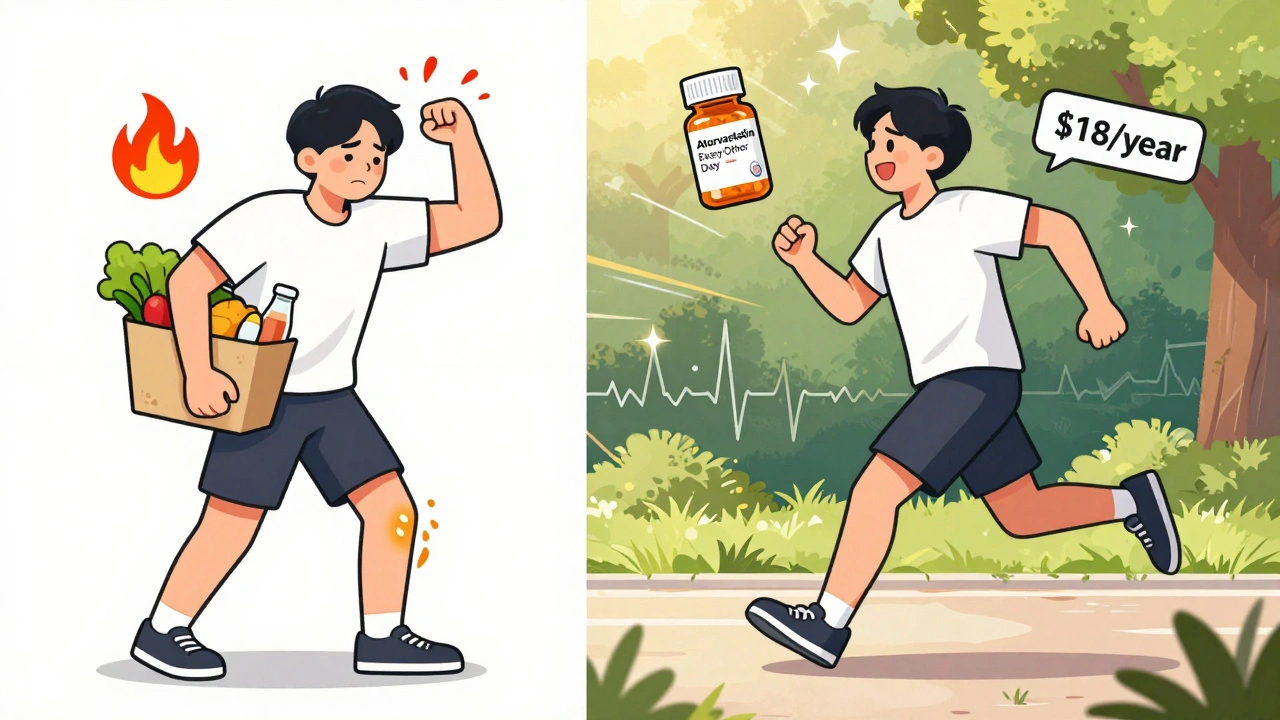
This is where alternate-day dosing really shines. In one study, 23 patients had tried daily atorvastatin or rosuvastatin and quit because of muscle pain. When switched to the same drug every other day - plus ezetimibe and colesevelam - 87% of them could stay on the regimen. That’s a huge jump from 0% tolerance on daily dosing. Another study looked at people who had muscle pain on daily statins. After switching to every-other-day dosing, 70-80% reported their muscle symptoms improved or disappeared. One patient told his doctor, “I can finally walk up the stairs without stopping.” That’s not just a feeling - it’s a change in quality of life. The reduction in muscle side effects isn’t random. Studies suggest alternate-day dosing cuts the risk of myopathy (muscle damage) by 30-50%. That’s because your muscles get a break. The drug doesn’t build up as much. Your body has time to recover between doses.Which Statins Work for Every Other Day? (And Which Don’t)
Not every statin can do this. The half-life matters. Short-acting statins like simvastatin, lovastatin, and fluvastatin don’t stick around long enough. If you take 40 mg of simvastatin one day, it’s mostly gone by the next. Skipping a day means you’re not getting enough coverage. Only two statins have strong evidence for alternate-day use: atorvastatin and rosuvastatin. - Atorvastatin: 10 mg, 20 mg, or 40 mg every other day works well. Studies show LDL reduction stays above 40%. - Rosuvastatin: 5 mg, 10 mg, or 20 mg every other day is effective. Even once-weekly dosing (2.5-20 mg) has been used successfully in some cases. If you’re on simvastatin or pravastatin and can’t tolerate it, switching to atorvastatin or rosuvastatin - then switching to every-other-day dosing - is often the best path forward.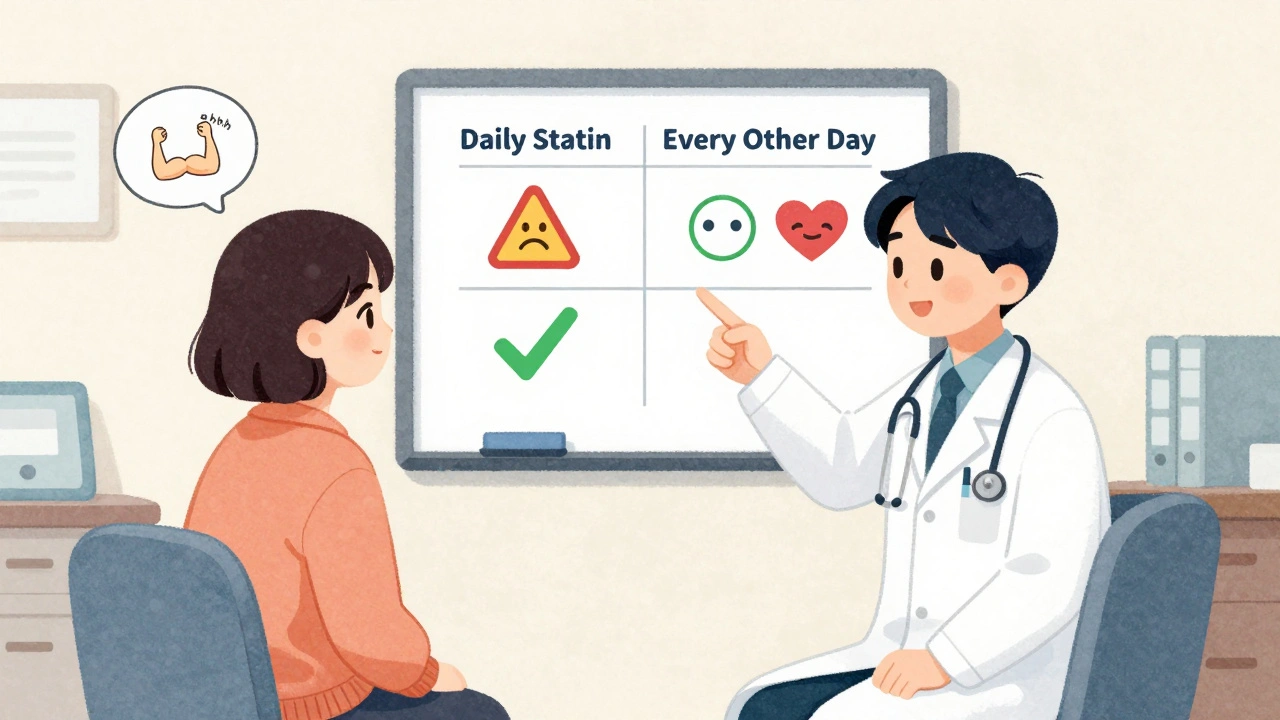
How Much Does It Lower LDL? (Real Numbers)
Let’s get specific. If you’re taking 20 mg of atorvastatin daily and lowering your LDL from 160 mg/dL to 90 mg/dL (a 44% drop), switching to 20 mg every other day might bring it down to 95-100 mg/dL. That’s still a 38-40% reduction. For most people, that’s enough to reduce heart attack risk significantly. Compare that to ezetimibe (Zetia), which lowers LDL by about 15-20% on its own. Or PCSK9 inhibitors like Repatha - which lower LDL by 50-60%, but cost over $10,000 a year. Alternate-day statin dosing gives you 70-80% of the LDL-lowering power of daily statins, at about half the cost. A 20 mg tablet of generic atorvastatin costs as little as $0.10 per pill. Taking it every other day? You’re spending $18 a year instead of $36. That’s not a small savings. It’s life-changing for people on fixed incomes.Who Should Try This? (And Who Shouldn’t)
This isn’t for everyone. It’s designed for one group: people with documented statin intolerance who still need strong LDL control. Good candidates:- Have muscle pain or weakness confirmed while on daily statins
- Have a history of cardiovascular disease or high risk (diabetes, high blood pressure, family history)
- Have tried at least two different daily statins and couldn’t stay on them
- Have normal or only mildly elevated creatine kinase (CK) levels - no signs of rhabdomyolysis
- People with no statin intolerance - daily dosing is still best
- Those with very high LDL (over 190 mg/dL) who need aggressive lowering
- People with kidney disease or liver issues - need closer monitoring
- Anyone who can’t remember to take pills every other day - adherence matters
How to Start - Step by Step
If you and your doctor think this might work for you, here’s how it usually goes:- Confirm you have true statin intolerance - not just temporary discomfort.
- Switch from your current statin to either atorvastatin or rosuvastatin (if you’re not already on one).
- Start with the same daily dose, but take it every other day. Example: 20 mg on Monday, skip Tuesday, take 20 mg Wednesday, etc.
- Get your LDL checked in 4-6 weeks. If it’s not down enough, your doctor might increase the dose (e.g., to 40 mg every other day) or add ezetimibe.
- Keep tracking muscle symptoms. Use a simple scale: 0 = no pain, 10 = unbearable. Recheck every 3 months.
The Downsides - What No One Tells You
Alternate-day dosing isn’t perfect. Here’s what you need to know: - It’s off-label. The FDA hasn’t approved this use. Insurance might not cover it if they see “every other day” on the prescription. Some pharmacies won’t fill it unless the doctor writes a note explaining why. - You won’t get the same LDL reduction as daily dosing. If your goal is under 70 mg/dL (for someone with heart disease), you might need to add ezetimibe or another drug. - Some patients report inconsistent control. One week their LDL is great. The next, it’s creeping up. That’s why regular blood tests are non-negotiable. - Complex combinations can be a burden. Some regimens include 6 pills of colesevelam a day - that’s a lot to swallow. The goal is to reduce pill burden, not add to it.How It Compares to Other Options
| Option | LDL Reduction | Cost per Year | Muscle Side Effects | Approved for Daily Use? |
|---|---|---|---|---|
| Daily Atorvastatin/Rosuvastatin | 50-60% | $30-$60 | High (10-15%) | Yes |
| Alternate-Day Statin | 35-45% | $15-$30 | Low (3-5%) | No (off-label) |
| Ezetimibe (Zetia) | 15-20% | $300-$400 | Very Low | Yes |
| Bempedoic Acid (Nexletol) | 18-25% | $480 | Low | Yes |
| PCSK9 Inhibitors (Repatha) | 50-60% | $5,000-$14,000 | Very Low | Yes |
What Experts Say
Dr. Robert Rosenson, a leading cardiologist at Mount Sinai, calls alternate-day dosing a “rational approach” for patients who can’t take statins daily. The American College of Cardiology acknowledges it can reduce side effects - but warns there’s no proof yet that it lowers heart attacks or strokes. That’s the big gap. We know it lowers LDL. We know it reduces muscle pain. But we don’t yet have 10-year studies showing fewer heart attacks in people on alternate-day regimens. That’s why it’s not in the official guidelines as a first-line option. But for someone who’s already stopped their statin and is now at higher risk? It’s a lifeline.Final Thought: It’s Not About Perfect - It’s About Consistent
The best cholesterol-lowering drug is the one you take. If daily statins make you feel terrible, you won’t take them. And then your risk goes up. Alternate-day dosing doesn’t promise perfection. But it offers something better: sustainability. It lets people live without constant pain, without crushing costs, and without giving up on their heart health. If you’ve quit your statin because of side effects, talk to your doctor. Ask: “Could I try atorvastatin or rosuvastatin every other day?” It might be the missing piece.Can I just skip a statin day on my own?
No. Don’t change your dosing schedule without talking to your doctor. Skipping doses randomly can lead to inconsistent cholesterol control. Alternate-day dosing is a planned medical strategy that requires the right drug (atorvastatin or rosuvastatin), the right dose, and regular monitoring. Self-adjusting could raise your heart risk.
Will my insurance cover alternate-day statin dosing?
It depends. Insurance covers the drug itself - not the dosing schedule. So if your doctor prescribes 20 mg of atorvastatin, your plan will pay for it whether you take it daily or every other day. But if the pharmacy or insurer questions the prescription because it’s “off-label,” your doctor may need to write a letter explaining your statin intolerance and why this approach is medically necessary.
How long does it take to see results?
You’ll usually see your LDL drop within 4 to 6 weeks. Muscle symptoms often improve faster - sometimes within 1-2 weeks. That’s why doctors check your cholesterol at the 6-week mark. If your LDL is still too high, they’ll adjust the dose or add ezetimibe.
Is once-a-week statin dosing safe?
Once-weekly dosing has been studied, especially with rosuvastatin, and can work for some people. But it’s less predictable than every-other-day dosing. LDL reduction is usually lower (around 20-25%), so it’s typically used only for patients who can’t tolerate even every-other-day dosing - and only when combined with other non-statin drugs like ezetimibe.
What if I feel worse on alternate-day dosing?
Stop and call your doctor. Muscle pain that gets worse, dark urine, extreme fatigue, or swelling could be signs of something serious. Even though side effects are lower with this approach, they’re not zero. Your doctor may need to try a different statin, adjust the dose, or switch to another treatment like bempedoic acid.
val kendra
December 4, 2025 AT 08:15Cost? $18 a year. Game changer.
Ben Choy
December 5, 2025 AT 10:47Just make sure you’re on atorvastatin or rosuvastatin. Don’t try this with simvastatin - it won’t work.
Emmanuel Peter
December 6, 2025 AT 09:41Jenny Rogers
December 8, 2025 AT 01:30Scott van Haastrecht
December 9, 2025 AT 10:18Heidi Thomas
December 10, 2025 AT 06:52Libby Rees
December 12, 2025 AT 01:58Rudy Van den Boogaert
December 13, 2025 AT 04:18My doctor says it’s not FDA-approved but he’s glad I’m still taking something.
Jordan Wall
December 14, 2025 AT 03:50Shofner Lehto
December 15, 2025 AT 13:09