
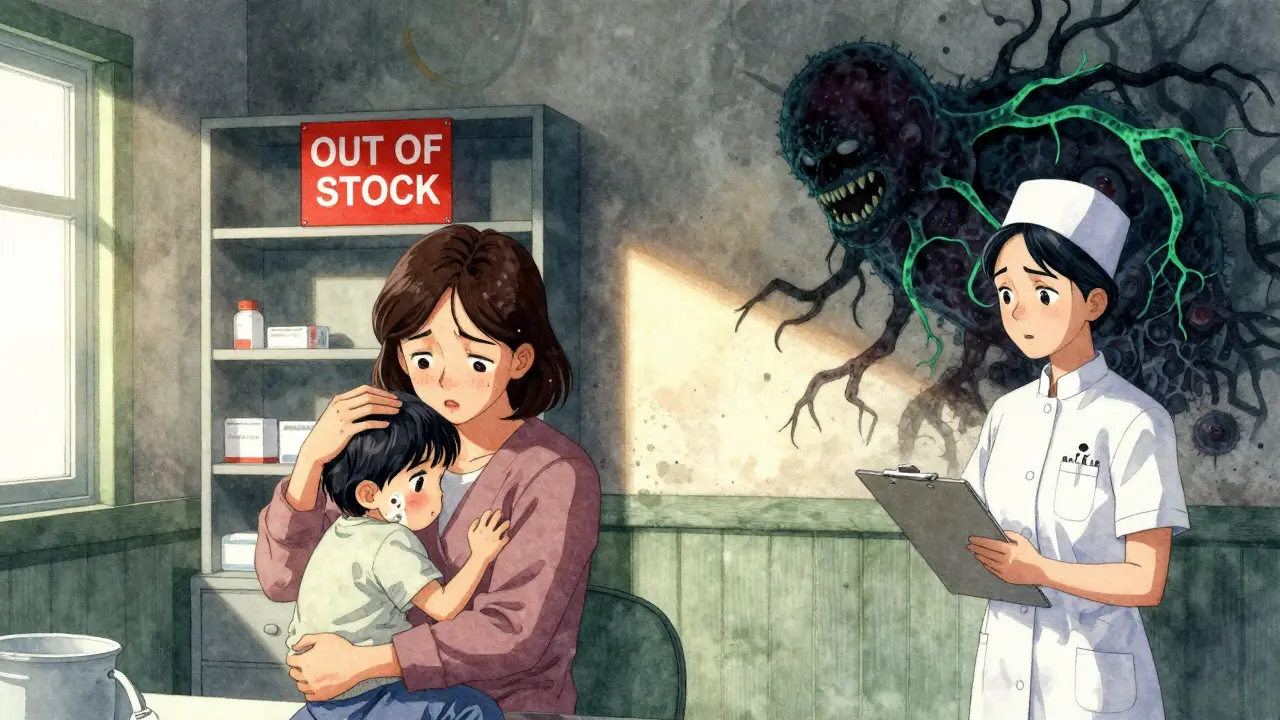
When you take an antibiotic, you expect it to work. But for millions around the world, that’s no longer a guarantee. Antibiotic shortages are no longer rare news-they’re a daily reality in hospitals, clinics, and rural health centers. In 2024, the U.S. FDA listed 147 active antibiotic shortages. Across Europe, 14 countries declared their shortages "critical." And in low-income regions, the problem is even worse: 70% of essential antibiotics are simply unavailable. This isn’t just about empty shelves. It’s about patients dying from infections that should be treatable.
Why Antibiotics Are Different
Most drug shortages hurt-but antibiotics hurt differently. When insulin or blood pressure meds run out, doctors can often switch to another class of drug. Not with antibiotics. If penicillin is gone, and your child has strep throat, there’s no easy substitute. The alternatives are either less effective, more toxic, or both. Take amoxicillin. It’s the go-to for ear infections, pneumonia, and sinusitis. In early 2023, shortages hit hard across the European Economic Area. By the end of the year, use dropped by 69% in hospitals using the combination with clavulanate. What happened next? Doctors turned to broader-spectrum drugs like azithromycin or ceftriaxone. Those are fine for some cases-but overuse pushes bacteria toward resistance. Now, over 40% of E. coli and over 55% of K. pneumoniae are resistant to third-generation cephalosporins. When those fail, the only option left? Carbapenems. And those are already being overused, making them less effective too.The Manufacturing Crisis
You might think drug companies just need to make more. But it’s not that simple. Antibiotics are cheap. Really cheap. The generic market, which supplies 85% of all antibiotics, has seen prices drop 27% since 2015. Meanwhile, regulatory costs for sterile injectables-like penicillin G benzathine-have jumped 34%. That’s a death sentence for manufacturers. Most antibiotics are made in just a handful of factories, mostly in India and China. One shutdown, one inspection failure, or one supply chain disruption-like Brexit-and entire regions go without. The UK saw antibiotic shortages jump from 648 in 2020 to 1,634 in 2023. The European Court of Auditors called it a "systemic failure"-regulators didn’t force companies to invest in backup capacity because the profit margin was too thin. Penicillin G benzathine has been in short supply since 2015. Why? Because it’s a single-dose shot for syphilis and rheumatic fever. It’s not glamorous. It doesn’t make big money. But it saves lives. And now, it’s still hard to find.Who Pays the Price?
In high-income countries, hospitals scramble. Pharmacists spend hours tracking down obscure alternatives. Nurses ration doses. A 2025 survey of U.S. hospital pharmacists found 78% had to change treatment plans in the past year. 62% saw more patients develop complications because they couldn’t give the right drug. One infectious disease specialist in California told a story that’s now common: a young woman with a urinary tract infection. First-line drugs? Gone. She was given colistin-a last-resort antibiotic with severe kidney toxicity. "It worked," she said. "But I felt like I was poisoning her to save her." In low- and middle-income countries, the crisis is deeper. When antibiotics vanish, there’s no backup. No import networks. No stockpiles. A nurse in rural Kenya described sending mothers home with their sick children because penicillin wasn’t in stock. "We know they might die," she said. "But we have no choice." In Mumbai, a mother waited 72 hours for azithromycin to treat her child’s pneumonia. By the time it arrived, the infection had spread. The child ended up in intensive care. These aren’t outliers. They’re the new normal.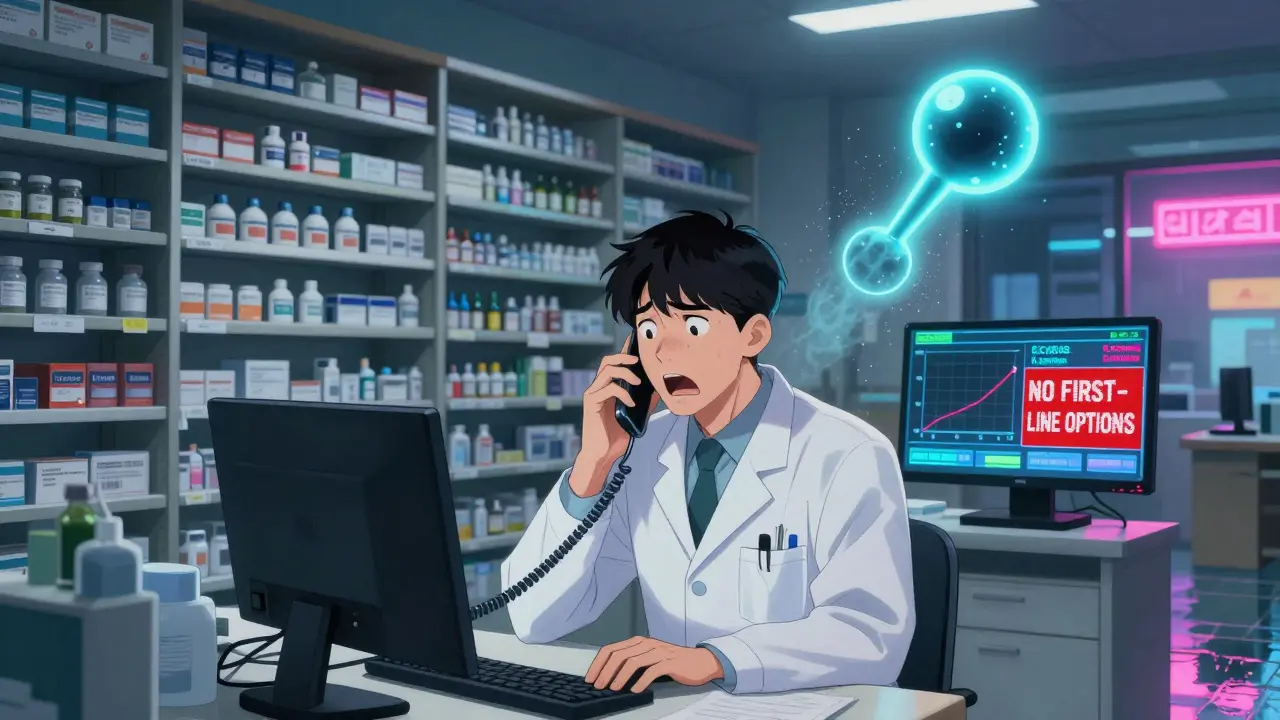
The Domino Effect: Resistance and Death
Every time a doctor uses a broader-spectrum antibiotic because the simple one is gone, we lose ground in the war against resistance. The WHO’s 2025 surveillance report found that one in six bacterial infections worldwide are now resistant to first-line antibiotics. For urinary tract infections? That number jumps to one in three. Between 2018 and 2023, resistance rose in over 40% of pathogen-antibiotic combinations. The average annual increase? 5-15%. That’s not slow. That’s accelerating. The Review on Antimicrobial Resistance predicts that without major intervention, antibiotic shortages will grow by 40% by 2030. And with them, 1.2 million additional deaths from infections we used to treat in hours.What’s Being Done?
Some places are fighting back. The WHO launched a $500 million Global Antibiotic Supply Security Initiative in October 2025, aiming to stabilize production by 2027. The U.S. FDA approved two new manufacturing facilities in early 2025-expected to cover 15% of current shortages by Q3 2025. Hospitals are adopting antimicrobial stewardship programs (ASPs). Johns Hopkins cut unnecessary broad-spectrum use by 37% during shortages by using rapid diagnostics to identify infections faster. California created a regional sharing network that reduced critical shortages by 43% across 12 hospitals. But progress is uneven. Only 37% of U.S. hospitals meet all WHO standards for stewardship. And in places without labs, without funding, without trained staff? Nothing changes.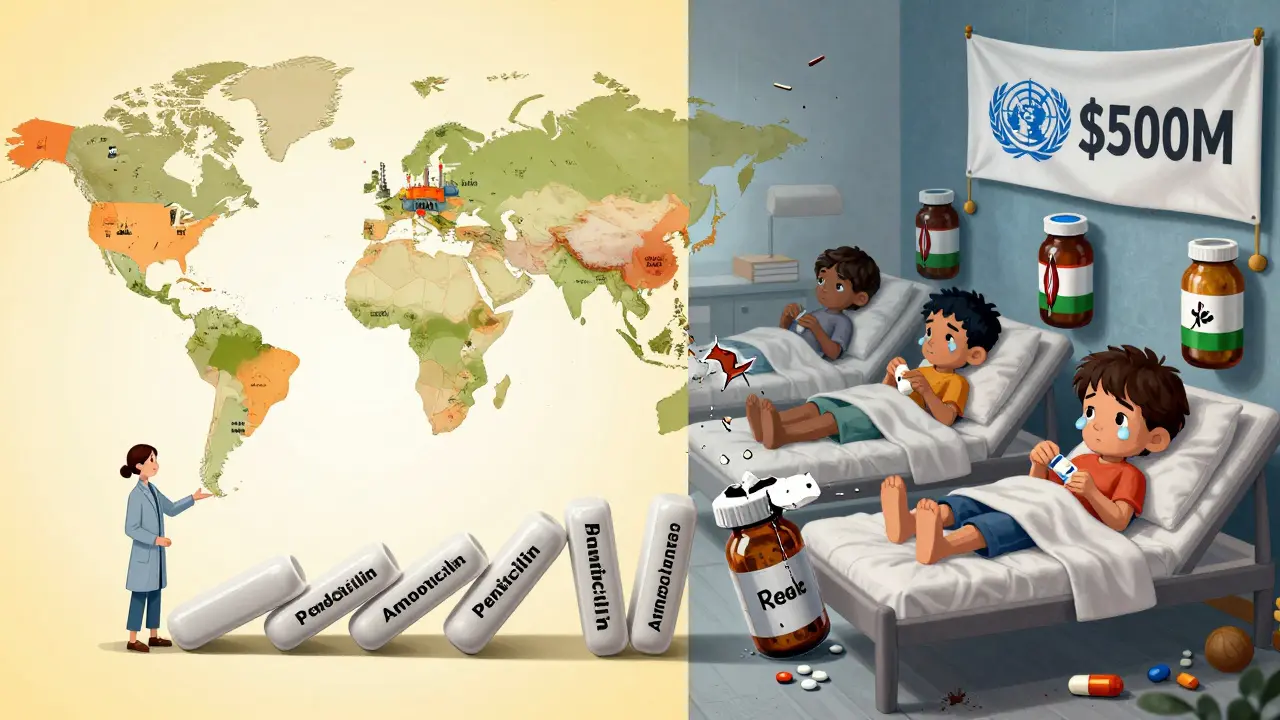
What You Can Do
You can’t fix the supply chain. But you can help stop the cycle.- Never demand antibiotics for colds or flu. They don’t work.
- Take your full course-even if you feel better. Stopping early breeds resistant bugs.
- Ask your doctor: "Is this the right antibiotic?" or "Is there a simpler option?"
- Support policies that fund antibiotic production and improve global access.
What’s Next?
The world is waking up. But not fast enough. The gap between need and supply is widening. Without major investment in manufacturing, better regulation, and global coordination, we’re heading toward a time when common infections become deadly again. We used to think antibiotics were magic. They’re not. They’re a public good. And like clean water or vaccines, they can’t be left to the market. If we don’t act now, the next generation won’t have the tools to treat the infections we take for granted today.Why are antibiotic shortages worse than other drug shortages?
Unlike other drugs, antibiotics often have no safe or effective alternatives. When penicillin or amoxicillin runs out, doctors can’t just switch to another drug in the same class. Alternatives are usually broader-spectrum, more toxic, or less effective-and overusing them speeds up antibiotic resistance. Other medications, like insulin or blood pressure drugs, have multiple substitutes. Antibiotics don’t.
Which antibiotics are most commonly in short supply?
Penicillin G benzathine has been in shortage since 2015 due to manufacturing issues and low profit margins. Amoxicillin and amoxicillin-clavulanate saw major global shortages in 2023. Other critical shortages include ceftriaxone, azithromycin, and carbapenems like meropenem. These are all first-line treatments for common infections like ear infections, pneumonia, and urinary tract infections.
How do antibiotic shortages affect antibiotic resistance?
When first-line antibiotics aren’t available, doctors are forced to use broader-spectrum drugs like carbapenems or colistin. These drugs are more powerful but also more likely to trigger resistance. Overuse of these last-resort antibiotics makes bacteria tougher to kill. The WHO reports that resistance is rising in over 40% of pathogen-antibiotic combinations, with shortages playing a major role.
Why don’t drug companies just make more antibiotics?
Antibiotics, especially generics, are cheap to produce and sell. The market is saturated, and profit margins are razor-thin. Meanwhile, regulatory costs for sterile injectables have risen 34% since 2015. Manufacturers make far more money from cancer drugs or diabetes medications. So they stop producing antibiotics-or only make them in one factory. One breakdown, and the whole world feels it.
Are low-income countries hit harder by antibiotic shortages?
Yes. In low- and middle-income countries, 70% of essential antibiotics are already inaccessible. There’s no backup supply, no import networks, and few resources to switch to expensive alternatives. When penicillin or amoxicillin runs out, patients often go without treatment. This creates a deadly cycle: untreated infections spread, resistance grows, and deaths rise. The WHO calls this a "syndemic"-where under-treatment and resistance feed each other.
Joseph Cooksey
February 5, 2026 AT 08:11Look, I get it-antibiotics are cheap, and profit margins are thin, but this isn’t just a market failure. It’s a moral collapse. We’ve outsourced production to two countries, trusted supply chains that are as fragile as wet toilet paper, and then acted shocked when the whole damn system crumbled. Penicillin G benzathine? A single-dose shot that prevents rheumatic fever in kids? It’s been out of stock for a decade. A DECADE. And yet, Big Pharma is out here spending billions on ‘me-too’ drugs for erectile dysfunction while the world’s most essential medicine gathers dust on a shelf because it doesn’t have a sexy label. We’re not talking about luxury goods here. We’re talking about a child in rural Kenya who dies because a $0.10 vial of penicillin didn’t make it to the clinic. This isn’t capitalism. This is negligence dressed up in a suit and tie.
And don’t even get me started on the ‘just take your full course’ nonsense. Yeah, sure, that’s great advice-if you can even get the damn thing. In 2023, I had to call three pharmacies before I could find amoxicillin for my daughter’s ear infection. One said they’d ‘order it in’-two months. Another said they’d ‘substitute’ with azithromycin. I said no. I know what happens next. I’ve read the studies. Every time we push a broader-spectrum antibiotic because the simple one’s gone, we’re lighting a match in a gas station. And now we’re surprised when the whole damn building burns down?
The WHO’s $500 million initiative? Cute. A drop in the ocean. We need mandatory backup manufacturing. We need government contracts that guarantee minimum production volumes. We need to treat antibiotics like vaccines-not commodities. If you’re going to make insulin, you need three production lines. If you’re going to make antibiotics, you need five. And if you refuse? Fine. Lose your license. Let someone else do it. We’re not asking for miracles. We’re asking for basic competence.
And yet, here we are. Talking about stewardship programs like they’re magic bullets. Johns Hopkins cut use by 37%? Great. But what about the hospitals in Alabama, Mississippi, or rural Ohio? The ones without infectious disease specialists? The ones where the pharmacist is also the nurse and the doctor? They don’t have ‘stewardship programs.’ They have Google and a prayer. This isn’t a policy problem. It’s a human problem. And we’re failing. Again.
Sherman Lee
February 5, 2026 AT 22:49Whoa. Hold up. 🤔 So… are we saying this is all a government plot? Like… what if the FDA and WHO are intentionally letting shortages happen so they can push mandatory vaccines? I mean, think about it-every time a kid gets pneumonia, they’re now getting ‘treated’ with colistin-which is basically poison. But then, BAM! Next visit, they’re offered a ‘new’ antibiotic that costs $2,000 a dose. Coincidence? I don’t think so. 🤫
Also, why are we trusting India and China to make our life-saving meds? What if they’re just sitting on stockpiles? Maybe they’re waiting for the perfect moment to ‘release’ them… like right before an election? 🤫
And don’t even get me started on ‘antimicrobial stewardship.’ Sounds like a cult. Who’s running it? Are they in cahoots with Big Pharma? 🤔
Also, why is the article not mentioning the 2022 bio-lab leak in Texas? I’ve got documents. I’ll DM you.
Lorena Druetta
February 7, 2026 AT 00:42I just want to say thank you for writing this. It’s heartbreaking, but so important. I work as a nurse in a small community hospital, and I’ve seen firsthand what happens when amoxicillin runs out. A three-year-old with an ear infection. A grandmother with pneumonia. We had to use azithromycin. We knew it wasn’t ideal. We knew it was contributing to resistance. But we had no choice. We cried. We hugged each other. We whispered prayers over IV bags.
This isn’t about politics. It’s about people. Real people. Real children. Real grandparents. Real nurses who stay late because they can’t bear to send someone home without help.
Please, if you read this-don’t demand antibiotics for a cold. Take your full course. Talk to your doctor. Support policies that protect access. This isn’t just science. It’s love. And we can’t afford to lose it.
Coy Huffman
February 7, 2026 AT 20:26sooo… like… we made antibiotics too cheap? and now no one wants to make em? that’s wild. like, imagine if we did that with water. ‘oh, it’s too cheap, let’s stop building pipes.’ yeah. that’d go great. 🤡
also, why are we still using 70-year-old drugs? like, penicillin? it’s 1940s tech. shouldn’t we be making new ones? or at least making the old ones in like 3 different factories? one in the us, one in eu, one in africa? just in case? seems obvious.
also, i just found out my neighbor’s kid had to wait 3 days for azithromycin. 3 DAYS. for pneumonia. that’s insane. we’re living in the future and we can’t get antibiotics? this feels like a dystopian movie i didn’t pay for.
Kunal Kaushik
February 9, 2026 AT 10:00As someone from India, I can tell you-this isn’t just about ‘outsourcing.’ We have factories here. But they’re making drugs for rich countries, not for us. My cousin in a village in Bihar? She couldn’t get amoxicillin for her daughter’s fever. The local clinic said, ‘We got it last week. Now we’re waiting for the next shipment.’ No one knows when. No one knows why.
We make 40% of the world’s generic antibiotics. But 80% of what we produce? Exported. The rest? Sold at prices only urban clinics can afford. Meanwhile, the WHO says ‘access’ matters. But access isn’t a slogan. It’s a supply chain. And right now? It’s broken on both ends.
And yeah-we’re not the problem. We’re the backbone. But we’re not getting the support. We need investment. Not lectures.
Nathan King
February 10, 2026 AT 04:04The systemic failure described herein is not merely an economic anomaly-it is a profound failure of public health governance. The market mechanism, when applied to life-sustaining pharmaceuticals, is demonstrably inadequate. The notion that profit motive alone can ensure equitable access to essential medicines is not only empirically false, but ethically indefensible. The regulatory architecture that permits single-source production for critical antibiotics constitutes a clear and present danger to global health security. A paradigm shift is required: one that reclassifies antibiotics as public goods, underwrites manufacturing through sovereign guarantees, and mandates redundancy in production infrastructure. Anything less is complicity in preventable mortality.
Wendy Lamb
February 11, 2026 AT 18:00One sentence: If we don’t fix this, our kids won’t survive a scraped knee.
Antwonette Robinson
February 12, 2026 AT 08:26Oh wow. Antibiotics are expensive to make? Wow. I’m shocked. 💀 Next you’ll tell me oxygen is hard to bottle. Let me guess-pharma execs are crying into their gold-plated yachts. Meanwhile, real people are dying because someone didn’t want to invest $50 million in a second factory. Congrats. You’ve invented capitalism. Again.
Ed Mackey
February 13, 2026 AT 02:15i didn’t even know penicillin was still in use. i thought we were on like, next-gen stuff. guess not. also, why is it so hard to make? it’s just… mold, right? can’t we just grow more of it? like, in a greenhouse? 🤔
also, i think the ‘take your full course’ thing is kinda messed up. if you feel better, why keep taking poison? just saying.
Katherine Urbahn
February 14, 2026 AT 05:05It is, without question, a moral outrage that the pharmaceutical industry has been allowed to abandon the production of life-saving antibiotics due to insufficient profitability. This is not a market failure-it is a systemic betrayal of public trust. The absence of regulatory enforcement, the lack of mandatory redundancy, and the prioritization of shareholder dividends over human survival are not merely policy oversights-they are criminal negligence. One must ask: Who benefits from this? And why has no one been held accountable?
Alex LaVey
February 15, 2026 AT 20:02Thank you for this. I’ve been thinking about this since my niece got sick last year. We drove 90 minutes because the local pharmacy had no amoxicillin. I didn’t know it was a global crisis. I thought it was just us. Turns out, we’re not alone. And that’s the scary part.
I’m not a doctor. I’m not a policymaker. But I can talk to my friends. I can say: Don’t ask for antibiotics for a cold. Take the full course. Support people who make these drugs. And demand better from our leaders.
Maybe we can’t fix the factories. But we can stop making it worse. And that’s a start.