
BPH Anticholinergic Risk Calculator
Risk Assessment Tool
This tool helps you understand your risk of urinary retention when taking anticholinergic medications if you have prostate enlargement (BPH).
Risk Assessment Results
Your risk is low. Continue monitoring with your urologist.
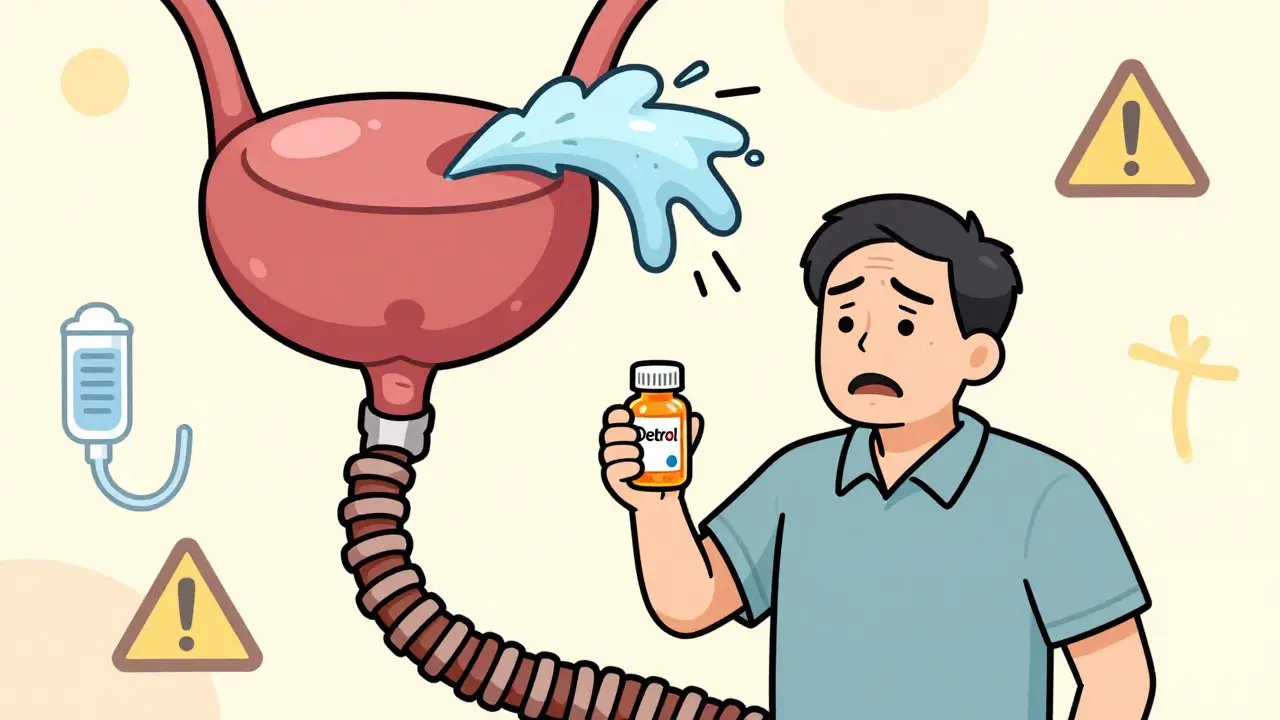
Men with an enlarged prostate don’t need another reason to struggle with urination. But when they take common bladder medications like oxybutynin or solifenacin, the problem can go from annoying to dangerous - fast. These drugs, called anticholinergics, are meant to calm an overactive bladder. Yet for men with benign prostatic hyperplasia (BPH), they can trigger a medical emergency: complete urinary retention. It’s not rare. It’s predictable. And it’s often avoidable.
What Anticholinergics Do to the Bladder
Anticholinergics work by blocking acetylcholine, a chemical that tells the bladder muscle to contract. That’s useful for people who feel sudden urges to pee or leak urine. Drugs like Detrol (tolterodine), Vesicare (solifenacin), and Oxytrol (oxybutynin) are commonly prescribed for this. But here’s the catch: in men with BPH, the bladder muscle is already working overtime to push urine past a swollen prostate. It’s like trying to squeeze water through a kinked hose. Now, add a drug that weakens that muscle further. The result? The bladder can’t contract hard enough to empty. Urine builds up. And if it gets bad enough, the bladder stops working entirely.This isn’t theoretical. A 2008 review in PubMed found that up to 10% of all urinary retention cases are caused by medications - and anticholinergics are the biggest offenders. In men over 65 with BPH, the risk of acute retention jumps by 2.3 times if they’re on these drugs. The American Urological Association (AUA) says it plainly: avoid anticholinergics if you have moderate to severe prostate enlargement.
The Double Hit: Prostate + Medication
Think of the urinary system like a car engine. The prostate is the exhaust pipe - if it’s clogged, the engine has to work harder. The bladder muscle is the engine. Anticholinergics don’t just slow the engine; they cut its power. That’s the double hit. One study showed that men with BPH who took anticholinergics had a 15% higher chance of urinary retention than those who didn’t. That might sound small, but in real terms, it means dozens of men end up in the ER every day with bloated bladders holding over a liter of urine - sometimes more than 1,200 mL. That’s more than a gallon. At that point, the bladder stretches so far it can lose its ability to contract at all. Recovery isn’t guaranteed.Patients don’t always realize the connection. One man on a prostate forum wrote: "I was on Detrol for urgency. Next thing I know, I couldn’t pee at all. They stuck a catheter in me. I’ve been on it for months now." That story isn’t unusual. Between 2018 and 2022, over 1,200 cases of urinary retention linked to anticholinergics were reported to the FDA. Over 60% of those cases involved men over 65 with diagnosed BPH.
What Alternatives Actually Work
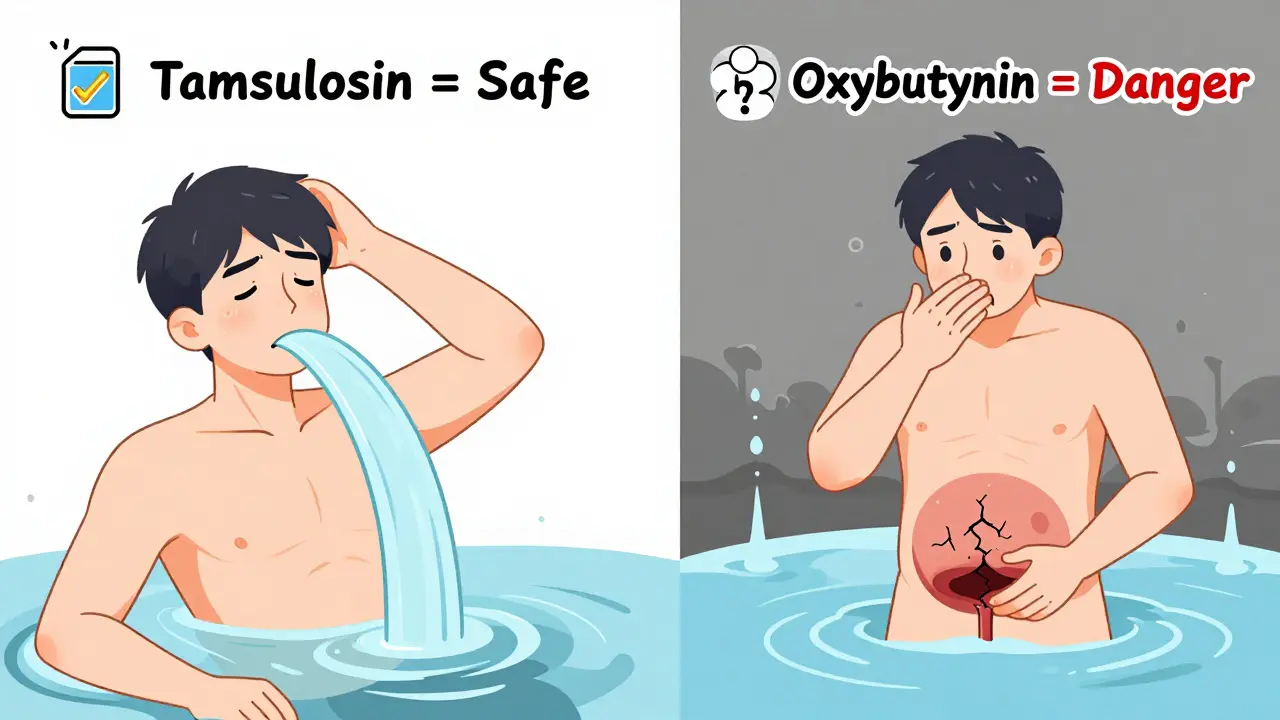
If anticholinergics are risky, what’s left? The answer isn’t just "do nothing." There are safer, better options.Alpha-blockers like tamsulosin (Flomax) and alfuzosin (Uroxatral) relax the muscles around the prostate and bladder neck. They don’t weaken the bladder - they help it work better. Studies show that after catheter insertion, men on alpha-blockers were 30-50% more likely to successfully urinate on their own within a few days compared to those on placebo. They’re not perfect - they can cause dizziness or low blood pressure - but they don’t cause retention.
For long-term management, 5-alpha reductase inhibitors like finasteride (Proscar) and dutasteride (Avodart) shrink the prostate over time. A four- to six-year course cuts the risk of acute retention by half. That’s a game-changer for men who want to avoid surgery.
Then there’s mirabegron (Myrbetriq) and vibegron (Gemtesa). These are beta-3 agonists. Instead of blocking bladder contractions, they gently stimulate the muscle to relax and hold more urine. No muscle weakening. No retention risk. In clinical trials, vibegron reduced urgency episodes by 92% with only a 4% chance of retention in men with mild BPH. That’s far better than the 18% risk seen with anticholinergics. The FDA approved vibegron specifically for patients with BPH who can’t tolerate older drugs.
Who Might Still Get Anticholinergics - and Why
Some doctors still prescribe them. Not because they’re unaware of the risks, but because they’re dealing with complex cases. Dr. Kenneth Kobashi points out that a small group of men with mild BPH and severe overactive bladder symptoms - confirmed by urodynamics testing - may benefit from low-dose solifenacin under close watch. One 2017 study found retention rates of just 12% in this carefully selected group, compared to 28% in unselected patients.But "carefully selected" means more than just saying "I have a little trouble peeing." It means:
- Uroflowmetry showing a peak flow rate above 10 mL/sec
- Post-void residual under 100 mL
- No history of prior retention
- Prostate size under 30 grams (measured by ultrasound or MRI)
- AUA symptom score under 20
Even then, monthly follow-ups are required. If the flow rate drops, or the residual urine climbs, the drug gets stopped - fast.
What Happens When Retention Strikes
If a man with BPH can’t urinate and his bladder is full, he needs immediate help. Delaying can damage the bladder or kidneys. The standard fix is a catheter - a thin tube inserted through the urethra to drain the bladder. In 85-90% of cases, this works. But here’s the thing: just draining the bladder isn’t enough. If you don’t treat the underlying problem, 70% of men will be back in the ER within a week.The best practice? Start an alpha-blocker like tamsulosin the moment the catheter goes in. That gives the bladder and prostate a chance to adjust. Studies show it boosts the odds of successful voiding after removal by over 40%. It’s not optional. It’s standard.
Some doctors try to drain the bladder slowly, fearing sudden decompression might cause bleeding. But research shows no benefit to slow drainage. Get it all out. Fast.

What to Ask Your Doctor
If you’re on an anticholinergic and have prostate symptoms, ask these questions:- "Have I been tested for bladder obstruction?" (Uroflowmetry and post-void residual)
- "What’s my prostate size?" (Measured by ultrasound or DRE)
- "Is this drug still helping, or just causing side effects?"
- "Could I switch to mirabegron or an alpha-blocker instead?"
- "Am I on too many medications that affect my bladder?"
Many men take multiple drugs - blood pressure pills, antidepressants, sleep aids - and don’t realize they’re all anticholinergic. The American Geriatrics Society’s Beers Criteria lists anticholinergics as "potentially inappropriate" for older adults with BPH. And yet, 40% of nursing home residents with these conditions are still prescribed them.
The Bottom Line
Anticholinergics aren’t evil. They help people with overactive bladder. But for men with prostate enlargement, the risks outweigh the rewards. The benefits are small - about one fewer leak per day - but the consequences can be severe: ER visits, catheters, bladder damage, even surgery.The future is clearer. Drugs like vibegron and mirabegron are changing the game. They offer relief without the danger. Guidelines are changing too. The European Association of Urology now says anticholinergics should be avoided in men with prostate enlargement - period. And by 2028, prescriptions for these drugs in older men with BPH are expected to drop by 35%.
If you’re a man over 50 with trouble urinating, don’t assume your bladder medication is safe. Talk to your urologist. Get tested. Know your numbers. And don’t let a drug meant to help you end up making things worse.
Can anticholinergics cause permanent bladder damage?
Yes, if urinary retention is left untreated for too long. When the bladder stretches beyond its limit, the muscle fibers can become overstretched and lose their ability to contract. This is called detrusor underactivity. Once that happens, the bladder may never fully recover - even after the drug is stopped. That’s why early intervention matters. If you can’t urinate, don’t wait. Get help immediately.
Are all anticholinergics equally risky for prostate issues?
No, but the difference isn’t enough to make them safe. Some, like solifenacin and darifenacin, are more bladder-selective than others. But no anticholinergic is truly selective. They all affect other parts of the body - the salivary glands (causing dry mouth), the intestines (causing constipation), and the brain (linked to memory issues). Even the "selective" ones still reduce bladder contraction strength. In men with BPH, that’s enough to trigger retention.
Why do doctors still prescribe anticholinergics to men with BPH?
Sometimes because they’re not aware of the guidelines. Other times, they’re trying to treat a patient’s urgency without fully assessing prostate size or bladder function. Some patients refuse alpha-blockers due to side effects like dizziness. In rare cases, a man has severe overactive bladder symptoms with minimal obstruction - and after testing, a low-dose anticholinergic might be tried. But this should be the exception, not the rule.
Can I stop my anticholinergic cold turkey?
No. Stopping suddenly can make overactive bladder symptoms worse. Talk to your doctor first. They may recommend tapering the dose slowly while switching to a safer alternative like mirabegron or an alpha-blocker. Never adjust your meds on your own.
What tests should I ask for before starting a bladder medication?
Ask for three things: a digital rectal exam to estimate prostate size, uroflowmetry to measure how fast you urinate (a peak flow below 10 mL/sec is high risk), and a post-void residual test to see how much urine is left in your bladder after you go. If any of these show obstruction or retention, anticholinergics are not safe for you.
Aisling Maguire
February 28, 2026 AT 03:35My grandma was on oxybutynin for years and never said a word about trouble peeing until she got catheterized at 82. She just thought it was "part of getting old."
Turns out, her prostate wasn't the issue-she had an enlarged prostate from a male hormone imbalance after a hysterectomy. Weird, right? Anyway, they switched her to mirabegron and she's been fine for two years now. Just saying: ask questions, even if it feels awkward.
Katherine Farmer
February 28, 2026 AT 22:19Oh look, another post from someone who clearly didn’t read the FDA’s 2021 warning on anticholinergic burden in geriatric patients. The fact that this is still even a debate is embarrassing. We’ve known since 2008 that these drugs are contraindicated in BPH. The real tragedy? Most prescribers still don’t check post-void residual before writing the script. It’s not negligence-it’s systemic laziness disguised as "clinical judgment."
Brandie Bradshaw
March 1, 2026 AT 13:52Let’s be precise: anticholinergics don’t "cause" urinary retention. They precipitate it in a pre-existing condition. The bladder’s compensatory hypertrophy from BPH creates a fragile equilibrium. Remove the contractile drive-via muscarinic blockade-and the system collapses. This isn’t pharmacology gone wrong; it’s physiology ignored.
And yes, detrusor underactivity can be permanent. The muscle fibers don’t just "get tired"-they undergo fibrotic remodeling. Once that happens, no amount of alpha-blockers will restore full function. Prevention isn’t optional. It’s biological imperative.
bill cook
March 1, 2026 AT 18:57I had to get a catheter in 2020 after taking solifenacin for "overactive bladder." I was 68. I didn’t even know I had BPH. Now I’m on tamsulosin and it’s been life-changing. But honestly? I’m mad. Why didn’t my urologist ask me about my urination habits before prescribing? I thought it was just a bladder pill. I didn’t know it could lock my pee in there like a prison. I’m still scared to go off the catheter. I don’t trust doctors anymore.
Noah Cline
March 3, 2026 AT 11:16It’s critical to distinguish between pharmacodynamic selectivity and clinical safety. While solifenacin and darifenacin exhibit M3 receptor affinity, they still demonstrate off-target activity at M1 and M2 subtypes in the detrusor. In the context of BPH, even 15% muscarinic receptor occupancy in the bladder neck can reduce voiding efficiency below the critical threshold of 10 mL/sec. The AUA guidelines are conservative for good reason: the risk-benefit ratio is inverted in this population. Furthermore, the 2022 meta-analysis in JAMA Urology demonstrated a 3.1-fold increase in catheterization rates within 30 days of anticholinergic initiation in men with urodynamically confirmed obstruction. This isn’t anecdotal. It’s biostatistical.
Lisa Fremder
March 4, 2026 AT 03:37Why do we keep letting doctors play Russian roulette with old men’s bladders? This isn’t medicine. It’s corporate negligence. Big Pharma pushes these drugs because they’re profitable. No one gets sued when a guy gets a catheter. But if you stop prescribing, you lose millions. Meanwhile, men are stuck with tubes for life because some intern didn’t read the damn guidelines. Wake up. This is preventable. It’s not an accident. It’s a crime.
Justin Ransburg
March 4, 2026 AT 19:04Thank you for this incredibly clear breakdown. I’m a nurse practitioner and I’ve seen too many men come in terrified after a retention episode. The fact that mirabegron and vibegron are now first-line options for men with BPH is a huge win. I always tell my patients: "Your bladder isn’t broken-it’s overworked. We don’t need to shut it down. We need to help it breathe."
And yes, alpha-blockers on catheter insertion? Non-negotiable. I’ve had patients who went home without them and ended up back in the ER. Don’t skip the step. It’s not optional.
Sumit Mohan Saxena
March 6, 2026 AT 17:56As a urology resident from India, I can confirm that the pattern described is globally consistent. In our rural clinics, we frequently encounter elderly men with chronic retention due to long-term anticholinergic use, often prescribed by general practitioners without urologic training. The lack of access to uroflowmetry and PVR testing is a major barrier. We are now advocating for standardized screening protocols in primary care. Education is the first step. We must train physicians to recognize that "urgency" and "obstruction" are not interchangeable terms. Thank you for highlighting this critical issue.
Brandon Vasquez
March 7, 2026 AT 01:01I had a friend who went through this. He didn’t talk about it for months. He was embarrassed. I just sat with him. Asked him if he wanted to go to the urologist. Didn’t push. Didn’t judge. Just said, "I’m here." He got tested. Switched meds. Got his catheter out in three weeks. He’s back to golfing. You don’t need to fix it. Just show up. That’s enough.
Vikas Meshram
March 8, 2026 AT 17:41It's not just anticholinergics. Many antidepressants, antihistamines, and even OTC sleep aids have anticholinergic properties. My uncle was taking diphenhydramine for sleep and oxybutynin for bladder. He didn't know either were anticholinergic. He ended up with a 1.5L PVR. The ER doc told him to stop both immediately. He's now on mirabegron and melatonin. He says he feels 20 years younger. The problem? No one ever told him. Not his PCP. Not his pharmacist. Not his daughter. That's the real tragedy.
Ben Estella
March 10, 2026 AT 11:27America is falling apart because doctors don’t listen anymore. This isn’t a medical issue-it’s a cultural one. We’ve turned health into a product. You want relief? Here’s a pill. You don’t want to get tested? Fine. Here’s another pill. Then you end up with a catheter and a bill for $20K. Meanwhile, real solutions like lifestyle changes, pelvic floor therapy, and timed voiding are ignored. Because they don’t make money. This isn’t about medicine. It’s about greed.
Jimmy Quilty
March 12, 2026 AT 06:06Did you know the FDA approved vibegron in 2020… but the same companies that make oxybutynin also own the patent for vibegron? They just rebranded the same chemistry under a new name. The "new" drug costs 10x more. The old one? Still on the market. Coincidence? I think not. This whole thing is a money scheme. They don’t care if you get catheterized. They care if you refill the prescription. They’re not saving your bladder. They’re saving their quarterly earnings.