
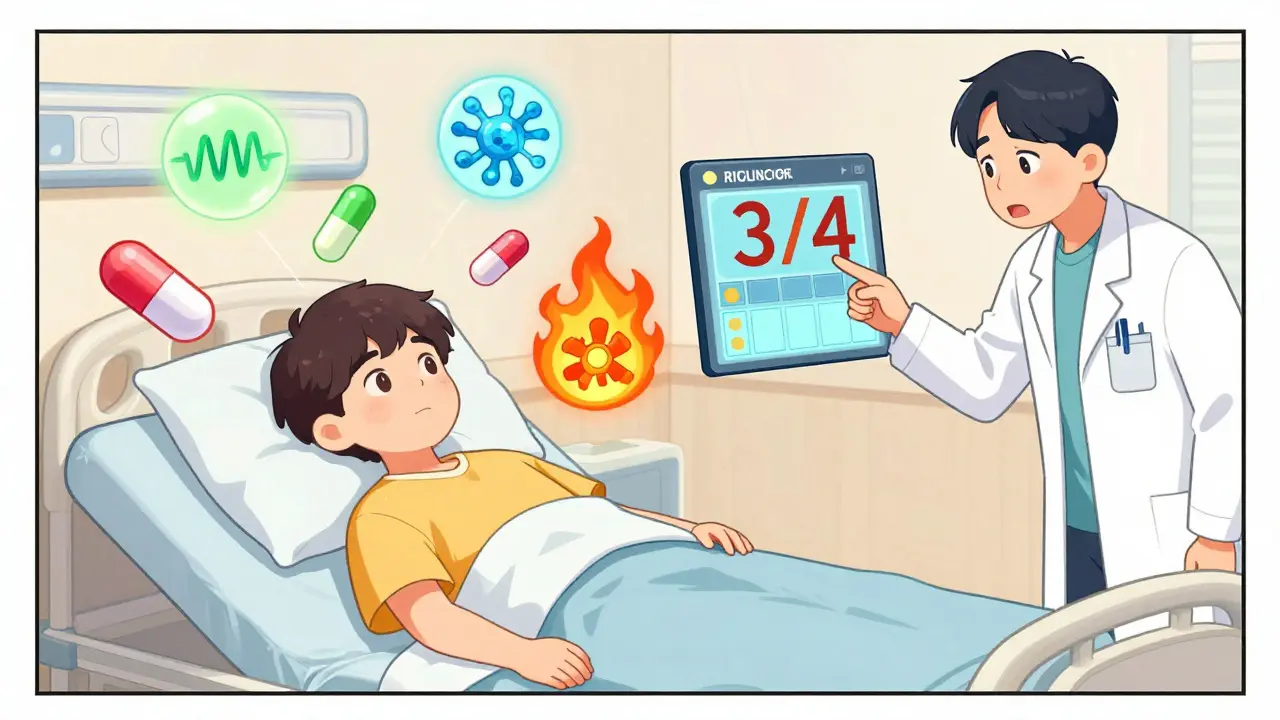
Post-Operative Nausea Risk Calculator
Calculate Your PONV Risk Score
The Apfel PONV Risk Score uses four clinical factors to determine your risk of post-operative nausea and vomiting.
When you're recovering from surgery, chemo, or even just taking pain pills, nausea isn't just annoying-it can delay healing, make you dehydrated, or even send you back to the hospital. Medication-induced nausea is one of the most common side effects in hospitals and clinics, affecting up to 30% of surgical patients and over half of those on opioids or chemotherapy. The good news? There are effective antiemetics-but picking the right one isn’t just about what’s on the shelf. It’s about matching the drug to your body, your meds, and your risk level.
How Antiemetics Actually Work
Not all nausea is the same. Your brain has different pathways for triggering vomiting, and each antiemetic blocks a different one. The most common classes you’ll see are:- 5-HT3 antagonists (like ondansetron, granisetron): Block serotonin in the gut and brainstem. Best for chemo and post-op nausea.
- Dopamine antagonists (like droperidol, metoclopramide): Target the brain’s vomiting center. Great for opioid-induced nausea and slow digestion.
- Corticosteroids (like dexamethasone): Reduce inflammation in the gut and brain. Work slowly but boost other drugs.
- Antihistamines and anticholinergics (like promethazine, scopolamine): Mostly useful for motion sickness, less so for drug-induced nausea.
- Opioid antagonists (like naloxone): Rarely used alone, but help when opioids are the direct cause.
For example, if you’re nauseous from morphine after surgery, a dopamine blocker like droperidol works faster and better than ondansetron. But if it’s from chemo, serotonin blockers are the gold standard. Mixing them-like ondansetron plus dexamethasone-often gives the best results.
Which Drugs Are Most Effective?
A 2023 analysis of over 6,600 patients who had cesarean sections showed clear winners:| Drug | Typical Dose | Effectiveness (PONV Prevention) | Cost per Dose | Key Risks |
|---|---|---|---|---|
| Ondansetron (Zofran) | 4-8 mg IV | 65-75% | $1.25 | Headache (32%), dizziness, QT prolongation |
| Droperidol (Inapsine) | 0.625-1.25 mg IV | 67-86% | $0.50 | Low sedation, rare QT risk above 1.25 mg |
| Dexamethasone | 8 mg IV | 20-30% (as add-on) | $0.25 | Delayed effect (4-5 hrs), blood sugar spikes |
| Metoclopramide (Reglan) | 10-50 mg IV | 44% (10 mg), 68% (25 mg) | $0.75 | Akathisia (restlessness), especially in elderly |
| Scopolamine patch | 1.5 mg transdermal | 40-50% | $5-10 | Slow onset (4 hrs), dry mouth, blurry vision |
Here’s what the data says: droperidol at low doses is more effective than ondansetron for post-op nausea, especially in opioid-tolerant patients. And at a fraction of the cost. Ondansetron is popular because it’s safe and works fast-most people feel relief in 15 minutes. But it’s not always the best choice. In fact, studies show combining droperidol and dexamethasone cuts PONV rates nearly in half compared to either drug alone.
Who Should Get What? Risk-Based Selection
You can’t just give everyone the same drug. That’s why doctors use the Apfel PONV Risk Score, based on four simple factors:- Female sex
- Non-smoker
- History of motion sickness or past PONV
- Post-op opioid use
Each factor adds one point. Then:
- 0-1 points: Skip prophylaxis. Give meds only if nausea hits.
- 2 points: Use one drug-either droperidol 0.625 mg or ondansetron 4 mg.
- 3-4 points: Use two drugs together-droperidol + dexamethasone is the top combo.
This approach isn’t theoretical. Hospitals that follow it cut unnecessary antiemetic use by 40% and save $1,000+ per avoided PONV case. One anesthesiologist in Boston reported a 32% drop in rescue meds after switching to this protocol.
Hidden Risks and Common Mistakes
Even safe drugs have traps:- Metoclopramide at 10 mg? Almost useless. At 25 mg, it works-but 30% of elderly patients get severe restlessness (akathisia). Many clinics now use olanzapine 2.5 mg instead for older adults.
- Dexamethasone takes 4-5 hours to kick in. If you give it right before surgery, it’s too late. Give it 1-2 hours pre-op.
- Ondansetron can prolong the QT interval. Avoid it if you have heart rhythm issues or are on other QT-prolonging drugs.
- Scopolamine patches need to be applied 4 hours before surgery. If you forget, they won’t help.
And cost matters. A single dose of netupitant/palonosetron (Akynzeo) costs $350. Generic ondansetron? $1.25. Most patients don’t need the expensive combo unless they’re on highly emetogenic chemo.

What’s New in 2026?
The field is moving fast:- Intranasal ondansetron (Zuplenz) is now approved-great for patients who can’t swallow pills or vomit after surgery.
- NK-1 antagonists like rolapitant are being used more for delayed chemo nausea, with 78% success rates.
- Genetic testing for CYP2D6 enzyme variants is starting to show which patients metabolize ondansetron too fast (and need higher doses) or too slow (and risk side effects).
But the biggest shift? Moving away from "one-size-fits-all" to precision antiemetics. If you’re a 52-year-old woman, non-smoker, with a history of motion sickness, and you’re getting fentanyl after knee surgery-you’re high risk. You don’t need one drug. You need two. And you need them timed right.
Real-World Tips from Clinicians
Practitioners share what works:- "In opioid-tolerant patients, droperidol beats ondansetron every time. No debate." - Anesthesiologist, r/Anesthesiology
- "We switched from metoclopramide to olanzapine for seniors. Akathisia dropped from 8% to under 1%." - Dr. Michael Torres, Medscape
- "Dexamethasone + ondansetron isn’t just better-it’s cheaper than giving three rescue doses of ondansetron." - Dr. Sarah Chen, Mass General
Bottom line: The best antiemetic isn’t the most expensive or the most advertised. It’s the one matched to your body, your meds, and your risk.
lela izzani
February 24, 2026 AT 03:30Just wanted to say this post saved my mom after her chemo cycle last month. We tried ondansetron first, but she was still nauseous. Switched to droperidol + dexamethasone based on the risk score, and boom - 24 hours of peace. No more vomiting, no more IV fluids. This isn’t just clinical info - it’s life-changing stuff.
Joanna Reyes
February 24, 2026 AT 10:56I’ve been working in oncology for over a decade, and I can’t tell you how many times I’ve seen hospitals default to ondansetron because it’s ‘safe’ and ‘fast’ - but safety doesn’t mean effectiveness. The data here is clear: for high-risk patients, especially those on opioids, droperidol at 0.625mg is superior. And the cost difference? It’s absurd that we’re still overpaying for brand-name serotonin blockers when a 50-cent generic combo works better. I’ve personally pushed for protocol changes at my hospital, and since we switched, rescue meds have dropped by 60%. It’s not rocket science - it’s just common sense wrapped in outdated habits.
Stephen Archbold
February 25, 2026 AT 21:18bro i just read this after my aunt got back from surgery and i’m like… why did they give her scopolamine? she’s 72, non-smoker, had motion sickness as a kid, and got fentanyl - that’s 3 points right there. they gave her ONE drug and said ‘it’ll be fine’. she puked 5 times in 8 hours. this post is literally the answer to why i hate healthcare. also, dexamethasone needs to be given EARLY. like, before the surgery. not after. lol.
Nerina Devi
February 27, 2026 AT 18:23As someone from India where antiemetics are often not even available in rural clinics, this breakdown is invaluable. We don’t have access to droperidol or olanzapine in many places, but dexamethasone is cheap and widely stocked. Even if it’s slow, combining it with whatever’s available - even promethazine - can make a difference. I hope this reaches more frontline nurses and paramedics. This isn’t just for urban hospitals.
Dinesh Dawn
February 28, 2026 AT 21:29Man, I wish my surgeon read this before my knee op. Gave me ondansetron, I got dizzy, headache, and still threw up. If they’d just checked the Apfel score… I’m 42, female, non-smoker, motion sickness history, on opioids - that’s 4 points. Should’ve gotten two drugs. Lesson learned the hard way.
Vanessa Drummond
March 2, 2026 AT 05:43Let’s be real - ondansetron is just a cash cow for pharma. It’s not better, it’s just marketed harder. And don’t even get me started on Akynzeo. $350 for a drug that does what $1.25 does? Wake up. They don’t care about you. They care about your insurance.
Nick Hamby
March 3, 2026 AT 03:30There’s a deeper philosophical shift here that deserves attention: the move from protocol-driven care to precision medicine. Antiemetics are a microcosm of a larger transformation in clinical practice - from population-based averages to individualized risk stratification. The Apfel score isn’t just a tool; it’s a philosophical statement that the body is not a machine to be treated uniformly, but a dynamic system requiring tailored intervention. When we reduce patients to risk scores, we risk dehumanizing them - yet when we ignore the data, we harm them. The art of medicine lies precisely in this tension: honoring both the science and the person.
kirti juneja
March 3, 2026 AT 21:39Y’all are missing the real win here - olanzapine for seniors. I’ve seen grandmas go from ‘I can’t eat, I can’t sleep, I’m shaking like a leaf’ to ‘I watched my grandkid’s soccer game yesterday’ after switching. It’s not in the textbooks yet, but in the trenches? It’s magic. Also, dexamethasone before surgery? Duh. Why is this even a debate? Someone’s got to tell the residents.
lela izzani
March 4, 2026 AT 18:59Replying to @7839 - you’re 100% right. And the worst part? Nurses get pressured to use the ‘standard’ drug because it’s in the EHR default. No one wants to fight the system. But when we do? We save money, reduce suffering, and stop treating patients like lab rats. I’ve started printing this table and taping it to the med cart. Small rebellion.