
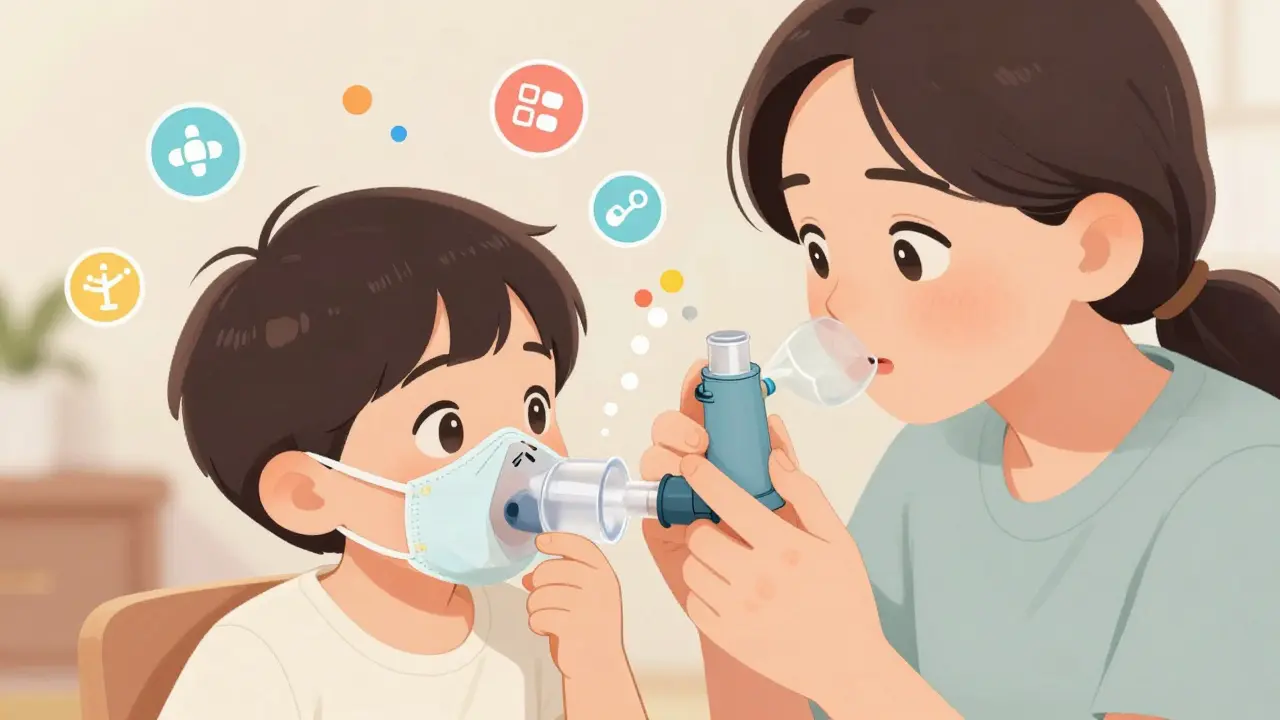
Getting the right dose of asthma medication into a child’s lungs isn’t just about the drug-it’s about technique. If the inhaler isn’t used correctly, even the best medication might as well be sitting in the back of the throat. For kids under 8, the difference between proper technique and a sloppy puff can mean the difference between breathing easy and ending up in the emergency room. The truth? Most parents don’t get it right the first time. And that’s okay-because with the right steps, anyone can learn how to do it well.
Why Spacers and Masks Are Non-Negotiable
Let’s cut through the noise: a regular inhaler alone delivers only 10-20% of the medicine to a child’s lungs. That’s not a typo. The rest sticks to the mouth, throat, or gets spit out. But when you add a spacer and a face mask? That number jumps to 60-80%. That’s not a small upgrade-it’s life-changing.
Spacers are clear plastic tubes that hold the puff of medicine after you press the inhaler. The mask fits snugly over the child’s nose and mouth, so they don’t have to coordinate breathing with pressing the device. For infants and toddlers, this is the only way the medicine even has a chance of working. Even older kids who can technically use a mouthpiece often benefit from a mask because they’re still learning how to breathe slowly and deeply.
According to the National Heart, Lung, and Blood Institute (NHLBI), improper technique is the #1 reason kids with asthma keep having flare-ups-even when they’re on the right meds. A 2022 study found that 63% of parents had a poor mask seal. That means more than half the medicine is lost before it even gets close to the lungs.
The 8-Step Technique That Actually Works
Here’s the exact sequence used by pediatric hospitals across North America. Don’t skip a step. Don’t rush. This isn’t a suggestion-it’s a protocol backed by clinical trials.
- Shake the inhaler for 10 seconds. Seriously, count it out. If you shake it for 3 seconds and think “that’s enough,” you’re wasting half the dose. The medicine inside is a suspension-particles settle. You need that full 10 seconds to mix it up.
- Attach the inhaler to the spacer. Make sure it clicks into place. If it wobbles, it’s not seated right. A loose connection means medicine leaks out before the child even breathes.
- Put the mask on the child’s face. It should cover the nose and mouth, with no gaps. The edge should sit from the bridge of the nose down to the bottom of the chin. If it’s too small, it’ll dig into the cheeks. Too big, and it’ll slip. Most spacers come with size guides-use them.
- Press the inhaler once. One puff. One press. Don’t press multiple times. That’s a common mistake. One puff = one dose. Pressing again before the child breathes in just wastes medicine.
- Hold the mask in place. Keep it sealed. Don’t let the child pull it off. If they’re crying or squirming, hold gently but firmly. You’re not restraining them-you’re helping them breathe.
- Let them breathe in and out normally for 5-10 breaths. For babies and toddlers under 3, this is key. They don’t take one deep breath-they take several small ones. Count each breath: 1…2…3…4…5…6…7…8…9…10. That’s how the medicine gets deep into the lungs. Don’t rush this. If they stop breathing, wait a few seconds and let them restart.
- Wait 30-60 seconds before the next puff. If the doctor prescribed two puffs, wait at least 30 seconds between them. Some guidelines say 1-3 minutes. Check the prescription. Rushing puffs doesn’t help-it just clogs the spacer.
- Wash the spacer once a week. Use warm water and a drop of mild dish soap. Rinse it well. Let it air-dry upside down on a clean towel. No towels, no paper towels, no heat. Drying it with a cloth creates static that traps medicine. Static = wasted dose.
Age-Specific Breathing Rules
One size doesn’t fit all. What works for a 2-year-old won’t work for a 6-year-old.
- Infants (under 12 months): Use a small mask (150-350 mL). Let them take 5-10 normal breaths after the puff. Don’t force deep breaths. Their lungs are tiny. Tidal breathing (normal breathing) is enough.
- Toddlers (1-3 years): Use a medium mask (350-500 mL). Aim for 6 breaths. If they fight the mask, try singing a short song or showing them a favorite cartoon. Distraction works.
- Preschoolers (3-8 years): You can start teaching them to use a mouthpiece instead of a mask. But only if they can seal their lips tightly. If they can’t, stick with the mask. For these kids, one slow breath in, hold for 3-5 seconds, then breathe out. No need for 10-second holds yet.
- Older kids (over 8): Transition to mouthpiece-only use. Have them breathe in slowly for 3-5 seconds, hold for 10 seconds, then breathe out. This is when they start acting more like adults.
What Happens When You Get It Wrong
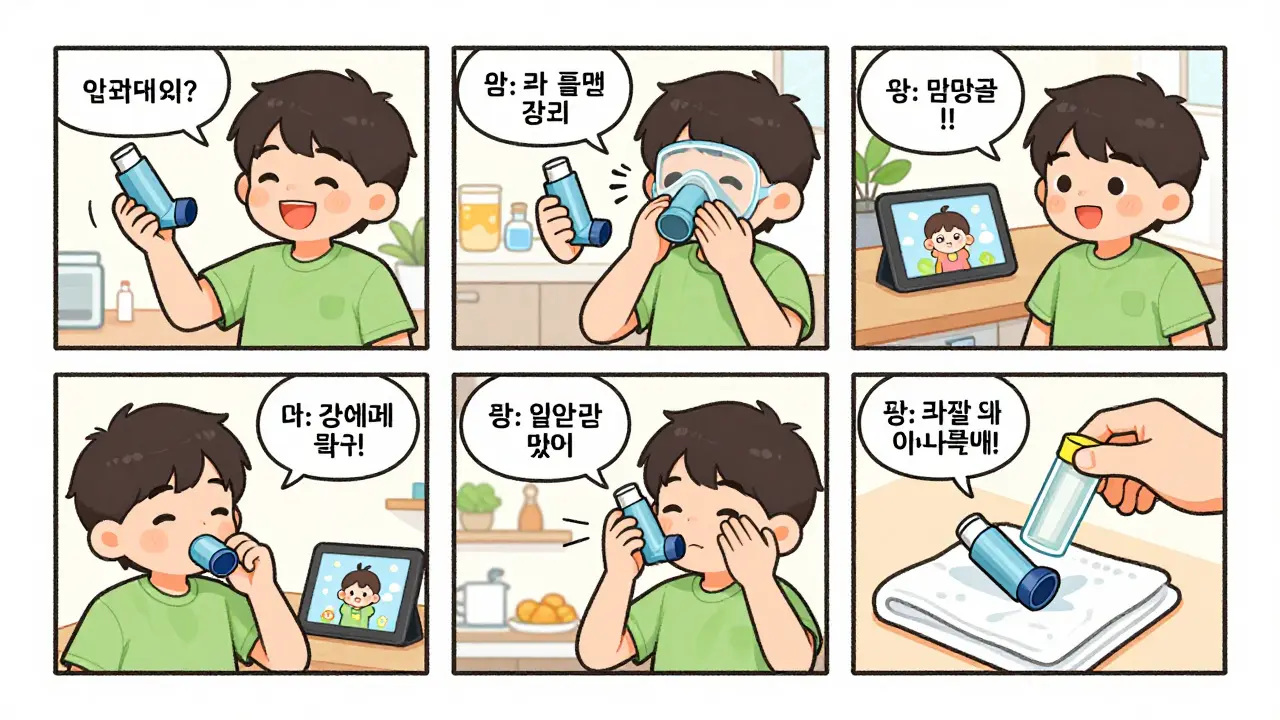
Bad technique isn’t just inefficient-it’s dangerous. Here’s what goes wrong when parents skip steps:
- Not shaking the inhaler: 42% of parents do this. The medicine settles. The child gets a weak dose.
- Mask not sealed: 34% of parents leave gaps. Half the dose goes into the air.
- Too many puffs at once: Pressing twice before the child breathes wastes 60% of the second puff.
- Washing with towels: Static builds up. A 2021 study showed unwashed spacers with towel drying lost 28% more medicine than air-dried ones.
- Using the wrong mask size: 28% of families use a mask that’s too big or too small. That’s like putting a too-tight hat on a baby-it just doesn’t work.
And here’s the kicker: a 2022 study found that 68% of kids labeled as “steroid-resistant” didn’t respond to treatment-not because their asthma was severe, but because their technique was off. They weren’t getting enough medicine. They weren’t failing treatment. The technique failed them.
What Spacers Actually Work Best?
Brand doesn’t matter as much as you think. A 2023 interview with Dr. Robert Strunk from Washington University put it bluntly: “I’ve seen perfect technique deliver 80% of the dose using a washed plastic water bottle as a spacer.”
But since most parents aren’t using water bottles, here’s what’s actually used in hospitals:
| Brand | Mask Size Options | Volume (mL) | Anti-Static Feature | Market Share (US, 2023) |
|---|---|---|---|---|
| AeroChamber with Mask (Trudell Medical) | Infant, Toddler, Preschool | 150-750 | Yes (anti-static lining) | 42.1% |
| Vortex (Monaghan Medical) | Infant, Toddler, Preschool | 150-750 | Yes (conductive plastic) | 28.7% |
| OptiChamber (HD Medical) | Infant, Toddler, Preschool | 150-750 | No (requires washing) | 12.3% |
| Generic Plastic Spacer | One size | 350-500 | No | 16.9% |
The top two brands-AeroChamber and Vortex-are used in 70% of pediatric clinics. But here’s the thing: if you’re using a generic spacer and washing it weekly, you’re getting nearly the same results. The key isn’t the brand. It’s consistency.
What to Do When Your Child Refuses
Most kids hate the mask at first. It’s weird. It’s cold. It covers their face. Here’s what actually works:
- Make it a game. “Let’s blow out birthday candles with our medicine!” One parent on Asthma.com said this raised compliance from 40% to 90%.
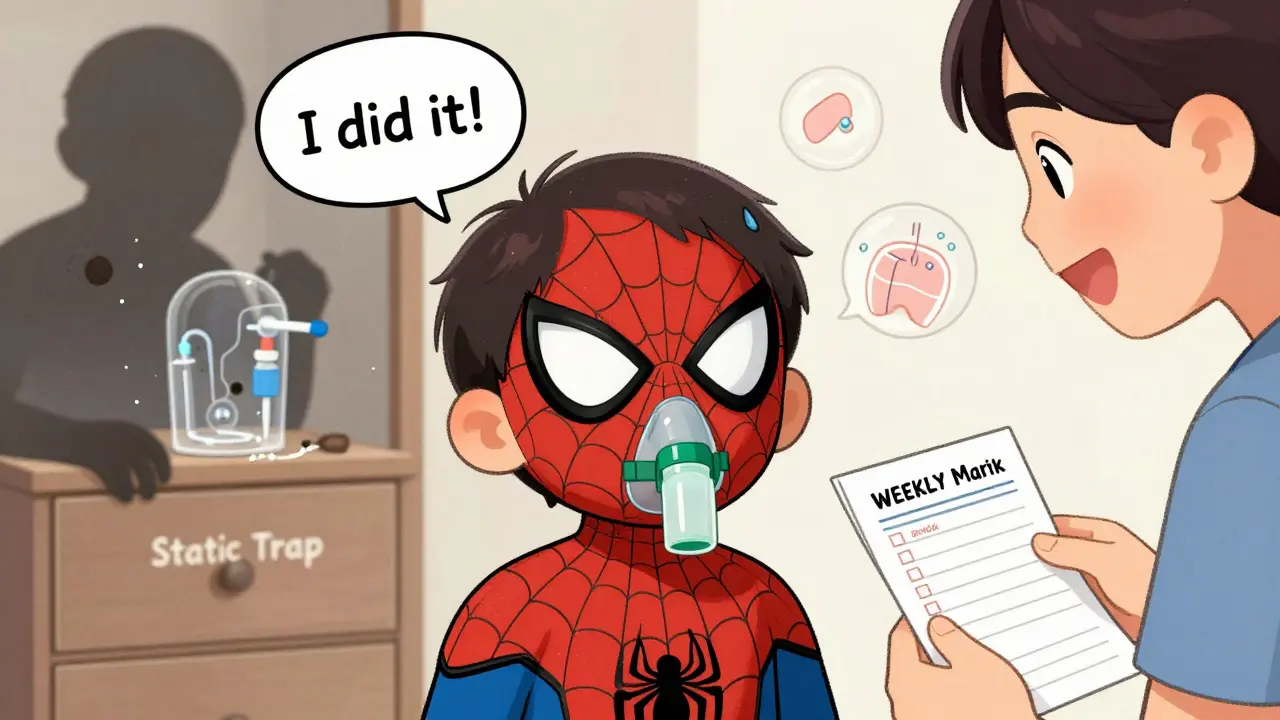
- Use masks with favorite characters. Spider-Man, Paw Patrol, or Elsa. 57% of parents who used themed masks reported less resistance.
- Practice without medicine. Do it with just the mask and spacer. Let them play with it. Let them wear it while watching cartoons. Normalizing it cuts fear.
- Don’t force it during a flare-up. If your child is coughing and scared, wait. Try again later. You’re not in a race.
One mom on Reddit said: “I started doing it in the car on the way to school. No pressure. No eye contact. Just ‘Hey, we’re doing your medicine now.’ It took two weeks. Now she asks for it.”
When to Call the Doctor
Not every cough is asthma. But if you’ve followed the steps and your child still has symptoms, it’s time to check in:
- They’re using their rescue inhaler more than twice a week (not including exercise).
- They wake up at night coughing or wheezing.
- They’re struggling to keep up during play or sports.
- You’ve been told they’re “steroid-resistant,” but you’re sure you’re doing the technique right.
There’s a good chance it’s not the asthma-it’s the technique. Ask your doctor to watch you do it. Many clinics now offer video reviews. Film yourself, send it in, and get feedback. A 2023 study found that parents who submitted technique videos had 47% fewer ER visits.
Final Thought: It’s Not About Perfection
You don’t need to be a nurse. You don’t need to memorize every guideline. You just need to be consistent. Shake. Attach. Seal. Breathe. Wait. Wash. Do it every time, even when your child is asleep or crying. That’s how you get the medicine where it needs to go.
And if you mess up? It’s okay. You’ll get better. Every parent does. The goal isn’t flawless technique. It’s better than yesterday. One more breath. One more seal. One more wash. That’s how kids with asthma stay out of the hospital-and stay alive.
Can I use a spacer without a mask for my 4-year-old?
No, not reliably. Children under 5 can’t seal their lips tightly enough around a mouthpiece to prevent leaks. A mask is required to ensure the medicine gets into the lungs. If your child is over 5 and can hold their lips tightly around the mouthpiece without air leaking, then you can switch. But if they’re still breathing through their nose or the mask slips off, stick with the mask.
How often should I wash the spacer?
Once a week with warm water and a drop of mild dish soap. Rinse well. Let it air-dry upside down. Don’t use a towel. Drying it with cloth creates static, which traps medicine. Some manufacturers say washing isn’t needed-but the NHLBI and American Lung Association both say weekly washing reduces static and improves delivery by up to 28%.
What if my child only takes 3 breaths instead of 6?
It’s better than nothing, but you’re losing medicine. For toddlers, 6 breaths is the target. If they stop after 3, gently hold the mask in place and wait. They’ll often take a few more breaths on their own. If they’re truly done, it’s okay-just make sure the next dose is given properly. Consistency over time matters more than perfection on a single day.
Can I use a spacer with a dry powder inhaler?
No. Dry powder inhalers (like Advair Diskus or Pulmicort Turbuhaler) require a strong, fast breath to pull the powder into the lungs. Spacers are designed for liquid mist from metered-dose inhalers (MDIs). Using a spacer with a dry powder inhaler won’t work-it’ll clog or fail to release the medicine. Always check the type of inhaler your child uses.
How do I know if my spacer is the right size?
The mask should cover from the bridge of the nose to the bottom of the chin without pressing into the cheeks. If it overlaps the cheeks or leaves gaps, it’s too big or too small. Most spacers come with size guides based on age. For infants, use 150-350 mL. For toddlers, 350-500 mL. For preschoolers, 500-750 mL. If you’re unsure, ask your pediatrician or pharmacist to check it.
Is it okay to use a spacer that’s been sitting in a drawer for months?
Not if it’s dusty or has static buildup. Even if it’s clean, static can trap medicine. If it’s been unused for more than a week, wash it with soap and water, then air-dry. Also, check the expiration date on the inhaler. Most MDIs expire after 200 puffs or one year after opening. Don’t use expired medicine.
Philip Mattawashish
March 9, 2026 AT 22:54You people are pathetic. You actually believe this 8-step nonsense? I’ve been an ER nurse for 18 years and I’ve seen kids die because their parents were too busy counting breaths to notice they were turning blue. You don’t need a spacer. You don’t need a mask. You need to get your kid to the hospital before it’s too late. This whole guide is a distraction from the real problem: lazy parents who think a plastic tube fixes everything. Stop reading blogs. Start calling 911 when they’re struggling.
Tom Sanders
March 10, 2026 AT 09:44lol ok but like… i’ve used a spacer for my 3yo for 2 years and never washed it. she’s fine. i just shake it, press it, hold the mask on, and let her breathe. no counting, no 30-second waits, no air-drying upside down. she’s never been hospitalized. so maybe the ‘protocol’ is just corporate fear-mongering? also, i used a dollar store spacer and it works fine. why are we turning this into a cult?
Jazminn Jones
March 11, 2026 AT 03:07While the intent of this guide is commendable, its empirical foundation is deeply flawed. The cited 2022 study on mask seal efficacy (63% poor seal) lacks methodological transparency-was the sample stratified by socioeconomic status? Were the parents trained or untrained? And the assertion that ‘68% of steroid-resistant children were merely misinformed’ is a gross oversimplification of pharmacokinetic variability. Furthermore, the recommendation to air-dry spacers upside down ignores the microbiological risk of biofilm accumulation in humid environments. The author conflates clinical protocol with anecdotal optimization. This is not a protocol-it’s a performative ritual disguised as science.
Stephen Rudd
March 12, 2026 AT 17:43Spacers? Masks? You’re all missing the point. The real issue is that asthma isn’t even a real disease. It’s a pharmaceutical invention. Look at the stats: 90% of kids on these inhalers are from middle-class homes with access to healthcare. Meanwhile, kids in slums with no spacers are breathing fine. Why? Because they’re not poisoned by processed food, air conditioning, and anxiety. You’re treating symptoms because you refuse to fix the root: modern life. Stop buying into the medical-industrial complex. Let your kid breathe naturally. Let them run in the park. Let them get dirty. That’s what real medicine looks like.
Robert Bliss
March 14, 2026 AT 03:44Just wanted to say thank you for this. My daughter used to cry every time we tried the mask. We started doing it in the car on the way to preschool like one mom mentioned, and now she asks for it. No more panic. No more ER trips. Just a little routine. It’s not perfect, but it’s working. And that’s enough. 💙
Peter Kovac
March 14, 2026 AT 18:44The assertion that static from towel drying reduces drug delivery by 28% is derived from a single in vitro study with negligible clinical correlation. Furthermore, the recommendation to air-dry spacers upside down introduces an unnecessary contamination risk in non-sterile domestic environments. The NHLBI guidelines do not mandate weekly washing-only ‘regular cleaning.’ The emphasis on ritualistic compliance-counting breaths, timing intervals, avoiding towels-is not evidence-based; it is behavioral conditioning masquerading as clinical protocol. This document functions less as a medical guide and more as a social performance artifact.
Judith Manzano
March 15, 2026 AT 02:24I love how this breaks it down so clearly. My son is 5 and we switched from mask to mouthpiece last month-only because he could finally seal his lips. We practiced for a week with no medicine, just the spacer. He thought it was a space rocket. Now he does it himself. It’s not about being perfect-it’s about being present. Thank you for writing this. I wish I’d seen it when he was first diagnosed.
rafeq khlo
March 16, 2026 AT 13:34