
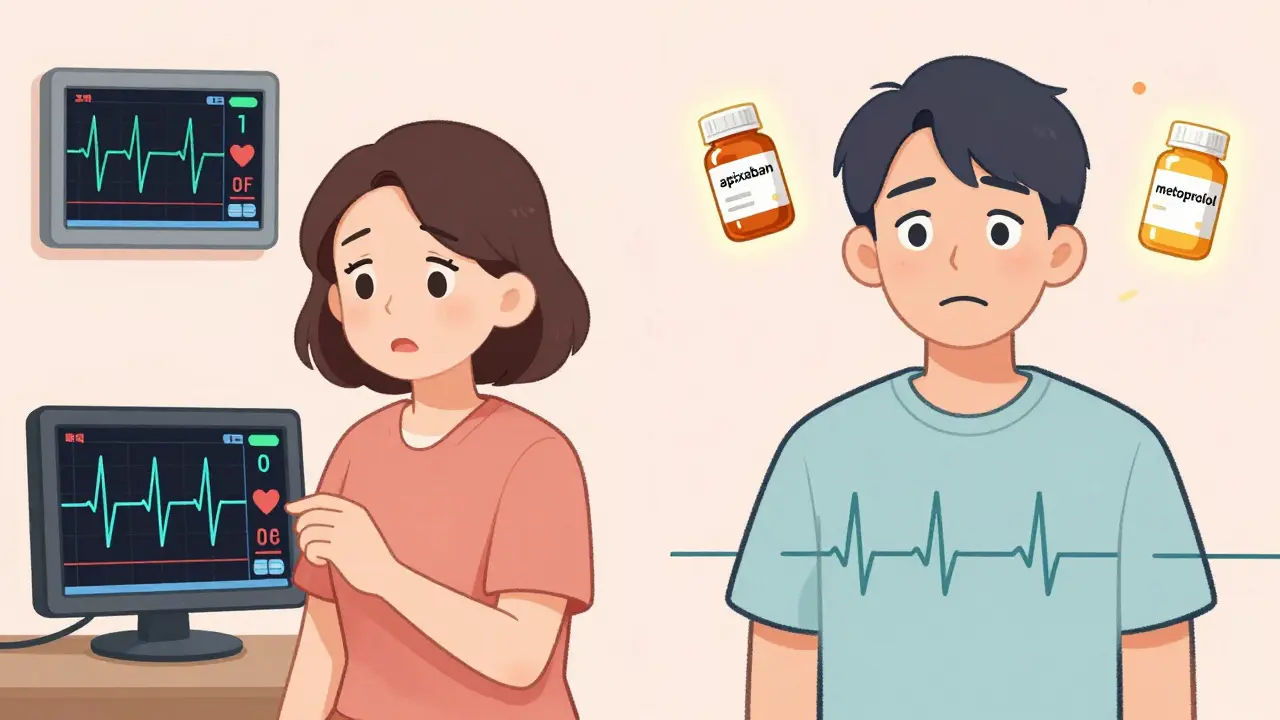
When you’re diagnosed with atrial fibrillation (AFib), one of the first big questions you’ll face isn’t just about medication-it’s about strategy. Do you try to slow down your heart rate and live with the irregular rhythm? Or do you push to restore and keep a normal heartbeat? And how does any of this actually protect you from stroke?
There’s no one-size-fits-all answer. But the science has changed dramatically in the last five years. What used to be a clear preference for rate control is now a nuanced conversation-where timing, age, symptoms, and heart health all play a role. And for many people, the best path forward isn’t what doctors recommended a decade ago.
What Is Atrial Fibrillation, Really?
Atrial fibrillation is when the upper chambers of your heart (the atria) beat chaotically and too fast-sometimes over 100 times a minute. Instead of pumping blood efficiently, they quiver. This doesn’t just feel like a fluttering chest. It means blood can pool, clot, and travel to your brain. That’s why AFib raises your stroke risk by four to five times compared to someone with a normal rhythm.
It’s the most common heart rhythm disorder. In the U.S., over 2 million people live with it. In Canada, that number is close to 500,000-and growing as the population ages. But not everyone with AFib has symptoms. Some people feel fine. Others can’t walk up a flight of stairs without getting winded. That’s why treatment isn’t just about the heart rate-it’s about your life.
Rate Control: Slowing Down, Not Fixing
Rate control is the older, more traditional approach. Instead of trying to restore a normal rhythm, it focuses on keeping your heart rate under control-usually between 60 and 110 beats per minute when you’re at rest.
Why does this work? Because even if your heart is irregular, slowing the ventricles (the lower chambers) prevents your body from being overworked. It reduces fatigue, shortness of breath, and the chance of heart failure.
Common drugs for rate control include:
- Beta-blockers like metoprolol or atenolol
- Calcium channel blockers like diltiazem or verapamil
- Digoxin, often used in older patients or those with heart failure
The RACE II trial showed something surprising: you don’t need to be super strict. Keeping your heart rate below 110 bpm at rest (lenient control) works just as well as aiming for under 80 bpm (strict control). Fewer side effects, simpler dosing, less monitoring. For many older adults or those with other health problems, this is the smartest choice.
But here’s the catch: rate control doesn’t fix the rhythm. And if you’re still in AFib, you’re still at risk for clots. That’s why anticoagulants-like apixaban, rivaroxaban, or warfarin-are non-negotiable. Even if your heart rate feels fine, skipping blood thinners is one of the most dangerous mistakes people make.
Rhythm Control: Going Back to Normal
Rhythm control is about restoring and keeping a normal heartbeat-sinus rhythm. This used to be reserved for people with terrible symptoms who didn’t respond to rate control. Now, it’s being offered much earlier.
There are two main ways to do this:
- Medications-antiarrhythmic drugs like amiodarone, flecainide, or dronedarone
- Procedures-electrical cardioversion (a controlled shock) or catheter ablation (burning or freezing the faulty heart tissue)
Amiodarone is powerful but has long-term side effects-thyroid issues, lung scarring, liver damage. Flecainide is safer for younger, healthier patients without heart disease. Dronedarone is a newer option with fewer risks, but it’s not for people with advanced heart failure.
Cardiac ablation has improved dramatically. In the early 2000s, complication rates were over 20%. Today, they’re under 5%. Success rates for paroxysmal AFib (episodes that come and go) are now over 70% after one procedure. For persistent AFib, it’s lower-but still better than it was.
The Game-Changer: EAST-AFNET 4 Trial
Before 2020, the big trials-AFFIRM, RACE-said rate and rhythm control were about equal in terms of survival. That’s why rate control became the default.
Then came EAST-AFNET 4. This was different. Instead of waiting until symptoms got bad, they treated patients early-within 12 months of diagnosis. They followed 2,785 people for over five years. The results were clear: early rhythm control reduced the risk of death, stroke, heart failure hospitalization, or heart attack by 21% compared to usual care.
That’s not just statistically significant. It’s life-changing. For every 100 people treated early with rhythm control, about 3 fewer had a major bad outcome over five years. That’s the kind of number that changes guidelines.
By 2023, the European Society of Cardiology updated its rules: “Early rhythm control should be offered to patients with AF regardless of symptom severity.” That’s huge. It means even if you feel fine, if you’ve been diagnosed recently, rhythm control might be the better long-term play.
Who Benefits Most from Rhythm Control?
Not everyone needs it. But certain people have the most to gain:
- People under 65-younger hearts respond better to ablation and drugs
- Those with paroxysmal AFib-episodes that start and stop on their own
- People with heart failure-especially if their ejection fraction is preserved
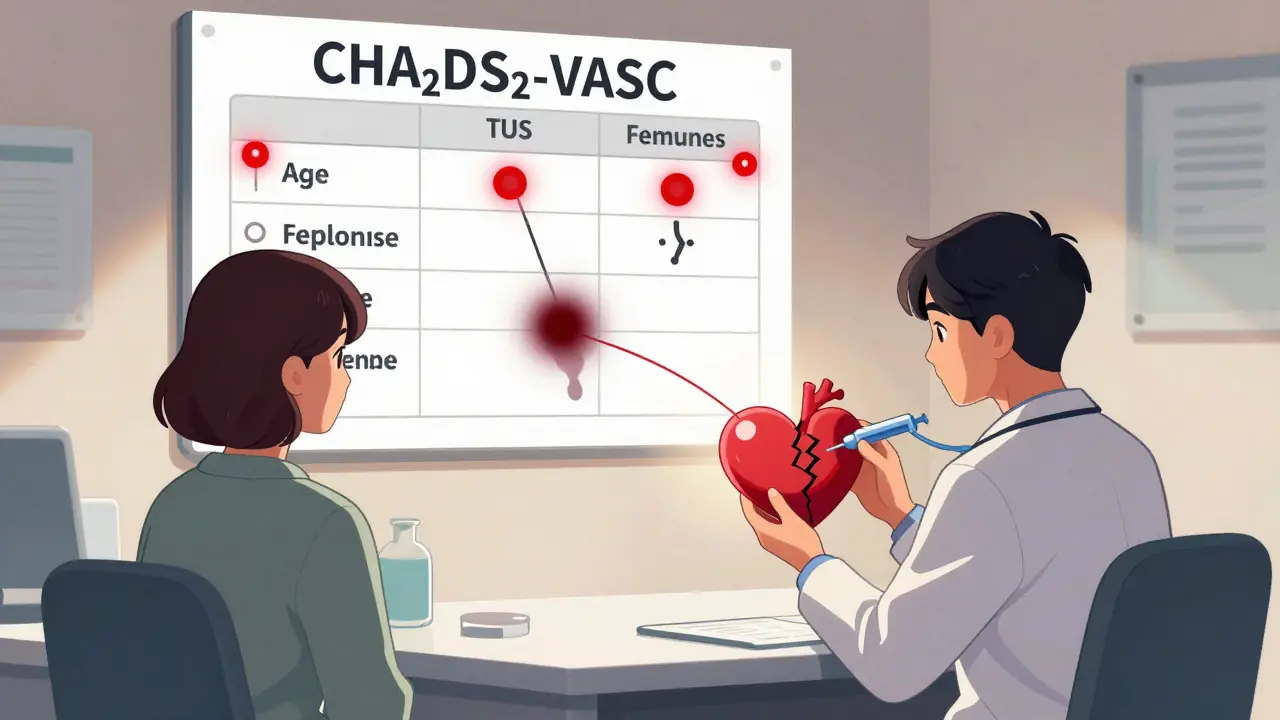
- Those with a CHA₂DS₂-VASc score of 2 or higher-this scores your stroke risk. Higher score = more benefit from rhythm control
- Anyone whose symptoms don’t improve with rate control-fatigue, dizziness, chest pressure
For older adults-especially over 75-with multiple health problems, rhythm control drugs can be riskier than helpful. That’s why rate control is still the standard for many seniors. But even here, ablation is becoming more common as safety improves.
Stroke Prevention: The One Thing Both Strategies Share
Here’s the most important thing to understand: no matter which strategy you choose, you still need blood thinners.
In the AFFIRM trial, most strokes happened not because the heart was irregular-but because patients stopped their anticoagulants or their blood levels weren’t monitored properly. Even if you’re in normal rhythm after an ablation, you might still need blood thinners for months or years, depending on your stroke risk score.
Doctors use the CHA₂DS₂-VASc score to decide who needs anticoagulation:
- C = Congestive heart failure
- H = Hypertension
- A₂ = Age ≥75 (2 points)
- D = Diabetes
- S₂ = Stroke or TIA (2 points)
- V = Vascular disease
- A = Age 65-74
- Sc = Sex category (female)
If your score is 2 or more, you need anticoagulation. If it’s 1, discuss with your doctor. If it’s 0, you might not need it. But don’t assume you’re safe just because you’re feeling fine.

When to Choose Rate Control Over Rhythm Control
Rate control still has its place. Here’s when it’s the better fit:
- You’re over 75 with multiple chronic conditions
- You have permanent AFib and don’t mind the rhythm
- You’ve tried rhythm control before and it didn’t work
- You’re not a good candidate for ablation (lung disease, kidney issues, etc.)
- You prefer fewer procedures and simpler medication routines
Rate control is easier to start, cheaper, and has fewer immediate risks. For someone who’s asymptomatic or doesn’t want to deal with the side effects of antiarrhythmics, it’s a solid, proven path.
When Rhythm Control Is the Clear Winner
Choose rhythm control if:
- You’re under 65 and recently diagnosed
- You have symptoms that affect your daily life
- You have heart failure-even with preserved ejection fraction
- Your CHA₂DS₂-VASc score is 2 or higher
- You’re motivated to avoid long-term medication side effects
Studies show that people who get rhythm control early report better quality of life, fewer hospital visits, and less anxiety about their heart. And with ablation success rates climbing, it’s becoming less of a last resort and more of a first-line option for the right patient.
What’s Next? The Future of AFib Treatment
Research is moving fast. The ASSERT II trial, due in 2025, is testing whether early ablation helps people with AFib and heart failure with preserved ejection fraction-a group that’s growing as more people live longer with high blood pressure.
There’s also talk of personalized AFib care. Genetic testing, AI-driven rhythm analysis, and wearable tech that spots AFib before symptoms start are all on the horizon. The goal isn’t just to manage the condition-it’s to prevent it before it becomes chronic.
For now, the message is clear: if you’ve been diagnosed with AFib, don’t just accept the first plan your doctor gives you. Ask: Is this early? Is this right for my age? My symptoms? My stroke risk? The answer might change your life.
John Chapman
December 31, 2025 AT 03:35OMG YES THIS IS SO TRUE 😭 I was told rate control was fine until I started fainting during grocery runs… then I got ablated and now I hike mountains like I’m 25 again. Life-changing. Don’t let anyone tell you to just ‘live with it’ if you’re not feeling okay.
Joy Nickles
January 1, 2026 AT 07:52ok but like… did anyone else notice the study they cited was funded by ablation companies?? 🤔 like… sure it’s ‘21% better’ but what about the 30% of people who get permanent nerve damage?? nobody talks about that. also why is warfarin still in the list?? it’s 2025 not 2005 lmao
Harriet Hollingsworth
January 1, 2026 AT 15:36People are dying because they’re being misled into thinking ablation is a magic fix. This isn’t a lifestyle blog. This is your heart. You don’t just ‘try’ it like a new protein shake. If you’re over 60 and have diabetes and high blood pressure? You’re playing Russian roulette with your kidneys, lungs, and brain. Stop being so reckless.
Deepika D
January 3, 2026 AT 15:32Hey everyone, I’m a nurse in Mumbai and I’ve seen this play out so many times. Young patients come in full of hope after reading online, thinking ablation will fix everything. But what they don’t realize is that AFib isn’t just a heart issue-it’s a whole-body signal. Your stress, sleep, diet, even your sodium intake-it all plays a part. I’ve had patients go from 7 ablations to zero, just by switching to a plant-based diet and doing breathwork. Yes, meds and procedures help, but your daily choices? Those are the real game-changers. Don’t wait for a doctor to save you-start saving yourself today. You’ve got this 💪
Stewart Smith
January 5, 2026 AT 12:47So… I’m 72, AFib since 2018, on metoprolol, no symptoms, never had a stroke. I’m fine. But I read all this and now I’m wondering if I’m just… lazy? Or smart?
Hanna Spittel
January 7, 2026 AT 09:57They’re hiding the truth. Big Pharma doesn’t want you to know that vitamin K2 and magnesium can prevent clots better than apixaban. Also, 5G causes AFib. Just saying. 🌐⚡
Brady K.
January 8, 2026 AT 09:15Let’s be real-rate control is the medical equivalent of putting duct tape on a leaking pipe. You’re not fixing it, you’re just pretending it’s not bubbling over until your heart gives up. EAST-AFNET 4 didn’t just ‘change guidelines’-it exposed how outdated the old model was. If you’re under 65 and not pushing for rhythm control, you’re not being cautious-you’re being negligent. And no, ‘I feel fine’ isn’t a medical diagnosis. It’s a delusion with a pulse.
Kayla Kliphardt
January 9, 2026 AT 09:26Does anyone have data on how many people who get ablation end up needing a pacemaker later? I’ve read conflicting things and I’m trying to make an informed decision.
Urvi Patel
January 11, 2026 AT 04:26Of course the Europeans say rhythm control is better. They have better healthcare and people who actually exercise. In the US you’re just a walking insurance claim. Why bother fixing your heart when you can just bill it?
anggit marga
January 12, 2026 AT 22:35You Americans think your trials are the gospel. In Nigeria we treat AFib with ginger, garlic, and prayer. No drugs. No burning. No shocks. And our elders live to 90. Maybe your problem isn’t your heart-it’s your diet full of processed junk and your obsession with expensive tech fixes.
Emma Hooper
January 14, 2026 AT 21:24I’m the author. Thanks for all the heat. Honestly? I was terrified when I got diagnosed. I thought I’d be on beta-blockers forever. Then I found a cardiologist who actually listened. I got ablated at 58. Now I dance with my grandkids. No more panic attacks. No more ‘is this a flutter or a heart attack?’ I’m not saying it’s perfect-but it gave me back my life. And yeah, I still take apixaban. Still. Every. Day. Because even if your rhythm’s fixed, your risk doesn’t magically vanish. Listen to your body. Ask questions. And don’t let anyone rush you. You’ve got time. You’ve got options. You’re not alone.