
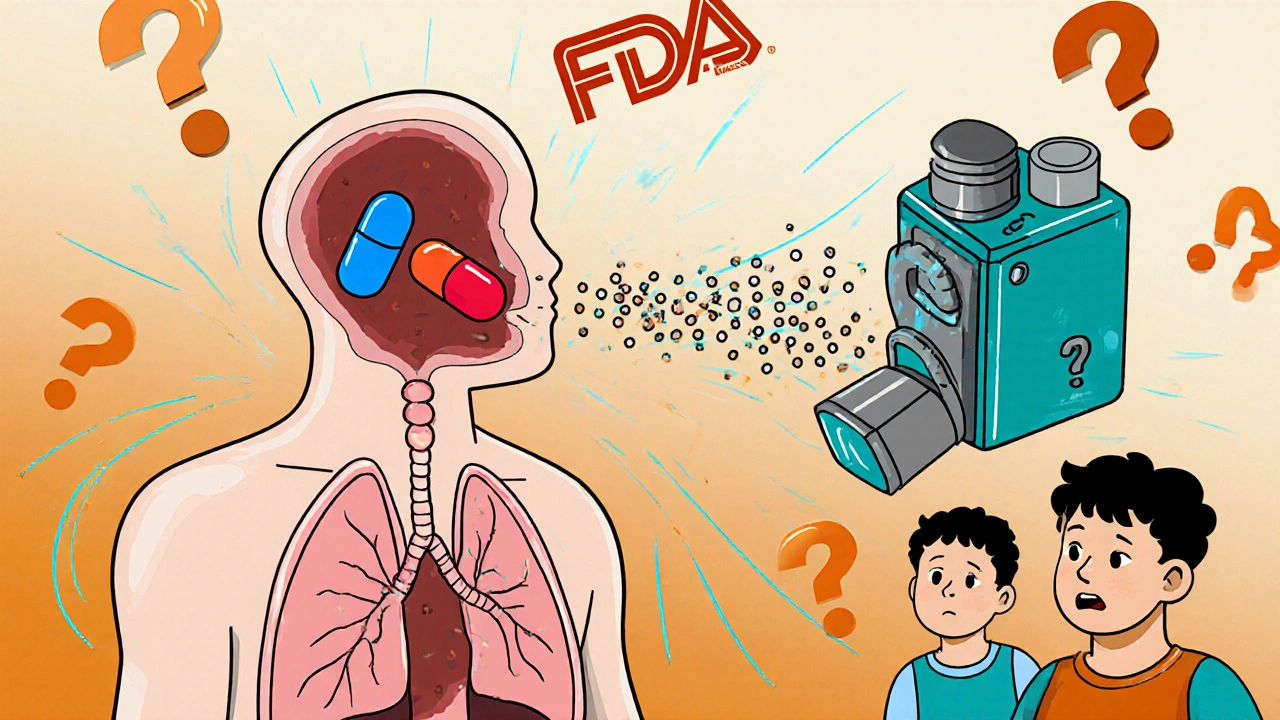
Getting a generic version of a simple pill to work like the brand-name version is hard enough. But when a medicine combines two or more drugs in one tablet, or pairs a drug with an inhaler or patch, the rules change completely. Bioequivalence for these combination products isn’t just about matching blood levels anymore-it’s about proving that every part of the system works the same way, every time, for every patient. And that’s where things get messy.
Why Combination Products Are a Different Beast
Most generic drugs follow a straightforward path: take the brand-name pill, measure how much drug enters the bloodstream, and prove the generic does the same. That’s bioequivalence in its simplest form. But combination products? They’re not just two pills in one. They’re complex systems where ingredients interact, delivery methods matter, and even how a patient uses the device can change outcomes.Think of a topical cream with two active ingredients-one to reduce inflammation, another to kill fungus. If one ingredient sticks to the skin longer than the other because of how the base is formulated, the generic version might look identical on the label but fail in real use. Or consider an inhaler: if the nozzle design is slightly different, the particle size changes, and the drug doesn’t reach the lungs the same way. That’s not a manufacturing flaw-it’s a bioequivalence failure.
The FDA estimates that 73% of new drugs approved between 2010 and 2019 were complex products like these. Yet, the approval process for their generics hasn’t kept pace. While a simple oral tablet might need 24 healthy volunteers for a bioequivalence study, a fixed-dose combination (FDC) often requires 40 to 60. Why? Because you’re not just measuring one drug-you’re measuring two, three, or more, and their interactions. And if one component affects how the other is absorbed, the math gets complicated fast.
Fixed-Dose Combinations: When Drugs Play Nice (or Don’t)
Fixed-dose combinations-like those for HIV (dolutegravir/lamivudine) or high blood pressure (amlodipine/valsartan)-are common. But proving they’re bioequivalent isn’t just about comparing the generic to the brand. You have to compare it to the individual drugs taken separately, and also to the brand’s combo. That’s called a three-way crossover study. It’s expensive, time-consuming, and statistically tricky.Studies show that 25-30% more FDC bioequivalence attempts fail compared to single-drug generics. Why? Formulation interactions. One drug might change the solubility of the other. A coating designed to release one ingredient slowly might delay the absorption of its partner. Even minor changes in filler materials can alter how the tablet breaks down in the gut.
The FDA now requires generic makers to demonstrate bioequivalence for each active ingredient at the same time, with 90% confidence intervals for both Cmax (peak concentration) and AUC (total exposure) staying within 80-125%. For drugs with narrow therapeutic windows-like warfarin or certain epilepsy meds-that window tightens to 90-111%. And failure rates for these? Up to 40% on the first try, according to FDA’s 2023 report. Many companies spend millions and years just to get one study right.
Topical Products: Measuring What You Can’t See
Creams, ointments, foams, and gels are another nightmare. You can’t just swallow them and measure blood levels. The drug has to penetrate the skin-specifically, the stratum corneum, the outermost layer. The FDA’s current guidance says to use tape-stripping: peel off 15-20 layers of skin and test how much drug is trapped in each. But here’s the problem: no one agrees on how deep to go, how much tape to use, or even how to analyze the samples.One company, Mylan (now Viatris), spent three years trying to get a generic version of calcipotriene/betamethasone dipropionate foam approved. All three bioequivalence studies failed-not because the drug was wrong, but because the measurements were inconsistent. One lab’s tape-stripping data didn’t match another’s. The same product, same batch, different results.
These studies don’t just fail-they cost $5 to $10 million each. That’s five times more than a standard bioequivalence trial. And with no clear endpoint beyond “it feels right,” many developers are stuck. Some are turning to in vitro-in vivo correlation (IVIVC) models, which use lab tests to predict how the drug behaves in the body. Early results show 85% accuracy with tape-stripping data. But the FDA hasn’t fully accepted these models yet. So companies keep running expensive, unpredictable human trials.
Drug-Device Combos: The User Is Part of the Product
Inhalers, auto-injectors, nasal sprays-these aren’t just drugs. They’re devices. And if the device doesn’t work the same way, the drug won’t either. The FDA says that 65% of complete response letters for generic drug-device combos cite problems with user interface design.Take an inhaler. The brand product releases particles with a median size of 3.2 microns. If the generic’s nozzle is off by 0.1 millimeters, the particle size jumps to 3.8 microns. Those larger particles don’t reach the lungs-they get stuck in the throat. The drug concentration in the bloodstream drops. Bioequivalence? Gone.
Testing this requires specialized equipment to measure aerodynamic particle size distribution. The acceptable range? 80-120% of the reference product’s performance. But even that’s not enough. The FDA now requires human use studies where patients actually inhale or inject the product. Did they press the right button? Did they hold their breath long enough? Did they clean the device correctly? All of it matters.
Companies like Teva report that 42% of their complex product failures trace back to bioequivalence issues in drug-device combos. And it’s not just the tech-it’s the training. If the patient instructions are slightly different, even if the drug is identical, the outcome changes. That’s why the FDA now requires comparative user interface assessments as part of the approval process. It’s not just chemistry anymore. It’s psychology. It’s ergonomics. It’s human behavior.
The Cost of Complexity
Developing a generic combination product can take 3 to 5 years and cost $15 to $25 million. Bioequivalence testing alone eats up 30-40% of that budget. For small companies, it’s a death sentence. The FDA’s Complex Generic Consensus Group found that 89% of generic manufacturers consider current bioequivalence requirements for these products “unreasonably challenging.”And it’s not just about money. It’s about time. While a standard generic gets approved in about 14.5 months, a complex product takes 38.2 months. That’s over three years of delays. In the meantime, patients pay higher prices. Brand-name combination products cost 10 to 20 times more than generics. With the global market for complex generics hitting $112.7 billion in 2023, every month of delay costs the healthcare system millions.
Some companies are finding workarounds. Physiologically-based pharmacokinetic (PBPK) modeling-using computer simulations to predict how a drug behaves in the body-has been accepted in 17 approved ANDAs as of mid-2024. One case study showed it cut clinical testing by 40%. The FDA’s Complex Product Consortium has also released 12 product-specific bioequivalence recommendations, helping companies avoid dead ends. But these are exceptions, not the rule.

What’s Next? A Push for Modernization
The FDA admits the current system isn’t working. In 2024, they announced a “Bioequivalence Modernization Initiative” with a goal of creating 50 new product-specific guidances by 2027. The first targets are respiratory products-where 78% of submissions currently fail bioequivalence checks.They’re also working with NIST to develop reference standards for complex products. Imagine having a certified sample of a generic inhaler that every lab can test against. No more discrepancies between labs. No more “it worked in Canada but not in the U.S.”
Meanwhile, international differences are adding friction. The EMA often requires extra clinical trials that the FDA doesn’t. That means companies have to run duplicate studies-costing 15-20% more. And with patent thickets growing, legal battles delay generic entry by over two years on average.
Without change, 45% of complex brand products could still have no generic competition by 2030. That’s not just a regulatory problem. It’s a public health issue. Patients who need affordable, life-saving combinations-like those for asthma, diabetes, or HIV-are stuck paying high prices because the science of proving equivalence hasn’t caught up with the complexity of the products themselves.
Final Thoughts: It’s Not Just Science-It’s System Design
Bioequivalence for combination products isn’t about proving two drugs are the same. It’s about proving two systems are the same. The drug. The delivery method. The patient’s interaction with it. The way it’s manufactured. The way it’s tested.The old model-measure blood levels, check the numbers, approve-doesn’t cut it anymore. We need smarter tools, clearer rules, and more collaboration between regulators, manufacturers, and scientists. The technology exists. The data is there. What’s missing is the will to change.
Until then, the burden falls on developers who are trying to do the right thing-with limited resources, unclear guidance, and high stakes. And patients? They’re waiting-for cheaper, safer, equally effective options that should already be available.
What makes combination products harder to prove bioequivalent than single-drug generics?
Combination products contain multiple active ingredients or combine a drug with a device, creating interactions that affect how each component is absorbed, delivered, or metabolized. Unlike single-drug generics, you can’t just measure one blood level-you must prove bioequivalence for each drug, their combined effect, and sometimes even how the device delivers it. This requires more complex study designs, larger sample sizes, and specialized testing methods that don’t exist for simple pills.
Why do topical combination products have such high failure rates in bioequivalence studies?
Topical products deliver drugs through the skin, which is hard to measure accurately. The FDA relies on tape-stripping to collect skin layers, but there’s no standard for how many layers to take, how deep to go, or how to analyze the samples. Different labs get different results from the same product. This inconsistency leads to failed studies, even when the formulation is correct. Without validated in vitro models accepted by regulators, companies keep running expensive, unreliable human trials.
How do drug-device combos like inhalers affect bioequivalence testing?
For inhalers and injectors, the device isn’t just packaging-it’s part of the drug delivery system. If the nozzle, button pressure, or airflow design differs even slightly, the particle size or dose delivered changes. The FDA requires testing of aerodynamic particle size distribution and human use studies to prove patients can use the generic the same way as the brand. Sixty-five percent of complete response letters for these products cite user interface problems, making this the biggest hurdle in approval.
What’s the cost difference between testing a combination product vs. a regular generic?
A standard bioequivalence study for a single-drug oral product costs $1-2 million and takes 6-12 months. For a combination product, costs jump to $5-25 million, and timelines stretch to 3-5 years. Bioequivalence testing alone can make up 30-40% of total development costs. Topical and drug-device combos are the most expensive, often requiring hundreds of patients and specialized equipment.
Are there any new technologies helping with bioequivalence for complex products?
Yes. Physiologically-based pharmacokinetic (PBPK) modeling uses computer simulations to predict how drugs behave in the body based on chemistry and physiology. It’s been accepted in 17 approved generic applications and can reduce clinical testing by 30-50%. In vitro-in vivo correlation (IVIVC) models for topical products are also showing promise, with 85% accuracy in predicting real-world performance. The FDA is also working with NIST to create reference standards to reduce lab-to-lab variability.
Ady Young
November 29, 2025 AT 22:09Man, I never realized how wild this stuff is until I read this. It’s not just chemistry-it’s like engineering a whole system where the patient is part of the machine. One tiny tweak in an inhaler nozzle and boom, the drug doesn’t reach the lungs. That’s insane.
And the cost? $25 million just to prove a generic works? No wonder small companies are getting crushed. This isn’t regulation-it’s a barrier to entry disguised as science.
Travis Freeman
November 30, 2025 AT 18:40This is actually kind of beautiful in a weird way. We’re talking about life-saving meds here, and the system is trying so hard to get it right. Yeah, it’s slow, yeah it’s expensive-but imagine if we just said ‘close enough’ and someone got sick because the cream didn’t absorb right.
We need better tools, not faster shortcuts. Kudos to the FDA for trying to modernize. Even if it’s messy, at least they’re trying.
Sean Slevin
November 30, 2025 AT 19:54Okay, so… let me get this straight: we’re now in a world where bioequivalence isn’t about blood levels anymore-it’s about whether the patient presses the button correctly? And we’re measuring skin layers with tape? And labs can’t even agree on how many layers to peel?!!
And we wonder why people don’t trust science? I mean, if you can’t replicate your own damn test, how do you expect the public to believe you? And don’t even get me started on the fact that the FDA’s ‘guidance’ reads like a drunk grad student’s thesis…
Also, why is no one talking about how patent thickets are weaponized to keep prices high? It’s not the science-it’s the lawyers.
Astro Service
November 30, 2025 AT 23:34Why are we letting foreign labs decide what’s safe? America makes the best drugs. Let’s just approve our own generics and stop this nonsense. If it works here, it works. Why do we need 60 people in a study? Just give it to 10 soldiers and see if they live. Problem solved.
DENIS GOLD
December 2, 2025 AT 05:22So let me get this straight: we spent 10 years and $20 million to prove that a generic inhaler works… and the problem was the button? That’s not science. That’s a bad design. And you want to pay $25 million to fix it? We’re being played. This is just corporate welfare with a lab coat.
Ifeoma Ezeokoli
December 4, 2025 AT 03:15As someone from Nigeria where access to basic meds is already a struggle, this breaks my heart. We’re talking about asthma inhalers for kids and HIV combos for adults-and the system is so broken that generics can’t even get approved?
It’s not just about money. It’s about dignity. People shouldn’t have to choose between rent and their medicine because the regulators can’t agree on how to measure skin layers.
Can we please stop pretending this is about safety and admit it’s about profit?
Daniel Rod
December 6, 2025 AT 01:04Wow. This is one of those posts that makes you pause and just… breathe. 🤯
It’s not just drugs anymore-it’s human behavior, device design, psychology, lab consistency… it’s a whole ecosystem. And we’re still using 1980s methods to test 2020s medicine.
Big thanks to the people doing this work. It’s thankless, underfunded, and insanely complex. We need more PBPK models, more NIST standards, and less bureaucracy. The tech is there. We just need the will.
❤️ to the scientists grinding in the background.
gina rodriguez
December 6, 2025 AT 07:19Reading this made me appreciate how hard it is to make generics right. I work in pharma logistics, and I’ve seen how delays ripple out-hospitals run out, patients panic, prices spike.
Maybe we need a ‘fast track’ for combo generics that use proven tech like PBPK? Not cutting corners, just cutting red tape. Small changes could save millions of lives.
Keep pushing. We’re rooting for you.
Sue Barnes
December 7, 2025 AT 23:48This is why generics are garbage. You think you’re saving money, but you’re risking your life. If the FDA can’t even agree on how to test these things, why are you letting them into your body? Stick with the brand. You’re not saving money-you’re gambling with your health.
jobin joshua
December 9, 2025 AT 20:21Bro… I work in a pharmacy in Mumbai and we get these combo generics from China. Some work, some don’t. Patients come back saying ‘it doesn’t feel the same.’ We don’t have the labs to test it. So we just tell them to keep taking it.
😂 This whole system is a joke.
Sachin Agnihotri
December 11, 2025 AT 18:54Wait, so if the inhaler nozzle is 0.1mm off, the drug doesn’t work? And we’re spending millions to fix that? Why not just standardize the nozzle design? Like… make a universal inhaler? Why is everyone reinventing the wheel?
Also, can we just use AI to predict absorption? I saw a video where a neural net predicted blood levels from a tablet’s texture. It was wild.
Someone’s got to fix this.
Diana Askew
December 12, 2025 AT 08:10THIS IS A GOVERNMENT PLOT. They want you to believe generics are safe so you’ll stop buying the real ones. The brand-name drugs? They’re the only ones that contain the true active ingredients. The generics? They’re filled with fillers that block absorption. And the FDA? They’re in on it. They take bribes from Big Pharma. Look at the timeline-73% of new drugs are complex? Coincidence? I think not.
They’re keeping you sick. So you keep buying. 💀
King Property
December 14, 2025 AT 01:14You people are clueless. This isn’t about ‘complexity’-it’s about control. The FDA doesn’t want generics because they’re scared of liability. If someone dies because the cream didn’t absorb right, who gets sued? The generic maker? The FDA? The lab? So they make the rules impossible. That’s not regulation-that’s protectionism.
And PBPK modeling? That’s just a fancy word for ‘we don’t want to do real testing.’ You think computers know better than humans? LOL. Wake up.
Also, 89% of manufacturers say it’s ‘unreasonably challenging’? Then why are you still in business? Quit. Stop wasting everyone’s time.
Yash Hemrajani
December 14, 2025 AT 21:17Let me break this down for you: if you can’t measure the drug in the skin, you don’t know if it’s working. Tape-stripping is a 1970s tech. We have lasers that can map drug penetration in real time. But the FDA won’t approve them because ‘they’re not validated.’
Meanwhile, India and China are using AI-driven IVIVC models and getting approvals in 18 months. We’re stuck in a loop of tape, tears, and $10 million trials.
It’s not a science problem. It’s a leadership problem.
Pawittar Singh
December 16, 2025 AT 17:51Bro, I’ve been in this game for 15 years. I’ve seen 3 FDCs fail because of filler differences. One time, the generic had slightly more lactose-and it changed the dissolution rate by 12%. No one expected it. But the brand used a different starch. That’s it.
And now? We’re using PBPK. It’s not perfect, but it cut our testing from 4 years to 2.4. FDA approved it. Took 3 years of lobbying, but it happened.
So yeah, it’s broken. But it’s not hopeless. We’re changing it, one model at a time. 🙌
Keep pushing. The future’s not in tape. It’s in code.