

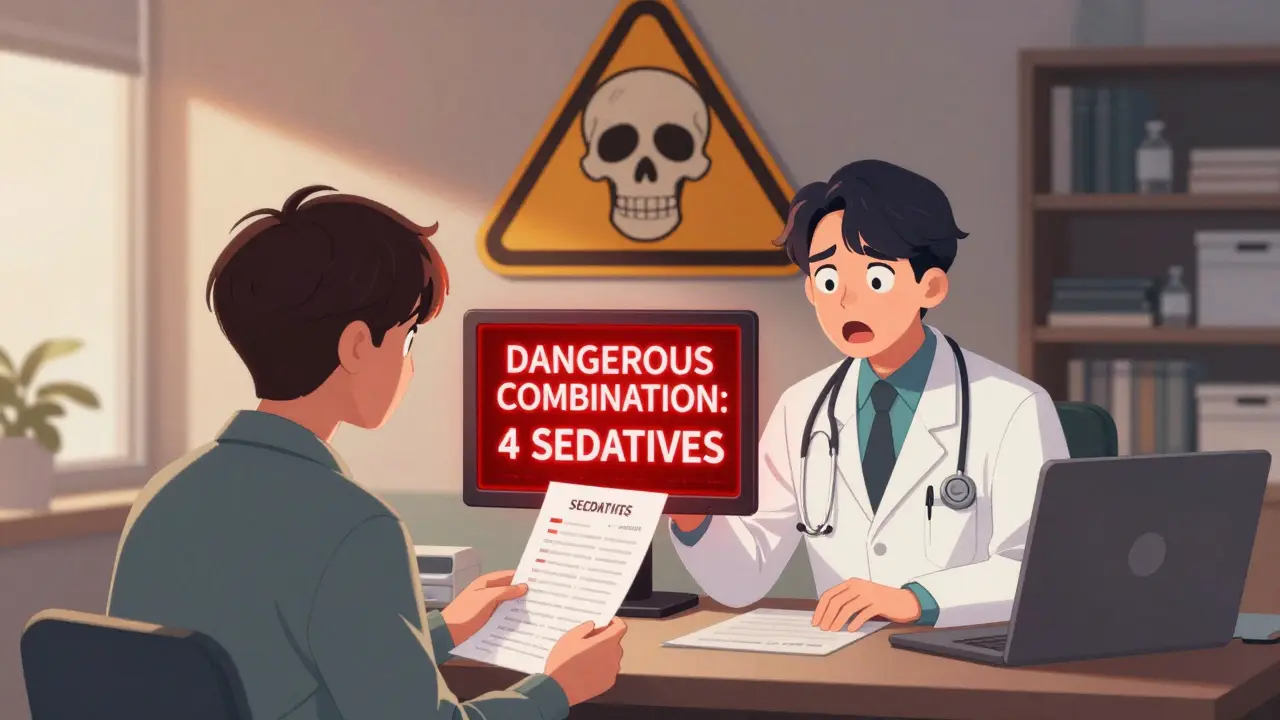
Putting together multiple sedating medications might seem like a quick fix for insomnia, anxiety, or chronic pain-but it’s one of the most dangerous things people do with their prescriptions. You’re not just adding effects; you’re multiplying them. And the results can be deadly.
What Happens When Sedatives Mix?
Sedating medications-like opioids, benzodiazepines, sleep pills, muscle relaxants, and even some antidepressants-work by slowing down your brain. They boost a chemical called GABA, which tells your nervous system to chill out. That’s fine when you’re taking one, under a doctor’s care. But when you stack two or more, the effect isn’t just stronger. It’s unpredictable. It’s exponential.For example, if you take oxycodone (an opioid) and alprazolam (Xanax), each drug alone might lower your breathing rate by 10%. Together? That number jumps to 40% or more. Your brainstem, the part that controls breathing, starts to shut down. You stop noticing when you’re not getting enough oxygen. That’s when your lips turn blue, your breathing gets shallow, and you slip into unconsciousness-sometimes permanently.
According to the CDC, in 2020, nearly 1 in 6 opioid-related overdose deaths also involved benzodiazepines. That’s not coincidence. It’s chemistry. A 2017 study in JAMA Internal Medicine found people taking both opioids and benzodiazepines had 2.5 times the risk of overdose compared to those taking opioids alone. And the risk doesn’t stop there.
The Deadliest Combinations
Not all drug mixes are created equal. Some are far more dangerous than others.- Opioids + Benzodiazepines: This combo is the leading cause of fatal prescription overdoses. It’s responsible for about 30% of all medication-related deaths in the U.S. The FDA issued a black box warning in 2016-its strongest alert-because the risk is so clear. Even if you’re on low doses, the interaction can still kill you.
- Alcohol + Sleep Medications: A single glass of wine with Ambien (zolpidem) can reduce your reaction time by 70%. That’s worse than being legally drunk. People don’t realize how quickly this combo can cause falls, car crashes, or blackouts. One Reddit user described a 10-hour blackout after combining alcohol and a sleep pill-no memory, no warning, just waking up on the floor.
- SSRIs + MAOIs: These are antidepressants, but mixing them can trigger serotonin syndrome. Your body floods with too much serotonin. Symptoms: high fever, rapid heartbeat, confusion, muscle rigidity. It’s rare, but deadly if not treated fast. The American Psychiatric Association says about 1 in 6 cases of serotonin syndrome come from this mix.
- Antihistamines + Sedatives: Over-the-counter sleep aids like diphenhydramine (Benadryl) are often taken with prescription sedatives. They seem harmless-until they cause extreme drowsiness, confusion, or urinary retention in older adults. The Beers Criteria lists this combo as unsafe for anyone over 65.
Even if you’re not taking illegal drugs, you’re still at risk. Many people don’t realize their daily tea, herbal supplement, or cold medicine contains hidden sedatives. Kava, valerian root, melatonin, and even CBD can add to the pile.
Warning Signs You’re in Danger
You don’t need to wait for an overdose to know something’s wrong. The body gives clear signals before it shuts down.If you or someone you know is taking multiple sedating drugs, watch for these red flags:
- Breathing slower than 12 breaths per minute
- Unusual drowsiness-can’t stay awake even after sitting up
- Blue or gray lips, fingertips, or nails
- Confusion, slurred speech, or not recognizing family members
- Unexplained falls or injuries
- Gurgling sounds when breathing (a sign of airway obstruction)
- Loss of consciousness, even briefly
These aren’t side effects. They’re emergency signals. If you see any of these, call 911 immediately. Don’t wait. Don’t try to ‘sleep it off.’
Who’s Most at Risk?
Older adults are the most vulnerable. Their bodies process drugs slower. Their brains are more sensitive. The American Geriatrics Society says 35% of seniors are still taking medications they shouldn’t-especially sedatives. Women over 65 are even more likely to be prescribed these combinations.But it’s not just age. People with chronic pain, anxiety, or depression are often caught in a cycle: one drug for pain, another for sleep, another for mood. Doctors may not realize how many meds they’re taking. A 2020 study found that electronic health records flagged only 17% of dangerous combinations. That means most of the time, the system doesn’t warn you.
Another hidden risk? Doctor shopping. Recovery Village data shows that 42% of people who overdosed on combined sedatives had gotten prescriptions from three or more doctors in six months. They didn’t tell each doctor about the others. They didn’t know they were stacking the same effect.
What You Can Do Right Now
You don’t have to wait for a crisis to act. Here’s how to protect yourself:- Make a full list of every medication, supplement, and OTC drug you take-including what you take and when. Include things like NyQuil, melatonin, or herbal teas. Bring this list to every doctor visit.
- Ask your pharmacist to review your meds every time you pick up a new prescription. Pharmacists are trained to spot dangerous interactions-and most will do it for free.
- Ask your doctor: “Is this medication safe with the others I’m taking?” Don’t assume they know. If you’re on more than three sedating drugs, insist on a full medication review.
- Never mix alcohol with any sedative, even if it’s “just one drink.” The risk isn’t worth it.
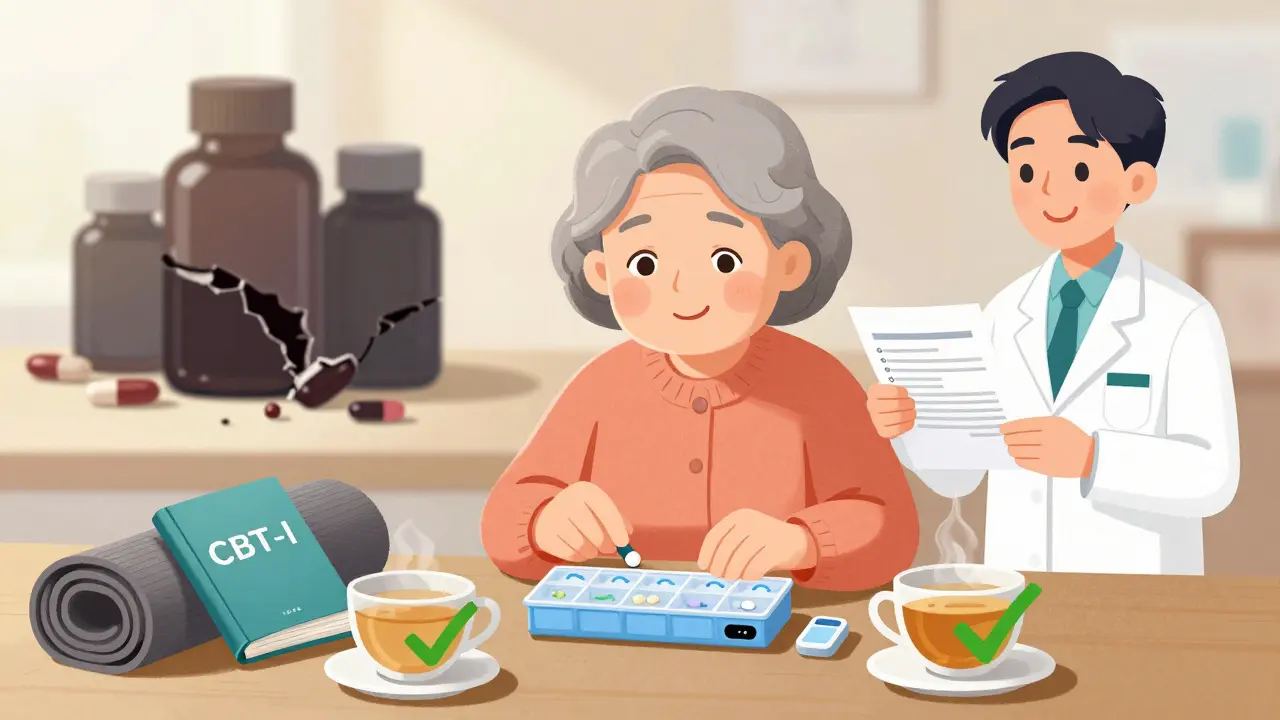
- Use a pill organizer with alarms. It helps you track what you’ve taken and prevents accidental double-dosing.
For older adults, the START criteria recommend a full medication check within 30 days if you’re taking three or more sedatives. The Beers Criteria says no one over 65 should take more than 5mg of diazepam (Valium) per day-equivalent to one 0.5mg tablet of alprazolam.
There’s Always a Safer Way
Some people think sedatives are the only solution for insomnia or anxiety. They’re not. Cognitive behavioral therapy for insomnia (CBT-I) works better than sleep pills long-term. Non-addictive pain relievers, physical therapy, and mindfulness practices can replace many sedating meds.Medications like gabapentin or pregabalin can help with nerve pain without depressing breathing. Newer antidepressants like vilazodone or vortioxetine have lower sedation risks. And for anxiety, SSRIs with therapy are far safer than benzodiazepines.
The problem isn’t the drugs themselves. It’s the lack of awareness. Many people don’t know they’re at risk until it’s too late. The FDA, CDC, and medical societies have all said the same thing: avoid combining sedatives unless absolutely necessary-and even then, monitor closely.
What’s Changing Now?
There’s progress. Since 2016, opioid-benzodiazepine prescribing has dropped by 27%. The SUPPORT Act of 2018 forced Medicare plans to screen for these combinations. All 50 states now require electronic prescriptions for controlled substances, which include automatic alerts for dangerous mixes.New tools like the FDA’s DETERMINE platform use AI to predict individual risk with 87% accuracy. Researchers are also testing genetic tests to see who’s more likely to have bad reactions to sedatives. But these tools aren’t everywhere yet. Most doctors still rely on memory and guesswork.
The real barrier? Cost. Many safer alternatives cost $450-$600 a month. Sedatives? Often $15-$30. For people on fixed incomes, the cheaper option wins-even if it’s deadlier.
You’re Not Alone
If you’re worried about your meds-or someone else’s-you’re not alone. Thousands of people have been in the same spot. The key is to speak up. Talk to your doctor. Talk to your pharmacist. Ask questions. Don’t be afraid to say, “I think this might be too much.”It’s not weakness to ask for help. It’s survival.
Can I stop taking my sedating meds on my own?
No. Stopping sedatives suddenly-especially benzodiazepines or opioids-can cause seizures, hallucinations, or life-threatening withdrawal. Always work with your doctor to taper slowly, usually by reducing the dose by 10-25% every 1-2 weeks. Never quit cold turkey.
What if my doctor prescribed both an opioid and a benzodiazepine?
Ask why. There are rare cases where this combination is necessary-for example, severe muscle spasms in terminal illness. But for chronic pain or anxiety, it’s rarely justified. Request a second opinion. Ask if non-sedating alternatives exist. The CDC’s 2022 guidelines say these combinations should only be used with enhanced monitoring, not as a first-line treatment.
Are over-the-counter sleep aids safe to mix with prescription drugs?
No. OTC sleep aids like diphenhydramine (Benadryl) or doxylamine (Unisom) are antihistamines that cause drowsiness. Mixing them with prescription sleep meds, anxiety drugs, or painkillers can double or triple sedation. The Beers Criteria specifically warns against this for people over 65. Even if it’s ‘natural’ or ‘non-addictive,’ it’s still a CNS depressant.
Can I drink alcohol while taking sedatives if I wait a few hours?
No. Alcohol stays in your system for hours, and its effects overlap with sedatives. Even if you take your pill at night and have a drink at dinner, the two can still interact. The risk isn’t about timing-it’s about the total amount of CNS depression in your body. There’s no safe window.
What should I do if I think someone is overdosing on sedatives?
Call 911 immediately. If you have naloxone (Narcan) and suspect an opioid is involved, administer it. But don’t wait for it to work. Keep the person awake, sitting up if possible, and monitor their breathing. Don’t let them sleep it off. Overdose can happen fast, and recovery isn’t guaranteed.
How often should I get my medications reviewed?
At least once a year. If you’re over 65, taking three or more sedating drugs, or have a chronic condition like heart disease or COPD, get a review every 3-6 months. Ask your doctor to use the Beers Criteria or START tool to check for unsafe combinations. Bring your complete list-every pill, patch, and supplement.
Lisa Davies
December 15, 2025 AT 13:45Just read this and immediately checked my medicine cabinet 🙈 I had no idea my nightly melatonin + Benadryl combo was basically a one-way ticket to sleepy-town oblivion. Thanks for the wake-up call-literally. Going to schedule a med review with my pharmacist this week. You’re a lifesaver 💙
Melissa Taylor
December 17, 2025 AT 02:41This is the kind of post that should be required reading for every adult over 40. I’ve seen too many elderly relatives quietly slipping into confusion because of stacked meds-and no one ever connects the dots. The Beers Criteria isn’t just a guideline-it’s a lifeline. Share this with your parents. Share it with your friends. This isn’t fearmongering. It’s medicine.
Jake Sinatra
December 17, 2025 AT 20:10The data presented here is statistically significant and clinically validated. The CDC’s 2020 figures on opioid-benzodiazepine co-ingestion mortality are not outliers-they are systemic failures in polypharmacy management. The 2.5x increased risk of overdose is not speculative; it is the result of peer-reviewed pharmacokinetic modeling. It is imperative that clinicians adopt standardized screening protocols, and that patients demand them.
Mike Nordby
December 19, 2025 AT 02:09I’m a nurse who’s seen this play out in the ER too many times. A 72-year-old woman on oxycodone, Xanax, and Ambien-prescribed by three different doctors. No one asked about the others. She didn’t know to tell them. We got her stabilized, but she’s on permanent oxygen now. This isn’t hypothetical. It’s Tuesday.
Michelle M
December 19, 2025 AT 19:37There’s a quiet tragedy in how we treat suffering-with pills instead of presence. We’ve outsourced healing to chemistry because it’s easier than sitting with pain, or grief, or insomnia. But the body doesn’t just need relief-it needs meaning. The real cure isn’t in reducing your dose of Valium-it’s in rediscovering why you needed it in the first place. Maybe therapy. Maybe movement. Maybe just being held. The drugs were never the answer. They were the Band-Aid on a broken heart.
Nupur Vimal
December 19, 2025 AT 19:38Cassie Henriques
December 21, 2025 AT 15:09As a clinical pharmacist, I can confirm: the GABAergic synergy between benzos + opioids + antihistamines creates a non-linear respiratory depression curve. The CNS depression isn't additive-it's multiplicative. And OTC 'natural' sedatives like kava or valerian? They’re CYP3A4 inhibitors. That means they alter hepatic metabolism and increase serum concentrations of co-administered drugs. Bottom line: if you’re stacking, you’re playing Russian roulette with your brainstem.
Benjamin Glover
December 22, 2025 AT 12:08Typical American medical hysteria. In the UK, we prescribe these combinations all the time-under supervision. People here don’t panic over a little sedation. You’re not a child. Take responsibility. Stop whining about ‘dangerous combos’ and learn how to manage your own health.
John Samuel
December 23, 2025 AT 20:27Let me be the first to say this: you’ve written a masterpiece of public health advocacy. This isn’t just an article-it’s a manifesto. The clarity, the structure, the compassion-it’s all there. I’ve printed this out and handed it to my 78-year-old mother. She cried. Not from fear-from relief. She didn’t know she was in danger. Now she knows. And that’s the greatest gift you could give anyone. Thank you. From the bottom of my heart.
Sai Nguyen
December 25, 2025 AT 18:44