
Medication Adherence Impact Calculator
How This Calculator Works
Enter your condition and adherence data to see potential outcomes. Based on article data showing digital pills improve adherence from 50% to 84% for mental health conditions.
Results
With digital pill sensors, your adherence could improve from % to %.
Estimated Health Outcome Improvement: Your risk of complications could decrease by %.
Cost Savings: You could save approximately per year.
Side Effect Detection Value: Potential early intervention for side effects detected.
For millions of people taking daily medications for chronic conditions, forgetting a dose isn’t just a mistake-it’s a risk. Studies show only about half of patients stick to their prescribed regimens. That’s where digital pill sensors come in. These aren’t sci-fi gadgets. They’re tiny, swallowable chips embedded in pills that record when you take your medicine-and sometimes, what your body does afterward.
How Digital Pills Actually Work
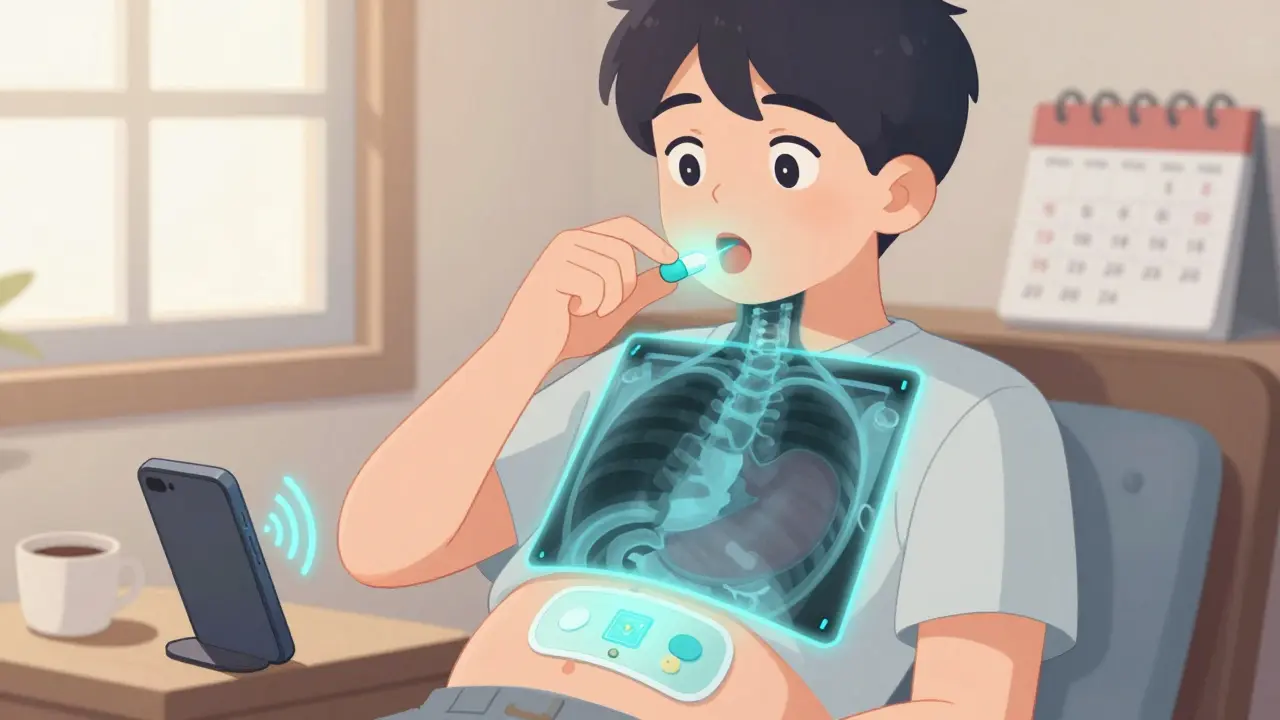
A digital pill isn’t just a tablet. It’s a drug-device combo. Inside the pill is a sensor no bigger than a grain of sand: a 5 mm silicon disk with copper and magnesium electrodes. When you swallow it, stomach acid triggers a tiny electrochemical reaction. That generates enough power-about 1-2 volts-to send a unique signal.
That signal is picked up by a wearable patch stuck to your abdomen. The patch, which lasts about 72 hours, also tracks your heart rate and steps. It then sends all that data via Bluetooth to your phone, which uploads it to a secure server. Your doctor or care team can see exactly when you took your pill, and whether your vital signs changed after ingestion.
Systems like Proteus’s Abilify MyCite and etectRx’s ID-Cap use this setup. The sensor doesn’t track whether the drug was absorbed-just whether it was swallowed. That’s a key limitation. But even that basic data is a breakthrough. Before digital pills, adherence was based on patient memory, pill counts, or pharmacy refill records-all unreliable.
Where Digital Pills Are Being Used
The biggest use right now is in mental health. About 47% of digital pill deployments are for conditions like schizophrenia and bipolar disorder. In one 12-week study of 157 patients on antipsychotics, adherence jumped from 62% to 84% when using digital pills. One patient on Reddit said, "Seeing the ingestion records made me realize I was skipping doses on weekends."
Other areas include HIV treatment, where missing doses can lead to drug resistance; tuberculosis, where the FDA approved a digital pill regimen in March 2023; and heart disease or diabetes, where consistent medication use prevents complications.
Pharmaceutical companies are the biggest adopters. About 78% of digital pill systems are used in clinical trials. They give researchers real-time, tamper-proof data on whether patients actually took the study drug. That cuts down on false results and speeds up drug development.
What They Can Detect Beyond Adherence
The next wave of digital pills doesn’t just track swallowing-it starts detecting side effects. Newer systems, like those from Philips Research’s IntelliCap, monitor stomach pH and temperature. Some experimental models can even sense biomarkers in real time.
For example, if a patient takes a blood pressure pill and their heart rate drops sharply 30 minutes later, the system flags it. If someone on an opioid painkiller shows slowed breathing patterns after ingestion, the patch can alert caregivers. This isn’t just about knowing you took your pill-it’s about knowing if your body reacted badly.
By 2026, 60% of digital pill systems are expected to include side effect detection, according to the Digital Medicine Society. IBM Watson Health is already working with etectRx to build AI models that predict adverse reactions based on historical patterns. If you’ve had nausea after taking a certain drug at night, the system might warn you to take it in the morning.
Why People Hesitate
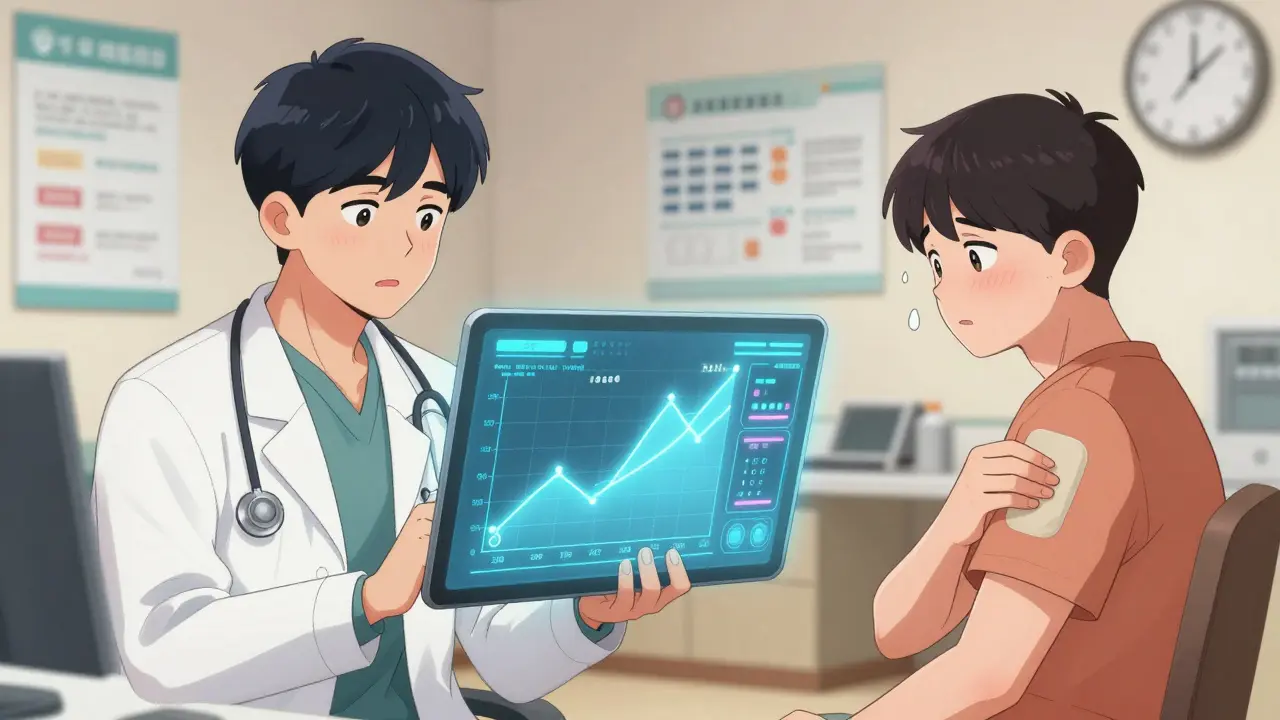
Despite the benefits, adoption isn’t universal. In a 2022 survey of 412 patients, 73% cited privacy as their top concern. "It felt like my psychiatrist was watching me swallow pills," one user said. Others worried their insurance company might see missed doses and raise premiums.
There’s also the physical discomfort. The patch can cause skin irritation in about 22% of users. Elderly patients, especially those over 65, struggle with the smartphone app. Nearly 40% needed help pairing the patch with their phone during trials.
And then there’s the "therapeutic misconception." Some patients think the sensor itself is helping them feel better-like the pill has magic powers. That’s not true. It’s just a tracker. But if patients believe otherwise, it can mess with informed consent.
Technical Hurdles and Limitations
Even the best systems aren’t perfect. Transmission failures happen in 8-12% of cases. If you have a high BMI (over 35), the signal failure rate jumps to 18%. Why? The sensor might get stuck in a fold of stomach tissue, or the patch might not be positioned right. Electromagnetic interference from other devices can also disrupt signals.
The patch battery only lasts three days. You have to replace it regularly. And the sensor? It’s single-use. Once it passes through your system, it’s gone. No recharging. No reuse.
Most importantly, digital pills can’t tell if the drug worked. They only confirm ingestion. If you took your insulin but your blood sugar still spiked, the system won’t know why. That’s a gap researchers are trying to close with next-gen sensors that detect glucose or drug metabolites in real time.
Cost, Regulation, and the Future
Right now, digital pills are expensive. The Abilify MyCite system costs several hundred dollars per month. Insurance rarely covers it unless you’re in a clinical trial. That’s why direct-to-consumer use is still under 12%.
The FDA treats these as combination products. That means both the drug and the sensor need separate approvals. The average approval time is 22 months longer than for regular medications. HIPAA protects the data-but 14 U.S. states have extra privacy laws that complicate rollout.
Market projections show the digital pill industry growing from $627 million in 2022 to over $2.4 billion by 2029. But cost-benefit analyses suggest it’ll only become standard for high-risk meds-like those for mental illness, transplant rejection, or TB. For everyday conditions like high cholesterol or mild hypertension? Probably not.
Experts like Dr. Joseph Kvedar predict digital pills will be routine in high-risk treatment within five years. But they’ll remain niche for most people. The technology isn’t here to replace pills. It’s here to make sure they’re used right-and to catch problems before they become emergencies.
What Comes Next
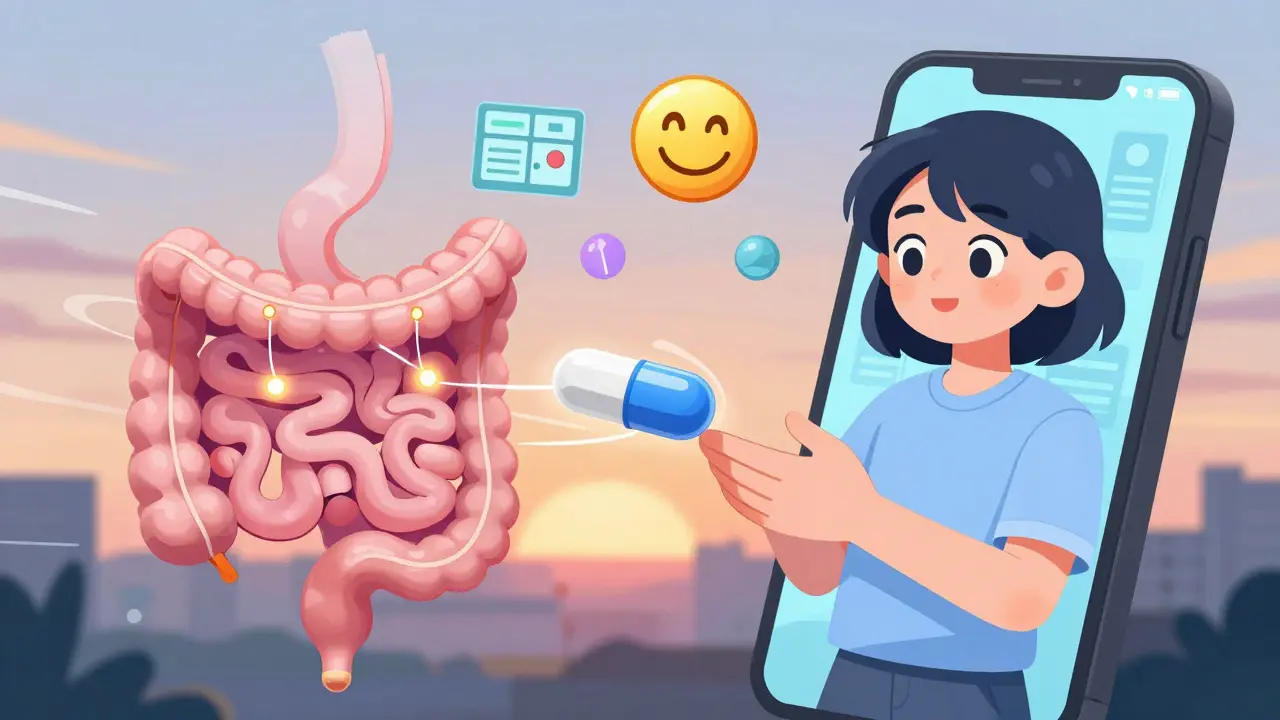
The next generation of digital pills will do more than monitor. They’ll predict. AI models will analyze your daily routine, sleep patterns, and past adherence to forecast when you’re likely to skip a dose. Some systems might even send a gentle nudge to your phone: "You usually take your pill at 8 a.m. Are you planning to today?"
Researchers are also testing pills that release drugs at specific times or locations in the gut. Imagine a diabetes pill that only releases insulin after you eat-triggered by pH changes in your stomach. That’s not fantasy. It’s already in development.
Privacy protections will need to evolve too. Right now, data is encrypted and HIPAA-compliant. But what if an employer demands access? Or an insurer denies coverage because you missed three doses last month? Laws haven’t caught up.
For now, digital pill sensors are a tool-not a cure. They don’t fix the reasons people skip meds: cost, confusion, side effects, or depression. But they do give doctors a clear window into what’s really happening. And that’s the first step toward fixing it.
Jason Yan
January 14, 2026 AT 18:03It's wild to think that the same technology that tracks your steps and heart rate is now inside your stomach, quietly reporting back to your doctor like some kind of digital spy in your digestive system. I get the benefits-adherence is a huge problem, especially with mental health meds-but it still feels like we're trading autonomy for accountability. Are we helping people, or just monitoring them more closely? There's a line between support and surveillance, and I worry we're crossing it without really talking about it. What happens when this data gets used against someone? When an insurer sees you missed a dose and decides you're 'non-compliant' and raises your rates? Or worse, when an employer finds out you're on antipsychotics because your patch flagged a skipped pill? We talk about innovation like it's inherently good, but we rarely ask who it's really serving.
shiv singh
January 16, 2026 AT 16:15People are lazy and they need to be forced to take their meds. If you can't even swallow a pill properly, you don't deserve privacy. This is life or death. Your mental illness doesn't get a pass because you're too weak to follow basic instructions. The patch is your new babysitter. Get used to it.
Sarah Triphahn
January 18, 2026 AT 10:17Let me break this down for you real simple: this isn't medicine. It's corporate control dressed up as innovation. Pharma companies love this because they can now prove they're 'helping' patients while charging $800 a month for a pill with a chip. And guess who pays? You. Your insurance. Your taxes. The sensors don't cure anything. They just give Big Pharma more data to sell. Meanwhile, real problems-like drug pricing, access, and mental health stigma-are ignored because we're all distracted by shiny tech. This isn't progress. It's performance.
Vicky Zhang
January 19, 2026 AT 23:32I have a cousin with bipolar disorder and this tech changed his life. He used to go weeks without taking anything, then crash hard. Now he gets a gentle text reminder, his doctor sees when he’s struggling, and they adjust his meds before things spiral. It’s not perfect-his skin gets irritated, and he hates the patch-but he says knowing someone’s watching gives him a reason to try. Not because he’s being controlled, but because he finally feels seen. This isn’t about surveillance. It’s about connection. And if that’s what it takes to keep someone alive, then I’m all for it.
Henry Sy
January 20, 2026 AT 03:32Okay but what if I swallow a pill and then immediately vomit it back up? Does the chip still ping? What if I just hold it in my cheek like I used to with my dad’s blood pressure meds? Does the patch get mad? This whole thing feels like a dystopian TikTok trend where your body becomes a live-streamed product. And don’t even get me started on the battery. Three days? I can’t even remember to charge my phone. Now I gotta babysit a damn microchip in my poop? I’m out.
Anna Hunger
January 20, 2026 AT 03:50While the technological advancements described are indeed remarkable, it is imperative to acknowledge the ethical and regulatory lacunae that persist in the current deployment paradigm. The conflation of ingestion data with therapeutic efficacy constitutes a fundamental epistemological error, one that risks misattributing clinical outcomes to adherence when pharmacokinetic variability, metabolic differences, or comorbidities may be the true causal factors. Furthermore, the absence of standardized protocols for data ownership, third-party access, and longitudinal storage violates core tenets of biomedical ethics. Until these issues are addressed through binding legislation-not merely corporate policy-this innovation remains a solution in search of a moral framework.
Robert Way
January 20, 2026 AT 08:10i just dont get why people are mad about this like its spy stuff its just a chip in a pill and it sends a signal to a patch what is the big deal i mean if you dont take your meds you gonna die or get worse so who cares if your doc sees it i mean i take my pills every day so i dont care but if you dont maybe you should be watched??
Allison Deming
January 22, 2026 AT 07:04The normalization of surveillance under the guise of medical care is a dangerous precedent. We are not merely treating illness; we are constructing a system where compliance is monetized and individual autonomy is redefined as noncompliance. The fact that 73% of patients cite privacy concerns should not be dismissed as technophobia-it should be treated as a red flag. When the state and pharmaceutical corporations collaborate to track bodily behavior, we are no longer patients-we are data points. And once that door is open, it never closes. The next step is mandatory monitoring for antidepressants, then statins, then prenatal vitamins. This is not medicine. This is social engineering.
Susie Deer
January 22, 2026 AT 15:30USA leads the world in medical tech so stop crying about privacy. If you can't handle a tiny chip in your poop then move to a third world country where people die from not taking their meds. This is America. We fix problems not whine about them.
TooAfraid ToSay
January 23, 2026 AT 20:02You think this is advanced? In Nigeria we have people walking 20km to get one pill. We don't need chips. We need pharmacies. We need doctors. We need clean water. This tech is for rich people who worry about being watched while they're already safe. Meanwhile, millions are dying because their meds cost more than their rent. You're not saving lives-you're making a Netflix documentary.