

Anticoagulant Timing Calculator for Spinal Procedures
Result:
Important Note: This tool is based on FDA and ASRA guidelines. Always consult with your healthcare provider for personalized medical advice. Proper timing is critical to prevent spinal epidural hematoma (SEH), which can lead to permanent paralysis.
Know the Symptoms: Severe midline back pain, numbness in legs/groin, weakness in feet/legs, and trouble urinating or having a bowel movement. Symptoms usually appear within 12 hours after procedure. Time is critical for recovery.
When you're on blood thinners and need an epidural or spinal procedure, the stakes are high. A single misstep in timing or technique can lead to a spinal epidural hematoma (SEH) - a rare but devastating complication where blood pools around the spinal cord, compressing it and potentially causing permanent paralysis. This isn't a theoretical risk. In the U.S. alone, over 40 million spinal procedures are done each year, and a significant number involve patients on anticoagulants. The question isn't whether it can happen - it's whether the right precautions are being taken.
What Exactly Is a Spinal Epidural Hematoma?
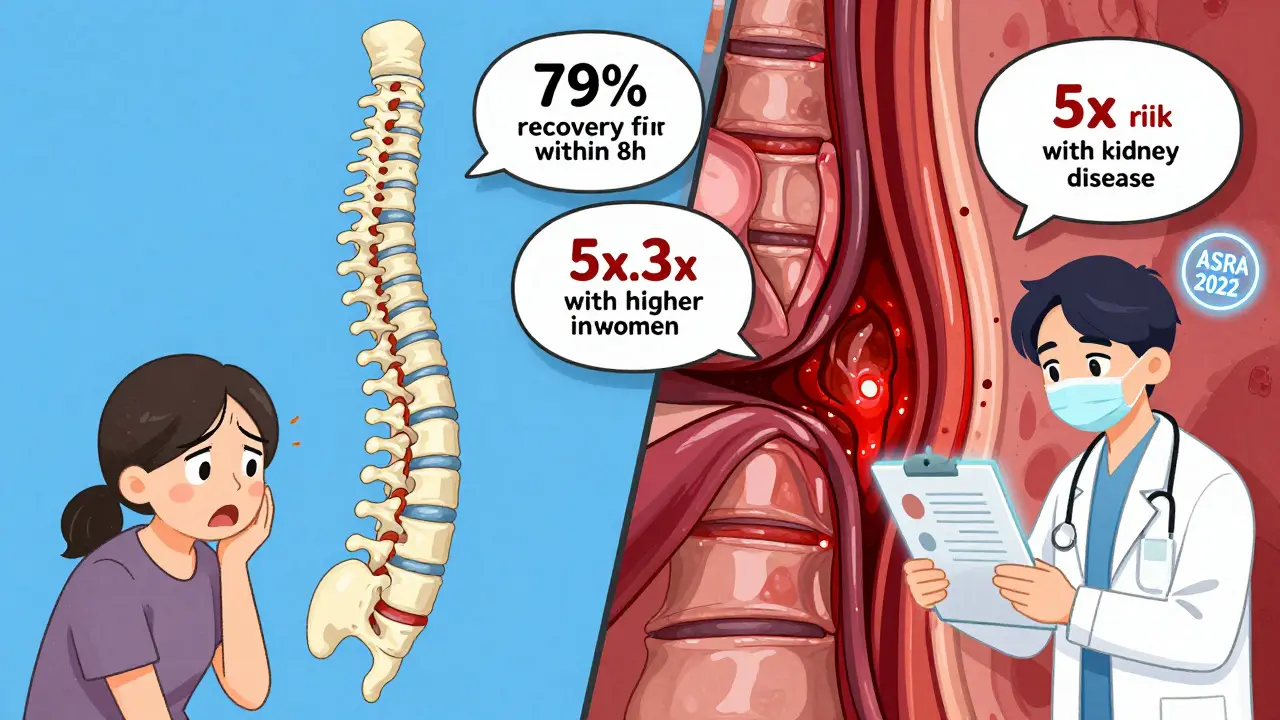
A spinal epidural hematoma happens when blood collects in the narrow space between the dura (the tough outer membrane around the spinal cord) and the ligamentum flavum (a ligament in the spine). This space is tiny - about the width of a pencil - and even a small amount of bleeding, as little as 1 to 2 milliliters, can crush the spinal cord. Symptoms come on fast: severe midline back pain, numbness in the legs or groin, weakness in the feet or legs, and trouble urinating or having a bowel movement. These signs usually appear within 12 hours after the procedure.
Time is everything. If surgery to remove the clot isn't done within 8 hours of symptom onset, the chance of full recovery drops dramatically. One study found that 79% of patients who got surgery within 8 hours regained full movement. Only 9% did if they waited more than 24 hours. Permanent paraplegia occurs in about 24% of cases. Death happens in 3 to 5% of untreated cases. This isn't a complication you can afford to ignore.
Which Blood Thinners Carry the Highest Risk?
Not all anticoagulants are created equal when it comes to spinal procedures. The risk varies widely depending on the drug, dose, and timing.
- Warfarin: This older blood thinner is tricky because its effect depends on your INR level. If your INR is above 1.4, your risk of hematoma jumps 8.7 times. Even if your INR is normal (1.0-1.4), there are documented cases of SEH - meaning normalization doesn't guarantee safety.
- Low Molecular Weight Heparin (LMWH) - like Lovenox: This is one of the most common culprits. The FDA reviewed over 170 cases tied to Lovenox between 1992 and 2013. Giving it within 8 hours before a procedure raises the risk to 0.31%. Wait 24 hours, and it drops to 0.04%.
- Direct Oral Anticoagulants (DOACs) - like Xarelto (rivaroxaban) or Eliquis (apixaban): These are newer and easier to manage, but still dangerous if timing is off. Rivaroxaban carries a 0.08% risk if stopped 48 hours before the procedure. If stopped too late, that jumps to 0.42%. Apixaban is slightly safer at 0.05% with proper timing.
- Antiplatelets - like aspirin or Plavix: Aspirin alone seems low-risk. One study of over 1,200 epidural steroid injections found zero hematomas when aspirin was continued. But dual antiplatelet therapy (aspirin + clopidogrel) increases risk 3.8 times. Many doctors now recommend stopping clopidogrel at least 7 days before a spinal procedure.
The FDA warns that all anticoagulants carry this risk. But the data shows some are far more dangerous than others - especially if used close to the time of the procedure.
What Makes Some People More at Risk?
It's not just the drug. Your body, your procedure, and how it's done all matter.
- Age: Being over 70 increases your risk by 3.7 times.
- Kidney function: If your creatinine clearance is below 30 mL/min (meaning poor kidney function), your risk jumps nearly 5 times. This is critical for DOACs, which are cleared by the kidneys.
- Spinal anatomy: Spinal stenosis (narrowing of the spinal canal) raises risk 2.8 times. The space is already tight - any extra pressure from blood can be catastrophic.
- Procedure type: A simple lumbar puncture has a 0.001% risk. A single epidural injection for pain relief is around 0.0067%. But if you're getting a spinal cord stimulator implanted or a multilevel fusion surgery? That risk climbs to 0.5-1.0%.
- Technical difficulty: If the needle has to be inserted more than three times, your risk increases 6.2 times. If the fluid that comes out is blood-tinged (a sign of trauma), risk jumps 11.8 times.
- Bleeding during surgery: Losing over a liter of blood during the procedure raises risk 5.6 times. A hemoglobin level under 10 g/dL? That's a 4.2 times higher risk.
These aren't abstract numbers. They're real factors that should be weighed before any procedure. A 75-year-old with kidney disease, on therapeutic enoxaparin, with a history of spinal stenosis - that’s a perfect storm.
Timing Rules: When to Stop and Restart Blood Thinners
Here’s the hard truth: You can’t guess. You need exact timing.
Warfarin: Check your INR within 24 hours before the procedure. Target: under 1.4. Restart 4 hours after a single injection, 6 hours after a catheter is removed.
LMWH (Lovenox, Fragmin): For prophylactic doses (low dose, once daily), stop 10-12 hours before. For therapeutic doses (higher, twice daily), stop 24 hours before. Restart 2 hours after single injection, 4 hours after catheter removal.
DOACs:
- Apixaban, Rivaroxaban: Stop 48 hours before if kidneys are normal. Stop 72 hours before if kidney function is impaired.
- Dabigatran: Stop 48 hours before normal kidney function, 72 hours if impaired.
- Edoxaban: Same as apixaban and rivaroxaban - 48 hours normal, 72 hours impaired.
These are not suggestions. They’re evidence-based cutoffs. A 2022 survey of 345 pain doctors found that only 58% knew all the correct timing rules. And 27% had experienced a near-miss because of a timing error. That’s not luck - that’s systemic risk.
Why Do Mistakes Keep Happening?
The biggest problem? Communication.
The FDA found that 34% of Lovenox-related hematoma cases involved inadequate documentation of anticoagulation status. A patient might have stopped their pill two days ago - but no one told the anesthesiologist. Or worse, the patient didn’t even know they were still at risk.
Another issue: guidelines change. The ASRA (American Society of Regional Anesthesia) has updated its recommendations five times since 2003. Many clinics still use outdated protocols. A 2021 study found that 17% of digital decision tools - apps doctors rely on - had wrong or outdated advice.
And then there’s the human factor. A nurse forgets to flag the patient’s anticoagulant. A surgeon assumes the patient stopped their pills. A patient says, “I took my pill this morning - it’s just aspirin.” But it’s actually clopidogrel. These aren’t rare errors. They’re common.
What’s New in 2025?
Things are changing fast.
In 2023, the FDA mandated a Risk Evaluation and Mitigation Strategy (REMS) for all anticoagulants. That means prescribers must complete training on neuraxial risks before they can prescribe. Hospitals are now required to report SEH incidents.
Starting January 2025, U.S. hospitals performing more than 50 spinal procedures a year must report SEH prevention metrics to the Agency for Healthcare Research and Quality. That’s a big shift - from optional best practice to mandatory safety standard.
Research is also moving forward. A 2022 study found that a blood biomarker called GFAP (glial fibrillary acidic protein) can detect an impending hematoma within 2 hours of a procedure - with 94% accuracy. That could change everything. Instead of waiting for symptoms, we might be able to catch bleeding before it causes damage.
And controversial new data from Europe suggests women may be at 2.3 times higher risk than men, even with the same drugs and doses. This could explain why 60% of SEH cases occur in women - a pattern noticed since the 1990s but never fully understood.
What Should You Do?
If you're on blood thinners and scheduled for an epidural or spinal procedure:
- Bring a full list of every medication - including over-the-counter pills like aspirin or fish oil.
- Ask: “What’s my exact risk based on my drug, dose, and health?”
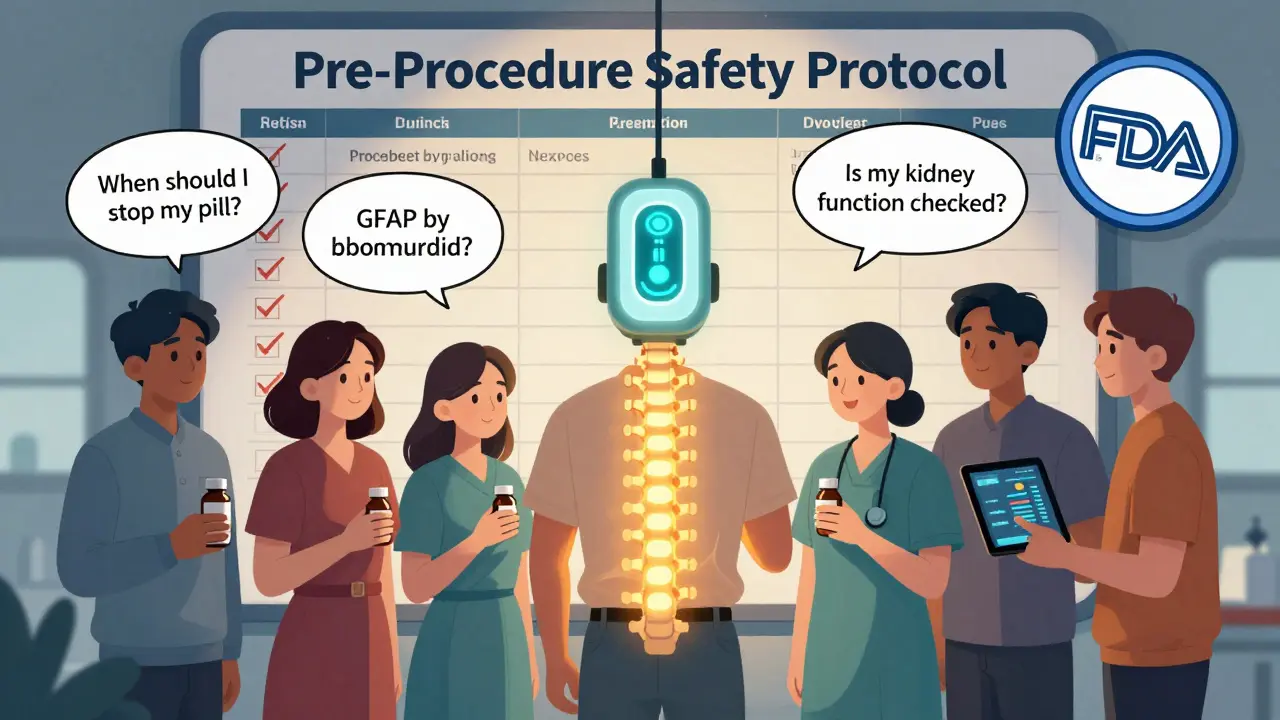
- Confirm the timing: When should you stop? When can you restart? Get it in writing.
- Ask if the facility uses the latest ASRA guidelines (2022 or later).
- Know the symptoms: back pain, leg weakness, trouble peeing. If they happen, tell someone immediately.
If you're a provider: Use checklists. Use apps that auto-update. Document everything. Never assume. Always verify.
Spinal epidural hematomas are rare - but they’re preventable. And when they happen, they’re often avoidable. The difference between paralysis and recovery often comes down to one question: Was the right protocol followed?
Sally Lloyd
March 16, 2026 AT 10:24Emma Deasy
March 16, 2026 AT 19:51tamilan Nadar
March 17, 2026 AT 18:35Adam M
March 18, 2026 AT 08:44Rosemary Chude-Sokei
March 19, 2026 AT 04:47Noluthando Devour Mamabolo
March 19, 2026 AT 14:57Lorna Brown
March 21, 2026 AT 00:37Rex Regum
March 22, 2026 AT 04:47Kelsey Vonk
March 22, 2026 AT 11:32Emma Nicolls
March 22, 2026 AT 15:35Jimmy V
March 22, 2026 AT 15:48Richard Harris
March 22, 2026 AT 20:47