
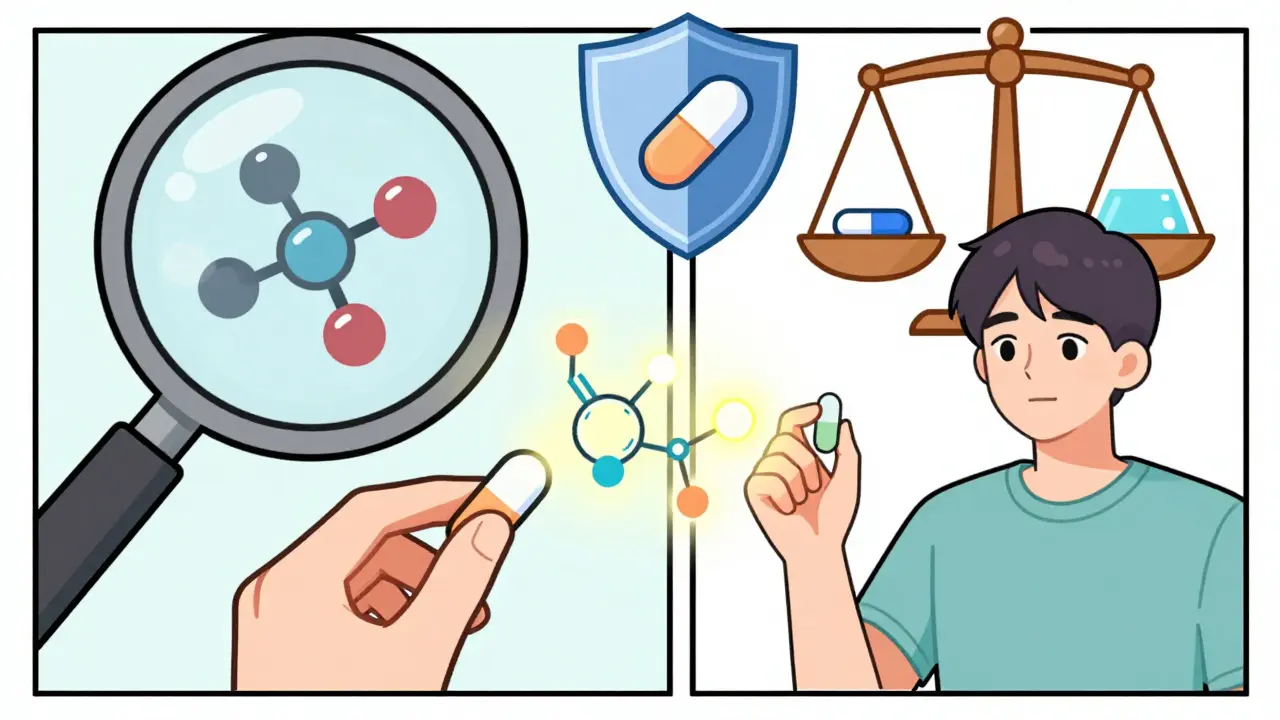
When you pick up a generic prescription at the pharmacy, you’re not getting a cheaper version of a drug-you’re getting the same drug, just without the brand name. But how does the FDA make sure it’s truly the same? The answer lies in a tightly controlled system built on three non-negotiable pillars: safety, quality, and strength. These aren’t vague ideals. They’re measurable, science-backed requirements that every generic drug must pass before it hits the shelf.
What Makes a Generic Drug the Same as the Brand?
The FDA doesn’t approve generics based on trust or cost savings. It requires proof. Every generic drug must contain the exact same active ingredient as the brand-name version, in the same strength, and delivered the same way-whether it’s a pill, injection, or inhaler. That’s the baseline. But that’s not enough. A pill that looks identical and has the same chemical formula can still behave differently in your body. That’s why bioequivalence is the heart of the approval process.
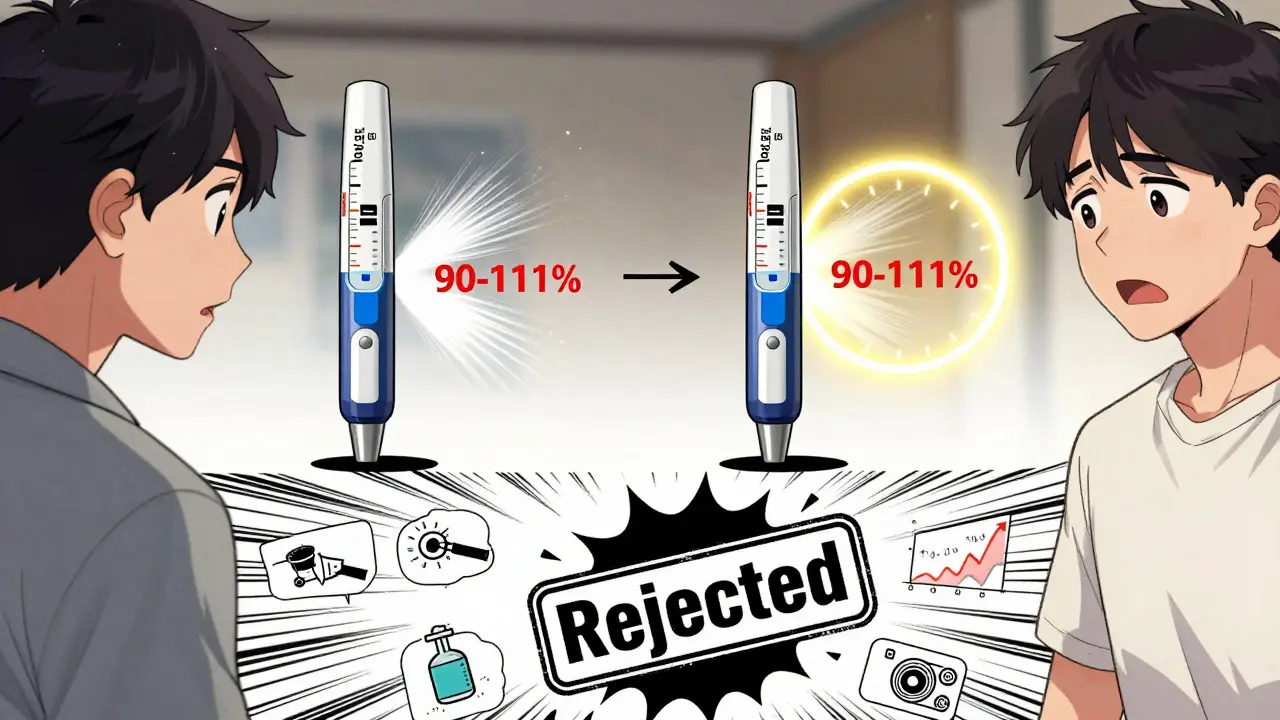
Bioequivalence means the generic drug enters your bloodstream at the same rate and to the same extent as the brand-name drug. The FDA uses blood tests in healthy volunteers to measure this. For most pills, the generic’s absorption must fall between 80% and 125% of the brand’s. That might sound like a wide range, but it’s based on decades of clinical data showing that within this window, there’s no meaningful difference in how the drug works in patients. For drugs with a narrow therapeutic index-like warfarin or levothyroxine-the range tightens to 90%-111% or even 95%-105%. These stricter limits exist because tiny changes in blood levels can cause serious side effects or make the drug ineffective.
Quality Isn’t Just About Ingredients-It’s About Consistency
Quality means more than just having the right chemical. It means every batch of pills you buy, whether it’s made today or six months from now, must perform the same way. This is where manufacturing standards come in. The FDA requires all generic drug factories to follow Current Good Manufacturing Practices (cGMP), which are the same rules brand-name companies must follow. These rules cover everything from the cleanliness of the facility to how ingredients are mixed, how tablets are pressed, and how finished products are tested before release.
The FDA doesn’t just take companies’ word for it. Each generic drug application triggers a pre-approval inspection of the manufacturing site. In 2022, the FDA conducted over 1,200 of these inspections. If inspectors find issues-like inconsistent tablet hardness, poor labeling, or uncontrolled contamination-the application gets a Complete Response Letter. That means approval is delayed until the problems are fixed and re-inspected. In 2021, Hetero Labs had its generic version of Jardiance rejected because tablet hardness varied too much across production batches. That’s not a minor oversight. It’s a failure to control a critical quality attribute.
Manufacturers must also prove their process is stable and repeatable. The FDA expects data from at least three consecutive commercial-scale batches showing consistent results. This isn’t a one-time test. It’s an ongoing commitment. If a company changes its manufacturing process later, even slightly, it must revalidate everything and notify the FDA.
Strength and Stability: No Room for Guesswork
Strength isn’t just about how much active ingredient is in the pill. It’s about how much stays in the pill over time. A drug that loses potency before its expiration date isn’t just less effective-it’s unsafe. That’s why stability testing is mandatory. Generic drug makers must store samples under real-world conditions-heat, humidity, light-and test them at intervals over months or years to prove the drug won’t break down too fast.
The FDA requires that the generic drug’s shelf life matches or exceeds the brand’s. If the brand lasts three years, the generic must prove it lasts at least three years too. This isn’t theoretical. In 2020, the FDA pulled a batch of generic metformin because it contained a cancer-causing impurity that formed over time. That’s why stability testing isn’t just paperwork-it’s a public health safeguard.

Why Do So Many Generic Applications Get Rejected?
It’s not because the standards are too low. It’s because they’re too high. While brand-name drugs go through full clinical trials, generics skip that step by relying on the brand’s safety data. But that doesn’t mean the approval process is easy. In fact, less than 10% of generic applications get approved on the first try. Why? Because the technical details are brutal.
For simple pills, the process is straightforward. But for complex products-like inhalers, topical creams, or extended-release tablets-it’s a different story. The FDA approved only 3 out of 27 generic EpiPen applications between 2015 and 2020. Why? Because the device isn’t just a needle-it’s a precise delivery system. The spray pattern, the force of the dose, the timing-all must match the original. Even a tiny difference in the propellant or valve can change how much medicine reaches the lungs.
Complex generics take longer, cost more, and fail more often. The average approval time for a simple generic is 28.5 months. For a complex one? 47.2 months. And the cost? While a standard generic might cost $1.3 million to develop, a complex one can hit $25 million. That’s why only a handful of companies have the expertise to tackle them.
How the FDA Ensures Ongoing Safety After Approval
Approval isn’t the end. The FDA keeps watching. Once a generic drug is on the market, it’s monitored just like any other medication. Doctors and patients report side effects through the FDA’s MedWatch system. If a pattern emerges-say, more patients on a certain generic report dizziness or nausea-the FDA investigates. Has the formula changed? Is there a new impurity? Is the manufacturing process slipping?
Post-market data is reassuring. A 2021 report from the American Medical Association reviewed 15 years of real-world use and found that 98.7% of therapeutic categories showed no clinically meaningful difference between generics and brand-name drugs. That’s not luck. It’s the result of strict standards enforced at every stage.
What This Means for Patients
If you’re taking a generic drug, you’re not sacrificing safety or effectiveness. You’re getting the same medicine your doctor prescribed, at a fraction of the cost. In 2023, generics made up 90% of all prescriptions in the U.S. but only 23% of total drug spending. That’s over $370 billion saved in a single year. Those savings come from competition-not from cutting corners.
The system works because it’s built on science, not speculation. The FDA doesn’t approve generics because they’re cheap. It approves them because they’ve proven they’re just as safe, just as strong, and just as reliable as the brand. And that’s why millions of people trust them every day.
What’s Changing in 2025?
The FDA is pushing to improve approval times for complex generics. Its 2023 plan aims to get half of these harder-to-make drugs approved within two review cycles by 2027-up from just 28% today. That’s good news for patients who need affordable versions of expensive biologics and specialty injectables. The agency is also updating its guidance for topical products, inhalers, and modified-release formulations to reflect new science and manufacturing tech.
But the core standards haven’t changed. Safety, quality, strength-they’re still the foundation. And they always will be.
Virginia Seitz
December 16, 2025 AT 20:44generics saved my life 💊❤️ no way I could afford my thyroid med without them. same pill, way cheaper. 🙌
Salome Perez
December 18, 2025 AT 15:07The FDA’s approach to generic drug approval is one of the most rigorously science-based regulatory frameworks in the world. Every bioequivalence threshold, every cGMP inspection, every stability study is designed not for bureaucratic box-checking, but to ensure that a patient in rural Alabama receives the same therapeutic outcome as a patient in Manhattan. This isn’t just policy-it’s public health integrity in action.
Chris Van Horn
December 19, 2025 AT 16:19Let’s be clear: the FDA’s ‘80–125% bioequivalence window’ is a dangerous illusion. It’s not ‘science-backed’-it’s a politically expedient compromise. A 25% variance in absorption? That’s not ‘clinically insignificant’-it’s a pharmacokinetic roulette wheel. And don’t get me started on the manufacturing inspections-half of those facilities are in India and China, where ‘cGMP’ is a suggestion, not a standard. This system is built on trust, not data.
And yet, somehow, we’re supposed to believe that a pill made in a factory with no visible QA logs is identical to one made by Pfizer? Please. The 98.7% success rate? That’s cherry-picked. What about the outliers? The patients who had seizures on generic levothyroxine? The ones who developed rashes on generic metformin? They don’t make the annual report. They just disappear into the ER.
And let’s not forget: the FDA approves generics based on the brand’s original clinical trials-trials that were done 20 years ago on a population that no longer exists. We’re prescribing modern generics based on 1998 data. That’s not innovation. That’s institutional stagnation.
And then there’s the cost argument. ‘Generics saved $370 billion!’ Sure. But who paid the price? The patients who got subpar formulations. The pharmacists who had to explain why the new pill made their grandma dizzy. The doctors who lost trust because the system failed. This isn’t a victory. It’s a quiet catastrophe masked as efficiency.
The FDA isn’t protecting patients. It’s protecting the pharmaceutical industry’s profit margins by pretending that a pill is just a pill. It’s not. It’s a complex system of excipients, coatings, dissolution profiles, and manufacturing tolerances-and we’re treating it like a commodity.
And don’t even mention ‘complex generics.’ The fact that EpiPen alternatives took five years and 24 rejections to get approved proves the system is broken. It’s not ‘too high’-it’s too slow, too opaque, and too easily gamed by corporations with deep pockets.
Real safety isn’t measured in percentages. It’s measured in outcomes. And the outcomes? We’re flying blind.
Evelyn Vélez Mejía
December 19, 2025 AT 17:50There’s a philosophical tension here that goes unnoticed: the FDA treats generic drugs as identical, yet their approval process demands proof of difference-bioequivalence, stability, manufacturing variance. This is the paradox of sameness. We demand that the generic be indistinguishable, yet we must quantify every possible deviation to prove it. The system is not merely regulatory-it’s epistemological. It asks: How do we know two things are the same when they are, by definition, not the same object? The answer lies not in chemistry, but in function. And function, in medicine, is measured in human bodies. That’s why the data matters. That’s why the inspections matter. That’s why the 25% absorption range isn’t a loophole-it’s a boundary drawn by decades of empirical observation. We don’t know what ‘sameness’ is. But we know what works.
Victoria Rogers
December 20, 2025 AT 05:45USA made the best drugs. China and India are just copying. FDA lets them in because they’re cheap. Bad move. Our kids are getting foreign pills. No wonder people get sick.
Meghan O'Shaughnessy
December 20, 2025 AT 19:10I’ve been on generic statins for 8 years. No issues. My cholesterol’s stable. My doctor says it’s fine. So I’m not worried.
Patrick A. Ck. Trip
December 21, 2025 AT 05:05The rigor of the FDA’s generic approval process is often underappreciated. While critics focus on cost savings, the real achievement is the consistency of therapeutic outcomes across millions of patients-regardless of income, geography, or insurance status. This system, flawed as it may be in execution, remains one of the most equitable mechanisms in modern healthcare. It doesn’t just lower prices-it lowers barriers to essential medicine.
Sam Clark
December 21, 2025 AT 07:58This is a masterclass in how regulation can work when grounded in science and transparency. The fact that the FDA requires three consecutive commercial batches to demonstrate consistency? That’s not red tape-that’s responsibility. And the post-market surveillance? That’s accountability in motion. We need more systems like this, not fewer.
Nishant Desae
December 21, 2025 AT 21:11As someone who grew up in a country where generic medicines were often unreliable, seeing how the FDA handles this is nothing short of inspiring. The level of detail-bioequivalence windows, stability testing under real-world conditions, pre-approval inspections-it’s not just about safety, it’s about dignity. Every pill you take should feel like it was made with the same care as if it were for your own family. And in the U.S., for generics, it often is. I’ve seen what happens when you cut corners. This isn’t perfect, but it’s the closest thing to a moral standard in pharmaceuticals I’ve ever seen.
And yes, complex generics take longer. But that’s because they’re harder. An inhaler isn’t just a canister-it’s a precision instrument. A delayed-release tablet isn’t just a pill-it’s a timed-release mechanism. These aren’t simple substitutions. They’re engineering challenges. And the fact that the FDA doesn’t rush them? That’s not bureaucracy. That’s integrity.
When I hear people say ‘just let them import cheaper pills from anywhere,’ I think of my cousin in Mumbai who died because the generic he took had too little active ingredient. That’s the cost of cutting corners. The FDA’s system, as slow and expensive as it seems, prevents that. It’s not perfect, but it’s the best we’ve got.
And yes, I know the numbers: 90% of prescriptions, 23% of spending. That’s not a statistic. That’s millions of people who can afford to live because of this system. That’s not a flaw. That’s a triumph.
Kaylee Esdale
December 22, 2025 AT 17:20generic works. no drama. just takes the edge off. i dont care if its blue or white. as long as it dont make me puke.
Jody Patrick
December 24, 2025 AT 14:21USA first. Buy American meds.
Erik J
December 26, 2025 AT 00:42I wonder how many of these bioequivalence studies are done on young, healthy volunteers-and how that translates to elderly patients with multiple comorbidities. The data might be statistically sound, but is it clinically universal?
BETH VON KAUFFMANN
December 26, 2025 AT 06:01Let’s not romanticize the FDA’s process. The 80–125% bioequivalence window is a regulatory fiction designed to appease industry lobbying. The ‘three-batch’ stability requirement? Often met with cherry-picked data. And the inspections? Over 1,200 in 2022? That’s less than one per facility per year for the thousands of global plants. It’s theater. The real gatekeepers are the contract research organizations that do the bioequivalence testing-many of which are owned by the same conglomerates that manufacture the generics. Conflict of interest? Please. It’s a closed loop.
And don’t even get me started on the ‘98.7% success rate.’ That’s a meta-study that excludes adverse event reports from MedWatch unless they’re statistically significant. Meanwhile, patients report ‘different effects’ in forums every day. Anecdotal? Maybe. But when 3% of 3 billion prescriptions equals 90 million people-those aren’t outliers. They’re a population.
This isn’t science. It’s a carefully constructed illusion of safety.
Martin Spedding
December 27, 2025 AT 15:07Generic drugs? More like generic disasters. I’ve seen people crash on them. FDA’s just playing with lives.