
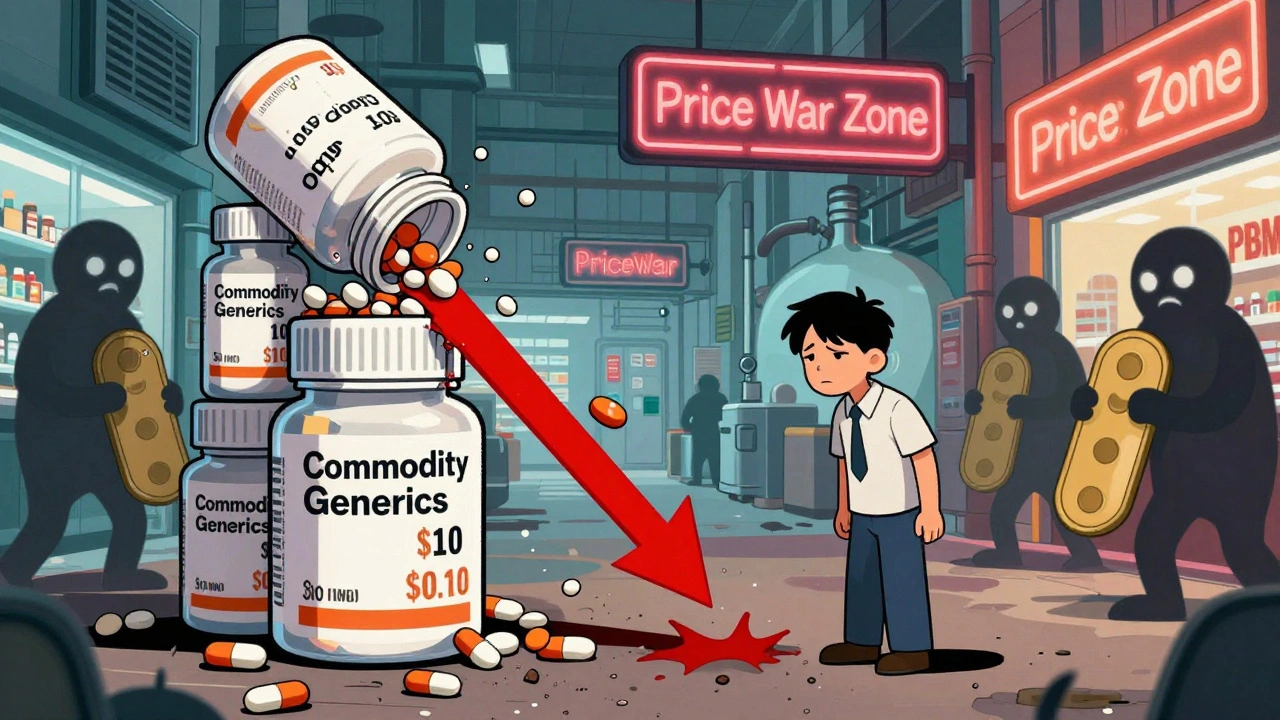
Generic drugs make up 90% of all prescriptions filled in the U.S., but they only cost 10% of what brand-name drugs do. That’s a win for patients - but a nightmare for manufacturers. How can a company stay in business when the price of a simple pill drops from $10 to $0.10 overnight? The answer isn’t simple, and it’s changing fast.
The Profitability Crisis in Generic Drugs
Generic drug makers aren’t making money like they used to. In 2025, Teva, one of the biggest players, lost $174.6 million. That’s not a glitch - it’s the new normal for many companies stuck in the commodity generics game. These are the old-school, easy-to-make pills: antibiotics, blood pressure meds, cholesterol drugs. Once the patent expires, ten other companies jump in. Prices crash. Margins shrink. Some companies now operate with gross margins under 30%, down from 50-60% just a decade ago.
Why does this happen? It’s the PBM system - pharmacy benefit managers - that drive prices down. They negotiate bulk deals with distributors, forcing manufacturers to compete on price alone. And with over 16,000 generic drugs on the market, there’s no shortage of suppliers. The FDA approved hundreds of new generic applications in 2022 alone, saving the U.S. healthcare system $18.9 billion that year. But those savings aren’t trickling down to the manufacturers.
And it’s not just about price. Getting a generic drug approved costs $2.6 million per application. Building a facility that meets FDA’s cGMP standards? That’s over $100 million. Most new entrants fail within two years. McKinsey found that over 65% of companies focusing only on basic generics don’t survive. The barrier to entry isn’t just money - it’s time, expertise, and endurance.
Three Paths to Survival
Not all generic manufacturers are failing. Some are thriving - not by playing the same game, but by changing it. Three business models are emerging as winners:
- Commodity generics: High volume, ultra-low margin. This model is dying. Companies clinging to it are bleeding cash.
- Complex generics: These are harder to copy. Think inhalers, injectables, topical gels, or drugs with tricky release profiles. Fewer companies can make them. That means less competition. And higher prices. Lenalidomide for multiple myeloma, for example, is a complex generic that now brings Teva real profits.
- Contract manufacturing (CMOs): Instead of selling their own brands, these companies make drugs for others. Brand-name companies outsource production to avoid building expensive facilities. Generic companies become suppliers. This segment is growing at nearly 10% a year and will hit $91 billion by 2030.
Teva shifted from pure commodity to complex generics and biosimilars. They raised R&D spending to $998 million in 2024. Viatris, formed from the Mylan-Upjohn merger, did the opposite: they sold off their biosimilars unit, their OTC brand, and their active ingredient business. They focused on what they could control - stable, profitable generics with reliable demand.
Why Complexity Wins
Complex generics aren’t just harder to make - they’re harder to copy. Take an inhaler: it’s not just the drug. It’s the propellant, the valve, the canister, the particle size. Getting all that right takes years of R&D and specialized equipment. The FDA requires extra testing. Fewer companies bother. That’s the sweet spot.
Look at Austedo XR - a delayed-release tablet for movement disorders. It’s a complex formulation. Only a handful of manufacturers can produce it. That means pricing power. Teva’s revenue from specialty generics grew 4% in 2024, even as their traditional lines shrank.
Complex doesn’t mean expensive for patients. It means expensive for competitors. That’s the advantage. And it’s not just pills. Transdermal patches, nasal sprays, implantable devices - all these are now battlegrounds for profitable generics.

The Contract Manufacturing Boom
Why make your own brand if you can make someone else’s? Contract manufacturing is the quiet winner of the generic industry. Companies like Egis Pharmaceuticals launched dedicated services in 2023 to produce APIs and finished drugs for global clients. No marketing. No sales force. Just manufacturing excellence.
This model has lower risk. You don’t need to fight for formulary placement. You don’t get hit by price wars. You get paid per unit. And with global demand rising - especially in Europe and Asia - the contracts are stacking up. A CMO in India or Hungary can produce a generic antibiotic at half the cost of a U.S. plant and still make a decent profit.
Even big players like Teva and Viatris now rely on CMOs for parts of their supply chain. The line between generic manufacturer and contract producer is blurring. The future belongs to those who can produce reliably, at scale, and under strict regulatory standards - regardless of whose name is on the label.
Regional Differences Matter
Profitability isn’t the same everywhere. In the U.S., PBMs crush prices. In Europe, governments set reimbursement rates - but they’re often higher. In Germany or France, a generic drug might still earn a 40% margin. In India and China, production costs are low, but regulatory hurdles and currency risks make it risky. Emerging markets offer growth, but they’re not quick wins.
North America still leads in contract manufacturing revenue - but it’s also the most pressured. Companies that succeed here are the ones who’ve moved beyond volume. They’re building technical expertise, not just production lines.

The Sustainability Question
Can generic manufacturing be sustainable? The answer isn’t yes or no - it’s “it depends.” If you’re making aspirin or metformin in bulk, probably not. But if you’re building a complex delivery system, or running a high-quality contract facility - absolutely.
The bigger issue? Supply shortages. When a drug becomes unprofitable, companies stop making it. That’s happened with antibiotics, chemotherapy agents, and even basic IV fluids. Dr. Aaron Kesselheim at Harvard calls it a market failure. Patients need these drugs. But no company can afford to produce them.
Some experts say the solution is policy change. Banning “pay-for-delay” deals - where brand companies pay generics to stay off the market - could save $45 billion over ten years. That would open up competition and give manufacturers a fighting chance.
Others point to the pipeline. Dozens of blockbuster drugs - like Humira and Enbrel - will lose patent protection between 2025 and 2033. That’s over $600 billion in potential generic sales on the horizon. The question is: will manufacturers be ready?
What’s Next for Generic Manufacturers
The companies that survive will be the ones who stop competing on price and start competing on capability. That means:
- Investing in formulation science, not just production lines
- Building partnerships with CMOs instead of fighting them
- Targeting complex, niche generics with fewer competitors
- Expanding into global markets where margins are better
- Using data to predict which patents will expire next - and getting ahead of the rush
The era of the generic drug maker as a low-margin commodity supplier is over. The new winners are engineers, scientists, and supply chain experts who understand that sustainability isn’t about selling more pills - it’s about selling better, harder-to-copy products. The patients win. The system wins. And if manufacturers adapt, they’ll win too.
Why are generic drug profits falling so fast?
Generic drug profits are falling because of intense competition after patent expiration. When a brand-name drug loses exclusivity, dozens of manufacturers enter the market, driving prices down. Pharmacy benefit managers (PBMs) then negotiate bulk discounts, squeezing margins even further. Manufacturing costs remain high - FDA approvals cost $2.6 million per drug, and facilities need $100 million+ to meet compliance standards. With gross margins now below 30% for many products, many companies can’t cover costs.
What’s the difference between commodity and complex generics?
Commodity generics are simple, off-patent pills like metformin or amoxicillin that are easy to copy. Hundreds of companies make them, prices are razor-thin, and margins are often under 20%. Complex generics involve difficult formulations - like inhalers, injectables, or extended-release tablets - that require specialized equipment, advanced R&D, and extra FDA testing. Fewer companies can make them, so competition is lower, and margins can reach 40-50%.
Is contract manufacturing a good option for generic companies?
Yes - and it’s one of the fastest-growing parts of the industry. Contract manufacturing organizations (CMOs) produce drugs for brand-name and generic companies without needing to market them. This reduces risk, avoids price wars, and provides steady revenue. The global CMO market is projected to grow from $56.5 billion in 2025 to $91 billion by 2030. Companies like Egis and Teva are expanding into this space because it’s more predictable and profitable than selling under their own brand.
Why do some generic drugs keep going out of stock?
When a generic drug becomes unprofitable - often because of price wars or low demand - manufacturers stop making it. This is especially common with older, low-margin drugs like antibiotics or IV fluids. Even if the drug is essential, no company will lose money to produce it. The FDA reports over 200 drug shortages in 2024, many tied to generic manufacturers exiting the market. The solution isn’t more competition - it’s better pricing models and incentives for essential products.
Will the next wave of patent expirations help generic makers?
Potentially - but only for companies ready for it. Dozens of top-selling drugs, including Humira and Enbrel, will lose patent protection between 2025 and 2033. That’s over $600 billion in potential generic sales. But if manufacturers are still stuck making basic pills, they’ll be crushed again. The winners will be those who’ve built expertise in complex formulations, biosimilars, and contract manufacturing. Timing matters - getting approval early and scaling fast is key.
nina nakamura
December 12, 2025 AT 21:11Let’s be real-this whole system is rigged. PBMs are the real villains, not manufacturers. They’re the middlemen sucking the life out of every dollar while claiming to save patients. The FDA approves generics like it’s a production line, but the moment a drug becomes profitable, the PBM forces another 12 competitors in. It’s not capitalism-it’s a cartel disguised as competition.
Hamza Laassili
December 14, 2025 AT 00:54U.S. is gettin crushed by this!! Why are we lettin India and China make ALL our meds?? We built the FDA, we invented pharma, now we’re beggin’ for pills from overseas?? This ain’t free market-this is national security risk!!
Casey Mellish
December 14, 2025 AT 12:28Interesting read, but I think we’re missing the global picture. In Australia, we’ve got the PBS-Pharmaceutical Benefits Scheme-which negotiates prices but still ensures manufacturers stay profitable. It’s not perfect, but it stops the race-to-the-bottom. Maybe the U.S. needs a public negotiation body instead of letting PBMs run wild. We’ve got the model right here in the Southern Hemisphere.
Tyrone Marshall
December 14, 2025 AT 21:10There’s a quiet truth here: the system isn’t broken-it’s working exactly as designed. Profit isn’t the goal anymore. Access is. But we’re punishing the people who make it possible. The real innovation isn’t in the pill-it’s in rethinking who gets to profit from health. Maybe we need to treat essential medicines like public infrastructure-like roads or water. Not commodities. Not stocks. Life-saving tools.
Emily Haworth
December 16, 2025 AT 09:23POV: PBMs are secretly owned by Big Pharma to keep generics from competing 😳 They’re paying them to let the patents expire just enough to look fair… but then they buy up the CMOs and control the supply chain… it’s all connected… 🤯 #DeepStatePharma
Himmat Singh
December 17, 2025 AT 11:51It is a matter of considerable concern that the prevailing economic paradigm within the pharmaceutical supply chain has resulted in the erosion of manufacturing viability. The commoditization of essential medicinal compounds, whilst beneficial to consumers, undermines the capacity for sustained innovation and infrastructural investment. A structural recalibration is imperative.
Webster Bull
December 18, 2025 AT 19:09Stop making pills. Start making solutions.
Complex = profit.
Simple = suicide.
CMO = survival.
It’s not hard. Just stop being lazy.
Donna Hammond
December 20, 2025 AT 13:12My dad’s on 12 meds-half are generics. Last year, his blood pressure pill vanished from the shelf for 3 months. No warning. No backup. He had to switch brands and his BP spiked. This isn’t about profits-it’s about people. We need a strategic reserve for essential generics. Like the government does for oil. We can’t let the market decide who lives and who doesn’t.
Karen Mccullouch
December 21, 2025 AT 11:29THIS IS WHY WE NEED TO BAN FOREIGN MANUFACTURING. EVERY SINGLE SHORTAGE? CHINA’S FAULT. THEY CONTROL THE APIs. THEY CONTROL THE FUTURE. WE’RE ALL JUST DRUG ADDICTS NOW, TRADING OUR FREEDOM FOR PILL SUPPLY. #MAKEAMERICAGENERICAGAIN 🇺🇸
Shelby Ume
December 22, 2025 AT 22:23It’s fascinating how the industry is evolving, yet the conversation remains so narrowly focused on profit margins. What if we reframed success not by revenue per unit, but by therapeutic continuity? A patient who gets their insulin every month without interruption is a victory, regardless of whether the manufacturer made 10% or 40%. Perhaps sustainability should be measured in human outcomes, not balance sheets.
nithin Kuntumadugu
December 24, 2025 AT 08:02Bro… u think this is bad? 😭 imagine trying to get a CMO to make your drug when the FDA says ‘oh btw your stability data is sus’ after 2 years of work… and then your investor bails… and then your factory gets audited for ‘microbial contamination’… and then your CFO says ‘just make it in Bangladesh’… i cried in my lab coat. 🤡