

Parasitic infections might sound like something from the past, but they’re still very real today - even in places with clean water and modern medicine. Two of the most common ones are giardia and pinworms. They don’t always make headlines, but they cause real discomfort, disrupt daily life, and can linger if not handled correctly. Whether you’re dealing with chronic diarrhea, nighttime itching, or just wondering why your kid keeps scratching their bottom, understanding these infections is the first step to fixing them.
What Is Giardia and How Do You Get It?
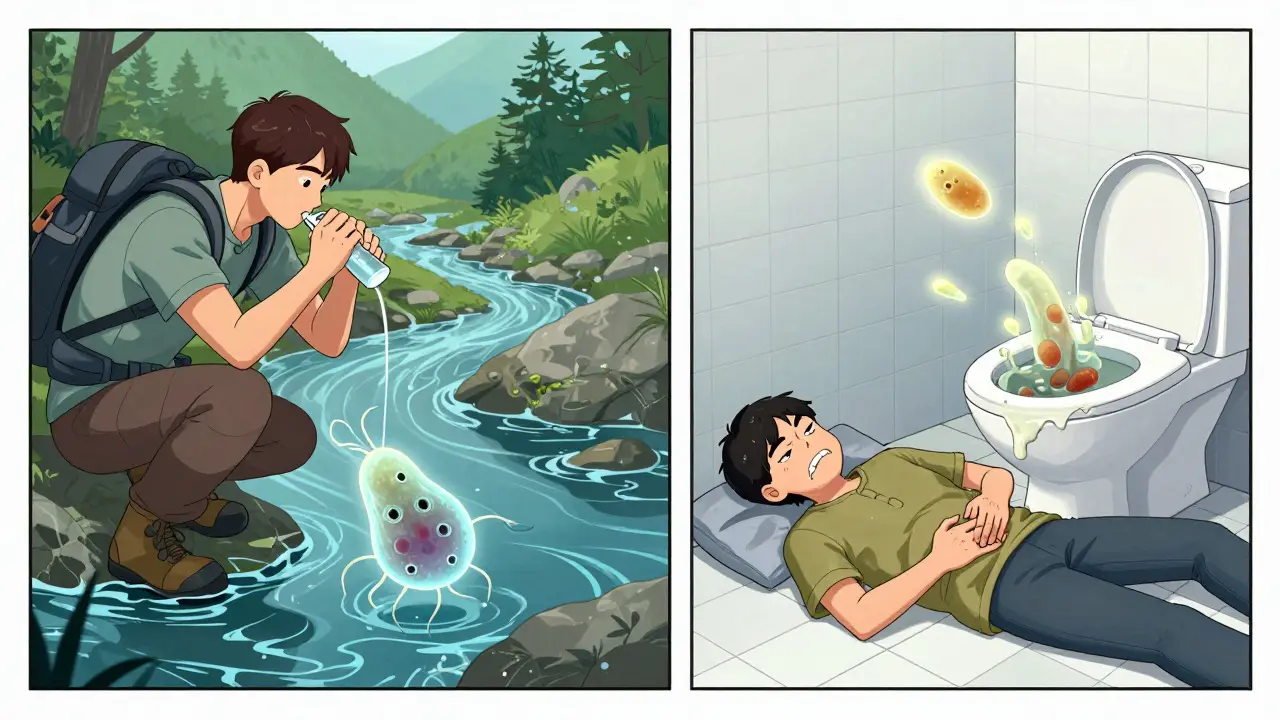
Giardia is a tiny parasite, Giardia lamblia, that lives in the small intestine. It’s not a worm - it’s a single-celled organism shaped like a pear with tiny flagella that help it swim. You can’t see it without a microscope, but its effects are unmistakable. The parasite exists in two forms: the active trophozoite (which causes symptoms) and the tough cyst form (which survives outside the body).
You catch giardia by swallowing something contaminated with feces - usually water, but sometimes food or surfaces. The cysts are incredibly hardy. They survive for months in cold water, even in swimming pools and streams. Boiling water for one minute kills them. Regular chlorine bleach? Not enough. That’s why outbreaks happen after heavy rain, flooding, or in places where water treatment isn’t perfect. Hikers, campers, and travelers to developing countries are at higher risk, but even in cities like Toronto or Chicago, outbreaks happen from contaminated municipal water or daycare centers.
It only takes 10 to 25 cysts to infect someone. The incubation period is usually around 7 days, but it can range from 1 to 14. Once inside, the cysts hatch, and the parasites attach to the lining of your small intestine. They don’t invade deeply, but they mess up the surface - shortening the tiny finger-like projections (microvilli) that help absorb nutrients. That’s why diarrhea, bloating, and weight loss are common.
What Are the Symptoms of Giardia?
Not everyone with giardia feels sick. About 1 in 3 people show no symptoms at all. But for those who do, the classic signs are:
- Watery, greasy, foul-smelling diarrhea
- Bloating and gas
- Stomach cramps
- Nausea
- Fatigue
- Weight loss
- Mild fever (rare)
Symptoms usually last 1 to 3 weeks, but in some cases, they drag on for months. Chronic giardia can lead to malabsorption - your body can’t absorb fats, vitamins, or lactose properly. That’s why some people develop lactose intolerance after an infection, even if they never had issues before.
Diagnosis used to rely on looking at stool samples under a microscope, but that’s outdated. The CDC now recommends stool antigen tests, which detect parasite proteins. These are 95% accurate - far better than the old 70% sensitivity of microscopy. If you’ve had diarrhea for more than a week and haven’t improved, ask your doctor about testing.
How Is Giardia Treated?
Thankfully, giardia responds well to medication. The most common treatments are:
- Metronidazole: 250 mg three times a day for 5 to 7 days. This is the go-to in most places. But it has side effects - a strong metallic taste (reported by 78% of users), nausea, and sometimes dizziness. Avoid alcohol while taking it - it can cause severe reactions.
- Tinidazole: A single 2-gram dose. Just one pill. It’s as effective as metronidazole but with fewer side effects. Not always available everywhere, but worth asking for.
- Nitazoxanide: 500 mg twice daily for 3 days. Approved for kids as young as 1 year. Good option if you can’t tolerate the other two.
Cure rates are 80-95% with proper dosing. But reinfection is common. If symptoms come back, it’s often because you didn’t fully clean your environment or got re-exposed. The CDC recommends avoiding childcare, food handling, or swimming pools for at least 2 weeks after symptoms stop.
What Are Pinworms?
Pinworms - or Enterobius vermicularis - are tiny, white, thread-like worms about 1 cm long. They live in the colon and rectum. Unlike giardia, they don’t cause diarrhea. Their main trick? They crawl out at night.
The female pinworm leaves the intestine through the anus and lays thousands of eggs on the skin around the anal area. This happens mostly between midnight and 5 a.m. The eggs are sticky, invisible to the naked eye, and can survive for 2 to 3 weeks on clothing, bedding, toys, or even in dust. The itching they cause is intense - so bad that people wake up scratching. Kids are the most common hosts, but adults get them too, especially parents or caregivers.
Transmission is simple: you touch something contaminated (a doorknob, a blanket, a pencil) and then touch your mouth. Eggs can even become airborne when shaking bed sheets. Once swallowed, they hatch in the intestine, mature in 2 to 6 weeks, and the cycle repeats.
Pinworm Symptoms and Diagnosis
The #1 symptom is perianal itching - especially at night. Kids might be irritable, have trouble sleeping, or scratch until their skin breaks. In girls, worms can migrate to the vagina, causing irritation or discharge.
Diagnosis is easy. The scotch tape test is the gold standard. Press a piece of clear tape against the skin around the anus first thing in the morning, before bathing or using the toilet. Stick the tape to a slide and take it to the doctor. Under the microscope, you’ll see the eggs. One test catches about 50% of cases. Three tests done on consecutive mornings raise accuracy to 90%.
Many parents think they’re seeing worms - but pinworms are rarely visible unless you catch one in the act. They’re usually only seen when they crawl out at night. If you see a moving white thread in your child’s stool or on their underwear, it’s likely a pinworm.
How Are Pinworms Treated?
Treatment is simple - but timing and household-wide action matter.
- Mebendazole: 100 mg single dose. Repeat after 2 weeks. Most common in the U.S. Approved for kids over 2.
- Albendazole: 400 mg single dose. Repeat after 2 weeks. Also effective. The CDC updated its guidelines in January 2024 to recommend triple doses (400 mg on days 1, 8, and 15) for resistant cases - 98% effective in trials.
- Pyrantel pamoate: 11 mg per kg (up to 1 gram) as a single dose. Available over the counter in some countries.
Here’s the catch: treating just one person won’t work. About 75% of household members are infected when one person has pinworms. Everyone in the home - even those without symptoms - needs treatment. Pets don’t carry pinworms, so no need to treat them.
Prevention: Stop the Cycle
Medication alone won’t fix this. You have to break the transmission chain.
- Wash hands with soap and water after using the toilet, changing diapers, and before eating. WHO studies show this reduces transmission by 30-50%.
- Shower every morning - especially after treatment. This removes eggs laid overnight.
- Change underwear daily and wash them in hot water (at least 54°C/130°F).
- Launder all bedding, towels, and pajamas in hot water on the day treatment starts.
- Wipe down surfaces - toys, doorknobs, toilet seats, countertops - with disinfectant. Vacuum carpets and upholstery.
- Keep fingernails short and discourage nail-biting.
- Avoid shaking bed sheets before washing. Eggs can become airborne.
One family on a parenting forum reported a 92% success rate when they followed all these steps - including double-dosing the whole family and washing everything. Skipping even one step leads to recurrence.

Who’s Most at Risk?
Giardia hits:
- Children in daycare centers
- Travelers to areas with unsafe water
- People who drink untreated water (hikers, campers)
- Immunocompromised individuals (HIV/AIDS patients can have infections lasting months)
Pinworms hit:
- Children aged 5 to 10 (highest rates)
- Parents and caregivers of infected kids
- People in long-term care facilities
Both infections are more common where hygiene is poor - but they don’t discriminate. Even clean, well-off households can get them.
What’s New in 2026?
Things are changing. In 2023, the WHO pushed for point-of-use water filters in high-risk areas - and in a trial in Bangladesh, they cut giardia cases by 42%. The CDC updated its pinworm guidelines in early 2024, now recommending triple-dose albendazole for stubborn cases.
Drug resistance is rising. In Southeast Asia, 15% of giardia cases don’t respond to metronidazole - up from 5% in North America. Researchers are testing a vaccine called GID1. Early trials show 70% of people developed protective antibodies. It’s still years away, but it’s a step forward.
Climate change might make giardia worse. By 2040, experts predict a 20-30% expansion of endemic areas in temperate zones like Canada and the northern U.S. because of more frequent flooding and water contamination events.
What to Do If It Comes Back
If symptoms return after treatment:
- Double-check that everyone in the house was treated.
- Re-clean the environment - especially bedding and bathrooms.
- Ask your doctor about testing for other parasites - sometimes giardia and pinworms are mistaken for each other.
- Consider drug resistance. If metronidazole failed, try tinidazole or nitazoxanide.
Don’t ignore recurring symptoms. Chronic giardia can lead to long-term gut damage. Persistent pinworm itching can cause skin infections from scratching.
Can you get giardia from a swimming pool?
Yes. Giardia cysts survive chlorine in pools, especially if the water isn’t properly filtered or maintained. Outbreaks happen when infected people swim and release cysts in the water. Always shower before swimming and avoid swallowing pool water.
Do pets spread giardia or pinworms to humans?
Giardia: Some strains can be shared between humans and animals, but most human cases come from other humans. Pinworms: No. Pinworms only infect humans. You can’t catch them from dogs, cats, or other pets.
Is it safe to treat children for pinworms with over-the-counter medicine?
Yes, but only if it’s approved for their age. Pyrantel pamoate and mebendazole are available OTC and safe for kids over 2. Never use them in infants under 1 year without a doctor’s advice. Always follow dosage instructions based on weight.
Why does giardia cause weight loss?
The parasite damages the lining of the small intestine, reducing the surface area available to absorb nutrients. Fats, vitamins, and sugars aren’t absorbed properly. This leads to malnutrition and weight loss, even if you’re eating normally.
Can you have giardia without diarrhea?
Yes. About 30% of people infected with giardia show no symptoms at all. They can still spread the infection. That’s why outbreaks can be hard to trace - asymptomatic carriers unknowingly contaminate food or water.
Final Thoughts
Giardia and pinworms aren’t glamorous diseases, but they’re common, treatable, and preventable. The key isn’t just taking medicine - it’s breaking the cycle. Wash your hands. Clean your home. Treat everyone in the household. Don’t assume it’s gone just because symptoms disappeared. Both infections are sneaky, and they come back if you don’t tackle the environment they live in.
Most people recover fully with the right steps. If you’ve been struggling with lingering symptoms, don’t blame yourself. These parasites are designed to survive. With accurate diagnosis, proper treatment, and thorough cleaning, you can win.
Oliver Calvert
February 17, 2026 AT 07:15Just want to say the scotch tape test is still the gold standard for pinworms - no joke. I’ve seen too many parents panic thinking they saw worms in the stool, but it’s always the eggs. And yes, three tests over three days is non-negotiable. One negative doesn’t mean clean. Also, hot water laundry? 54°C minimum. Anything less is just wishful thinking. Wash everything. Seriously. I’ve had recurrences because I skipped the pajamas.
Prateek Nalwaya
February 17, 2026 AT 07:19Really appreciate how this breaks down the science without the fluff. I’m from Kerala and we used to get giardia every monsoon - untreated well water, kids playing in puddles, the whole thing. What’s wild is how little we knew back then. We’d just blame ‘bad digestion’. Now I see how much of it was giardia cysts in the rainwater runoff. The part about microvilli damage? That’s why my cousin developed lactose intolerance after her infection. Never made the connection until now. Also, WHO’s point-of-use filters in Bangladesh? Brilliant. We need that here.
Linda Franchock
February 18, 2026 AT 16:30So let me get this straight - you’re telling me my 7-year-old’s 3am butt-scratching is a parasite, not a phase? And I spent $80 on probiotics? 😅
Tony Shuman
February 19, 2026 AT 17:19Why are we treating this like it’s some global crisis? We’ve had clean water for decades. If your kid gets pinworms, maybe stop letting them eat off the floor. And giardia? Don’t drink from streams. Duh. This whole post reads like fearmongering dressed up as public health. We’re not in a third-world village. People need to stop being so paranoid about germs. It’s not a pandemic. It’s a hygiene issue. Stop overmedicating and start parenting.
Geoff Forbes
February 20, 2026 AT 12:53Metronidazole has a metallic taste? Bro that’s not a side effect that’s a feature. If you can’t taste the medicine, how do you know it’s working? Also, tinidazole? That’s the one they use in Europe. We should stop importing foreign meds. Make our own. America First. Also, why are we still using albendazole? That’s a 90s drug. We need CRISPR parasites. Fight fire with gene editing.
Kancharla Pavan
February 22, 2026 AT 03:06People treat these infections like they’re harmless - but they’re not. This is a moral failure. If you let your child get pinworms, you’re failing as a parent. If you drink from a stream, you’re asking for it. If you don’t wash your hands after using the bathroom, you’re a danger to society. We’ve become soft. We let our kids touch everything, eat without washing, sleep in dirty sheets. No wonder we have outbreaks. This isn’t science - it’s consequence. And yet, we treat it like a quiz on Reddit. Wake up. Hygiene isn’t optional. It’s sacred.
Dennis Santarinala
February 23, 2026 AT 04:29Love this breakdown. I had giardia last year after a camping trip - thought it was food poisoning. Took 3 weeks to get diagnosed. The worst part? The diarrhea stopped but the bloating and fatigue lingered. I thought I was just ‘stressed’. Turns out my gut was still wrecked. Took 3 rounds of nitazoxanide and 6 months of probiotics to feel normal again. The part about lactose intolerance? Real. I still can’t drink milk. But now I know why. This post saved me from a year of confusion.
Philip Blankenship
February 24, 2026 AT 11:54As someone who’s treated two kids for pinworms, I can tell you - the scotch tape test is the only thing that works. We did it on three mornings. First test: negative. Second: negative. Third: bingo. Two eggs. One of them was still moving. Gross. But now I know. And yeah, we treated the whole house. Even the cat. Wait - no, cats don’t carry pinworms. Right. Got that right. We washed everything. Changed sheets. Blew out the dust. Vacuumed the mattress. And now? Zero recurrence. It’s not rocket science. It’s laundry. And discipline. And not letting your kid lick the dog’s butt. Which, by the way, is also a bad idea.
Adam Short
February 24, 2026 AT 18:38Giardia in Canadian lakes? Please. We’ve had clean water since the 1970s. This is all American overreaction. My cousin hiked the Rockies last year - no issues. You don’t need to boil water. You need to stop being so afraid of nature. And pinworms? That’s a daycare problem. If your kid’s in a good school, they won’t get it. Stop treating kids like they’re walking petri dishes. We’re not in a dystopia. We’re in Britain. We have standards.
Logan Hawker
February 25, 2026 AT 21:15It’s fascinating how the trophozoite’s flagellar motility disrupts the brush border microvilli - a classic example of surface-mediated malabsorption. The cyst’s resilience, particularly its chitin-rich wall, confers extraordinary environmental persistence. I’m curious - has anyone considered the epigenetic implications of chronic giardiasis on gut microbiome dysbiosis? The 2024 triple-dose albendazole protocol is statistically compelling, but we’re missing the meta-analysis on long-term intestinal permeability. Also, I read somewhere that pinworm eggs can remain viable in aerosolized dust for up to 30 days. Fascinating. We should publish this.
Sam Pearlman
February 27, 2026 AT 12:49Okay but what if you’re the only one in the house with symptoms? Do you still treat everyone? I mean, I’m the only one scratching. My partner’s fine. My dog’s fine. The cat’s fine. The plants? Also fine. Why punish the innocent? Also, I hate that tinidazole is hard to get. Like, why? It’s one pill. Why can’t CVS just stock it? Also, can I just use bleach wipes on my couch? I’m not kidding. I’m tempted.
Jonathan Ruth
March 1, 2026 AT 07:11Why are we still using drugs for this? This is a hygiene issue not a pharmaceutical issue. We’ve been conditioned to pop pills for everything. Boil your water. Wash your hands. Don’t touch your face. That’s it. No pills needed. The CDC is just keeping Big Pharma rich. And pinworms? That’s what happens when you let kids go to daycare. We need to go back to homeschooling. Clean homes. Clean kids. No drugs. No tests. No panic. Just common sense. And stop making everything a national health crisis. It’s not a pandemic. It’s a choice.
PRITAM BIJAPUR
March 1, 2026 AT 10:09There’s something deeply poetic about these tiny organisms - giardia, pinworms - that have outlived empires, survived wars, and still find a way into our homes. We think we’ve conquered nature with filters and antibiotics, but they’re still here, quiet, patient, waiting. A single cyst. A single egg. A moment of carelessness. And yet, we fight them with soap and hot water, not with rage, but with ritual. Maybe that’s the real lesson. Not the science. Not the drugs. But the daily act of cleaning - not just our bodies, but our spaces. Our routines. Our love. We wash because we care. Not because we fear. 🌿🫶
Haley DeWitt
March 3, 2026 AT 07:36Thank you for this!! I had no idea about the triple-dose albendazole for resistant cases. My daughter got pinworms 3x in 8 months. We did everything right - laundry, tape test, meds - but still came back. Turns out we were underdosing. Now we’re doing 400mg on days 1, 8, 15. First time ever - zero eggs on the tape. Also, I’m crying because I finally feel like I’m not failing as a mom. 🥲