
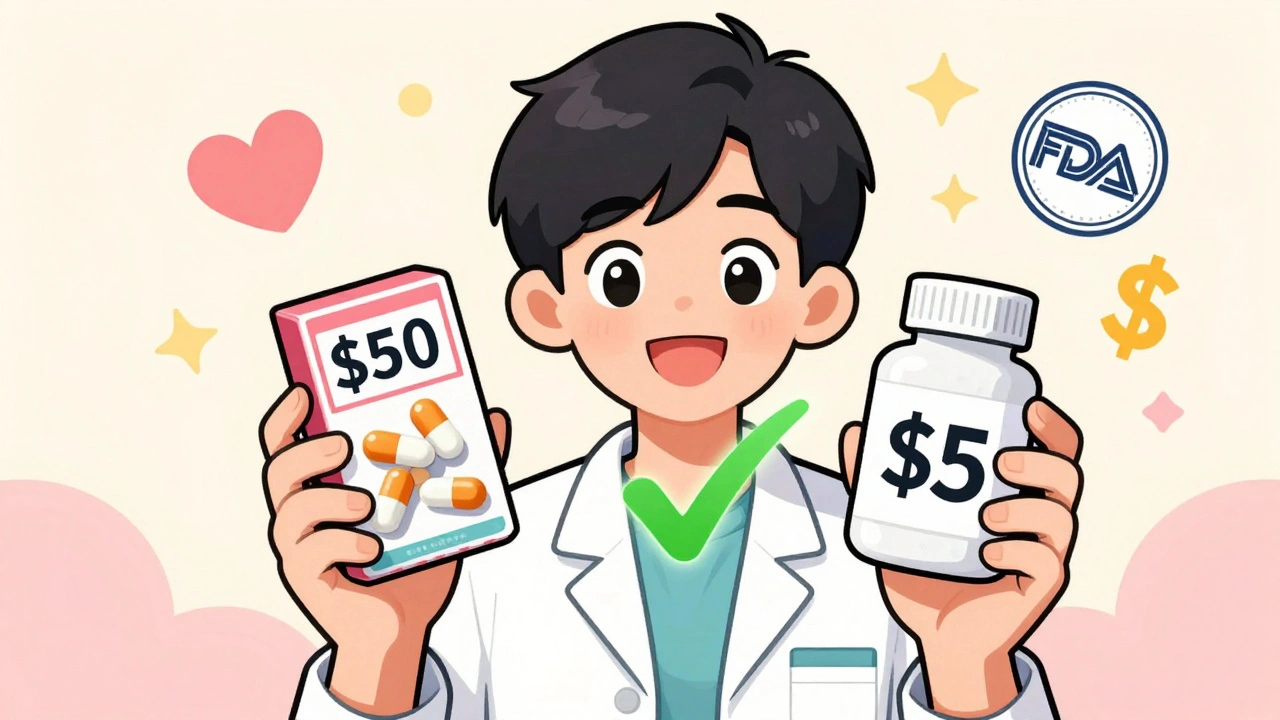
For most people, the biggest surprise about generic medications isn’t that they’re cheaper-it’s that they’re exactly the same as the brand-name versions you’ve been paying way more for. If you’ve ever looked at your pharmacy receipt and seen two versions of the same pill-one costing $5 and the other $50-you might wonder: is the cheap one any good? The answer, backed by decades of science and real-world data, is yes. And choosing generics isn’t just smart-it’s saving the U.S. healthcare system billions every year.
Generics Are Not Cheaper Because They’re Inferior
The FDA doesn’t allow generic drugs to be sold unless they meet the exact same standards as the brand-name version. That means the same active ingredient, same strength, same dosage form, and same way it works in your body. The only differences? The color, shape, or inactive ingredients like fillers-and the price. Generic manufacturers don’t have to repeat expensive clinical trials because they’re proving bioequivalence, not inventing something new. The FDA requires generics to deliver the same amount of medicine into your bloodstream within the same time frame as the brand drug-usually within 80% to 125% of the original. That’s not a loophole; it’s a strict scientific benchmark.
Think of it like buying a generic battery instead of a name-brand one. Both power your remote the same way. The brand might have a fancy logo and packaging, but the performance? Identical. That’s what’s happening with medications like sertraline (Zoloft), atorvastatin (Lipitor), or levothyroxine (Synthroid). The generic versions work just as well-and cost a fraction.
The Real Numbers: How Much Are You Really Saving?
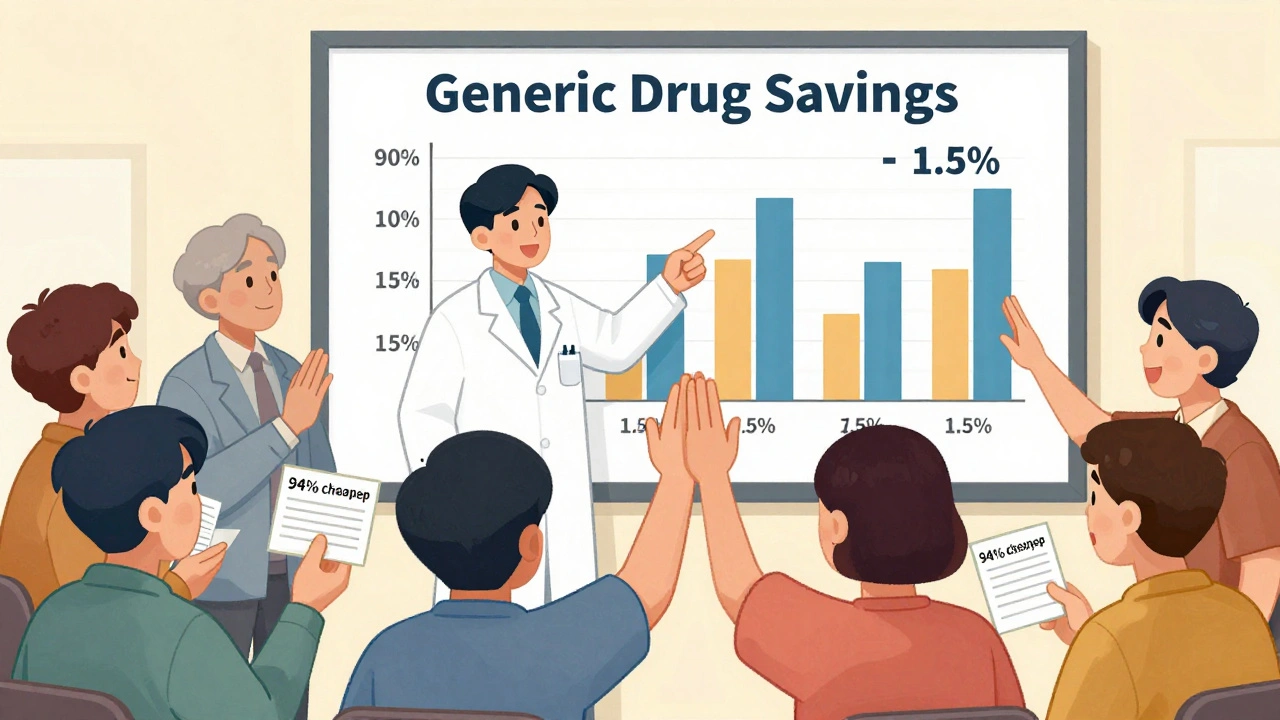
In 2022, generic and biosimilar drugs saved the U.S. healthcare system $408 billion. That’s not a guess. That’s from IQVIA’s official report. Over the last decade, those savings have added up to $2.9 trillion. And here’s the kicker: generics make up 90% of all prescriptions filled, but they account for just 1.5% of total drug spending. Brand-name drugs? They’re only 10% of prescriptions, but they soak up nearly 82% of the money spent on medications.
At the pharmacy counter, the difference is even starker. The average copay for a generic is $6.16. For a brand-name drug? $56.12. That’s more than nine times more. And 93% of generic prescriptions cost under $20. Only 59% of brand-name ones do. If you’re on a chronic medication-say, blood pressure or diabetes pills-that $50-a-month difference adds up to $600 a year. Multiply that by millions of people, and you see why generics are the backbone of affordable care.
Therapeutic Substitution: The Hidden Way to Save Even More
Most people think switching from brand to generic is the only way to cut costs. But there’s another layer most don’t know about: therapeutic substitution. That means swapping one generic drug for another generic that does the same job-but costs even less.
A 2022 study from Johns Hopkins looked at the top 1,000 generic drugs in Colorado and found 45 high-cost generics that had cheaper alternatives with the same effect. In many cases, the cheaper version was just a different strength or form of the same drug. One example: switching from a $120 monthly generic pill to a $6 version of the same medicine. That’s a 94% drop in cost. And in 62% of those cases, the switch was possible without any loss in effectiveness. Doctors and pharmacists can make these swaps if they’re allowed by state law and approved by your prescriber. It’s not a secret-it’s just not talked about enough.
Who’s Making the Money? Who’s Getting Left Behind?
Big pharmaceutical companies still make billions off brand-name drugs, even after patents expire. Some use legal tactics-like filing dozens of minor patents-to delay generic entry. The FTC found that brand manufacturers file an average of 17.5 patents per drug, many just to extend their monopoly. That’s why some generics take years to appear on the market, even after the patent is supposed to expire.
Meanwhile, patients are still paying too much-even for generics. A 2023 AAM report noted that while the wholesale price of many generics has dropped, copays haven’t. Insurance plans often set fixed copays that don’t reflect the lower cost of the drug. So you might pay $15 for a generic that costs the pharmacy $2. That’s not fair. And for people on Medicare, even with 91% of prescriptions being generics, 41% still struggle to afford them. The Inflation Reduction Act’s $2,000 annual cap on out-of-pocket drug costs in Medicare Part D will help, but it won’t fix everything.
When Generics Aren’t the Answer
There are exceptions. For drugs with a narrow therapeutic index-like levothyroxine (for thyroid), warfarin (a blood thinner), or certain seizure medications-tiny changes in blood levels can matter. Some patients report feeling different after switching, even if lab tests show the levels are within range. That’s why some doctors are cautious. But here’s the truth: in most cases, those differences are psychological or due to other factors. A Harvard Medical School survey found that when doctors explained the FDA’s bioequivalence rules, 87% of patients stopped worrying.
Still, if you’ve had a bad experience switching, talk to your doctor. Don’t assume the generic doesn’t work. But also don’t assume the brand is better. Often, it’s just a matter of finding the right generic manufacturer. The FDA’s Orange Book lists all approved generics and their therapeutic equivalence ratings. Most are rated AB-meaning they’re interchangeable. If you’re concerned, ask your pharmacist to stick with the same manufacturer each time.

What’s Next? More Savings Coming
The FDA approved 831 generic drugs in 2022-the second-highest number ever. More are coming. Biosimilars, which are generic versions of complex biologic drugs like Humira or Enbrel, are starting to hit the market. They’re not as simple as a pill, but they’re already saving billions. In 2023, biosimilars generated $3.2 billion in savings, and that number is expected to climb to $50 billion annually in the next few years.
Drug shortages are a growing problem-78% of current shortages involve generics. That’s because manufacturing is often outsourced overseas, and supply chains are fragile. But even with those challenges, the trend is clear: generics are expanding, not shrinking. The global generic market is projected to grow to $665 billion by 2029. And if we fully use therapeutic substitution, we could unlock another $15 billion in annual savings.
What You Can Do Today
- Ask your doctor: “Is there a generic version of this?” Always. Even if you think there isn’t, there often is.
- Ask your pharmacist: “Is there a cheaper generic alternative that works the same?” They know the Orange Book better than you think.
- Check your insurance formulary. Some plans have tiered pricing. The cheapest tier is often the generic.
- If you’re paying more than $20 for a generic, ask why. The drug might cost less than $5 wholesale.
- Don’t assume brand = better. If your doctor says the brand is necessary, ask for proof. Most of the time, it’s not.
Generic medications aren’t a compromise. They’re the smart choice. They’re safe, effective, and proven. And if you’re not using them, you’re paying more than you need to-for no reason.
Are generic medications as effective as brand-name drugs?
Yes. The FDA requires generic drugs to have the same active ingredient, strength, dosage form, and bioequivalence as the brand-name version. They must deliver the same amount of medicine into your bloodstream at the same rate. Over 98% of FDA-approved generics are rated AB, meaning they’re therapeutically equivalent. Millions of people use generics every day with the same results as brand-name drugs.
Why are generic drugs so much cheaper?
Generic manufacturers don’t have to pay for expensive clinical trials because they’re proving the drug works the same way, not inventing it. They also don’t spend money on marketing or branding. Once multiple companies start making the same generic, competition drives prices down-even further. In many cases, the price drops 80-85% within the first year after a generic enters the market.
Can I switch from a brand-name drug to a generic without my doctor’s permission?
In 49 U.S. states, pharmacists can automatically substitute a generic for a brand-name drug unless the doctor writes "dispense as written" or "no substitution." In New York, the prescriber must explicitly allow substitution. Always check your prescription label. If you’re unsure, ask your pharmacist-they’re trained to handle this and can explain your options.
Why do some people say generics don’t work for them?
A small number of patients report differences with drugs that have a narrow therapeutic index, like thyroid meds or blood thinners. But studies show these cases are rare and often linked to switching between different generic manufacturers, not generics versus brand. If you feel different after switching, talk to your doctor. Sometimes, sticking with the same generic manufacturer helps. But don’t assume the brand is better-most of the time, it’s not.
Is it safe to buy generic medications online?
Only buy from licensed U.S. pharmacies. Many websites sell counterfeit or substandard drugs labeled as generics. The FDA warns that over 50% of online pharmacies are not legitimate. Always check if your pharmacy is verified by the National Association of Boards of Pharmacy (NABP). Your local pharmacy or a mail-order service approved by your insurance is the safest route.
Do generics have the same side effects as brand-name drugs?
Yes. Since generics contain the same active ingredient and work the same way in your body, they cause the same side effects. The inactive ingredients (like fillers or dyes) may differ slightly, which can rarely cause minor reactions in sensitive individuals. But these are not safety issues-they’re just differences in formulation. If you have allergies or sensitivities, mention them to your pharmacist.
Iris Carmen
December 8, 2025 AT 16:45so i just switched my blood pressure med to generic and saved like $40 a month?? mind blown. i thought the brand was magic or something lol
Delaine Kiara
December 9, 2025 AT 05:05okay but let’s be real-big pharma is literally running a pyramid scheme. they patent the color of the pill, then act like you’re crazy for thinking a $5 tablet could do the same thing as the $50 one. i had a doctor tell me ‘the brand is better’ and i literally pulled up the FDA’s orange book on my phone mid-appointment. he shut up. the system is rigged, and we’re all paying for it.
Noah Raines
December 9, 2025 AT 16:28generic = same active ingredient, same results, 90% cheaper. it’s not a gamble, it’s math. i’ve been on generic sertraline for 5 years. my anxiety didn’t come back. my wallet did. if your doctor pushes brand, ask them if they’re getting kickbacks. 😏
Michael Robinson
December 10, 2025 AT 00:54we treat medicine like a luxury good, but it’s not. it’s a basic human need. if a pill works the same, why should we pay more for a logo? it’s like buying a lightbulb and paying extra because it has a fancy name on it. we’ve lost touch with what matters: function, not branding.
Andrea Petrov
December 11, 2025 AT 15:26you think this is about savings? think deeper. the FDA is controlled by pharma lobbyists. the ‘bioequivalence’ standards? manipulated. the ‘same’ generic you take this month might be made in a factory in India that’s never been inspected. your ‘$6 pill’ could be laced with fillers that cause long-term damage. they don’t want you to know this. they want you to feel safe taking cheap pills. but safety isn’t cheap-it’s controlled.
Suzanne Johnston
December 12, 2025 AT 00:52as someone from the UK where generics are the default, I’ve seen how this transforms lives. People don’t skip doses because they can’t afford meds. The real tragedy isn’t the cost-it’s that in the US, people still believe the myth that expensive = better. It’s not ignorance. It’s marketing. And we need to unlearn it, together.
Graham Abbas
December 13, 2025 AT 16:19remember when we used to think ‘made in America’ meant better? now it means ‘overpriced’. i switched my statin to generic, saved $800 a year, and my cholesterol is better than ever. the real scandal isn’t that generics work-it’s that we still question them. we’ve been trained to fear the simple, the cheap, the common. but sometimes, the best thing is the thing nobody marketed to you.
Haley P Law
December 15, 2025 AT 04:23okay but i tried switching my thyroid med to generic and felt like a zombie for two weeks. i switched back. i don’t care if science says it’s the same. my body said no. so stop telling people they’re wrong for feeling it. not everyone is a lab rat.