
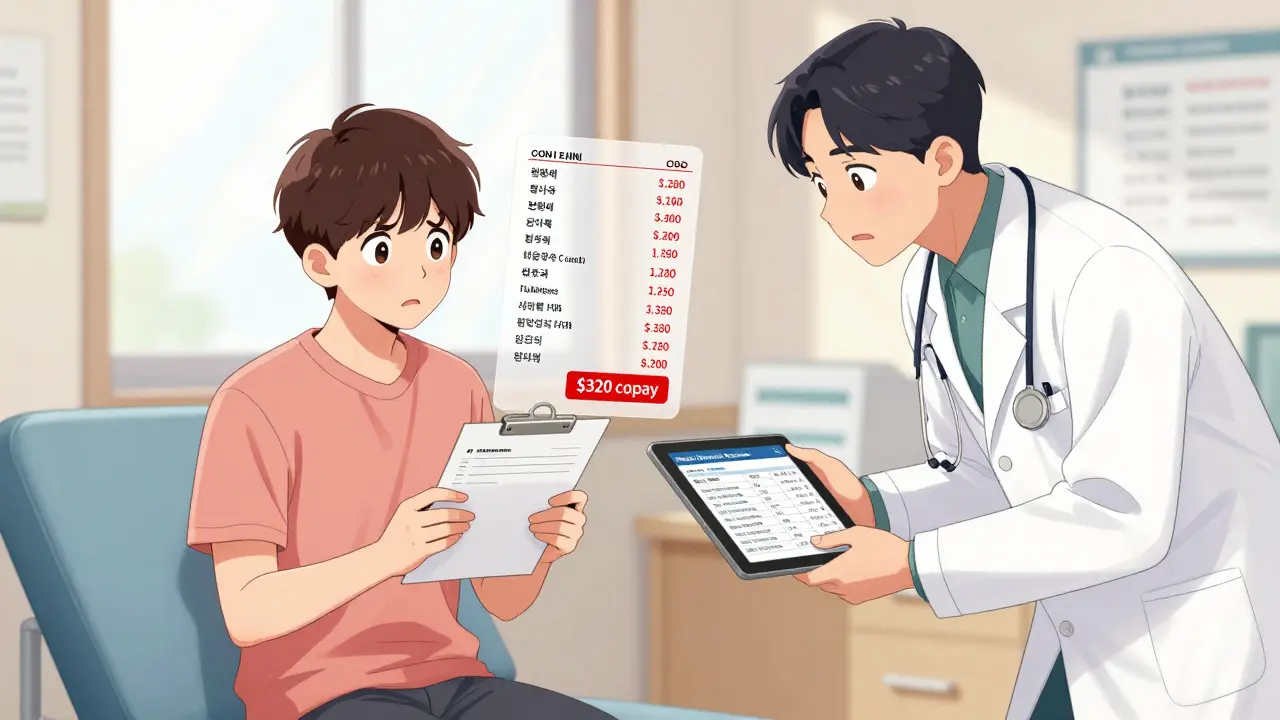
Imagine this: you leave your doctor’s office with a new prescription, excited to start feeling better. But at the pharmacy, the pharmacist says your copay is $320. You didn’t expect that. You didn’t even know your plan had a $500 deductible this year. So you leave the prescription on the counter. You’re not alone. About 22% of people skip filling prescriptions because of cost, according to 2023 GoodRx data. That’s not just inconvenient-it’s dangerous. Skipping doses because of price can lead to hospital visits, worse health, and even higher long-term costs.
The good news? You don’t have to guess. You can know exactly what you’ll pay before you ever walk into the pharmacy. And it starts with a simple conversation-before the prescription is even written.
Ask Before You Write
The best time to talk about cost isn’t at the pharmacy counter. It’s in the exam room, right after your doctor says, “I’m going to prescribe this.” That’s when you have the most power to change things. Once the script is printed, your options shrink. But while it’s still just an idea, your doctor can swap it out, adjust the dose, or suggest a generic.
Don’t wait for your provider to bring it up. Most doctors don’t. Only 15% of patients report having a cost conversation during their visit, even though 30% struggle to afford their meds, according to JAMA Internal Medicine. You’re not being rude-you’re being smart. Say something like: “I’m on a tight budget. Can we talk about what this will cost me?” Or: “Is there a cheaper option that works just as well?”
Doctors aren’t trained to know every drug’s price, but they know how to find out. Many now use tools like Surescripts’ Real-Time Prescription Benefit (RTPB), which shows up right in their electronic health record. It tells them your exact copay, whether the drug is on your plan’s formulary, and if there’s a lower-cost alternative. If your doctor doesn’t use it, they can still call your insurer or check online during your visit.
Know Your Plan’s Formulary
Your insurance plan doesn’t cover every drug. It has a list-called a formulary-that tells you what’s covered and how much you pay. These lists are divided into tiers. Tier 1 is usually generic drugs, costing $5-$15. Tier 2 is preferred brand-name drugs, maybe $25-$50. Tier 3 is non-preferred brands, $50-$100. And then there’s specialty tier-some drugs cost 25%-33% of the total price, with no cap. That’s where you can get hit with $500 bills for one prescription.
Before your appointment, log into your insurer’s website and search for your medication. Look for the tier, copay, and whether prior authorization is needed. Some plans require your doctor to prove the drug is necessary before they’ll cover it. If you find out it’s not covered, you can ask your doctor to pick something else-or start the prior auth process right then.
Medicare Part D plans must cover at least two drugs in each category, but their formularies vary wildly. In 2023, 78% of them used tiered pricing. Commercial plans? Even more complex. The average plan in 2024 covers over 3,250 drugs across five or six tiers. That’s overwhelming. But you don’t need to memorize it. Just check your specific drug.
Use Tools to Compare Prices
There are free tools that show you exactly how much a drug costs at different pharmacies-even with your insurance. GoodRx is the most popular, with 70% market share. SingleCare and RxSaver are also reliable. Just type in your drug name, zip code, and insurance (or choose “without insurance”), and you’ll see prices at CVS, Walgreens, Walmart, and local pharmacies.
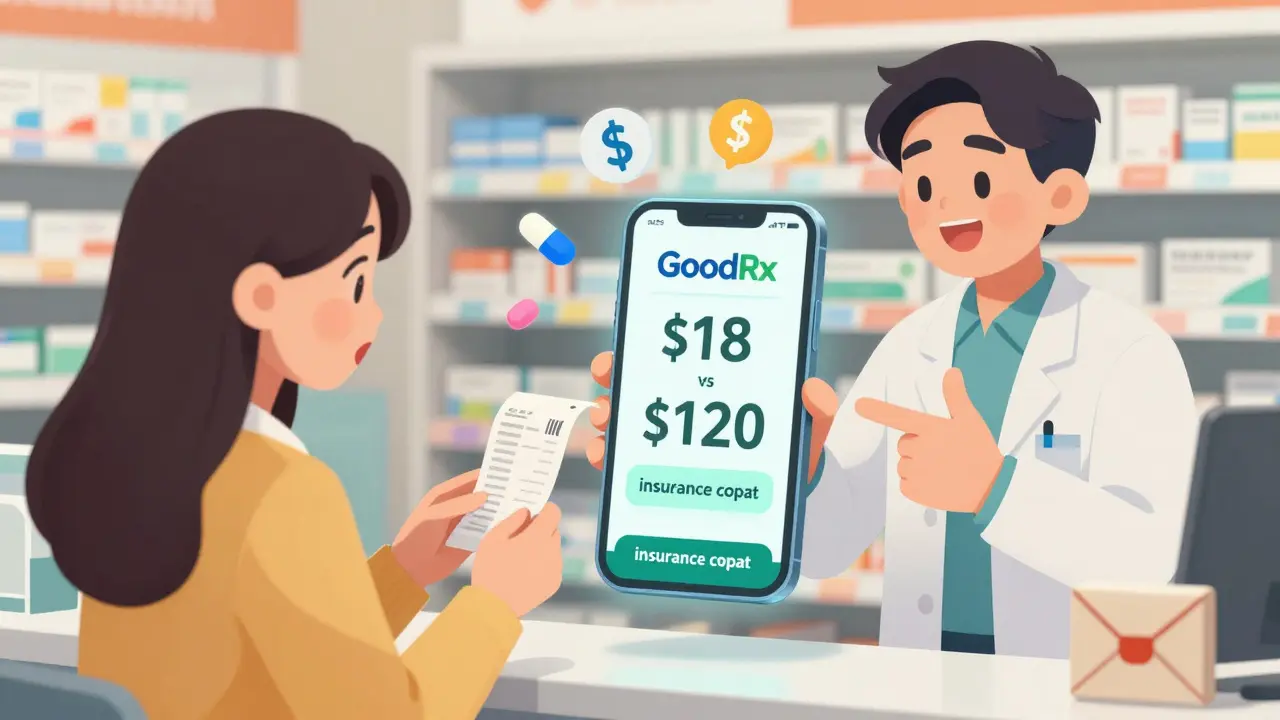
Here’s how it works: a patient in Toronto used GoodRx to check her blood pressure med. Her insurance copay was $120. GoodRx showed the cash price at Walmart was $18. She paid $18 and saved $102. That’s not a trick. It’s legal. Pharmacies often sell drugs cheaper to cash-paying customers than they’re reimbursed by insurers for the same drug.
Don’t just use these tools after the fact. Bring the printout or phone screen to your doctor. Say: “This drug costs $18 cash at Walmart. Is there a version like this that my plan covers?” Your doctor might be surprised too-and willing to switch.
Understand Your Deductible and Out-of-Pocket Limits
January through March is the worst time to get a new prescription if you have a deductible. Most people haven’t met theirs yet. In 2023, the average individual deductible for a marketplace plan was $480. If your drug costs $150 and you haven’t paid $480 in medical bills yet, you pay the full $150. No discount. No copay.
Medicare Part D changed that in 2025. Starting this year, beneficiaries pay no more than $2,000 out of pocket for all prescriptions annually. That’s a big deal. Before, people could hit $8,000 before catastrophic coverage kicked in. Now, once you hit $2,000, your plan covers the rest. And insulin? Capped at $35 per month. Always.
Commercial plans don’t have this cap. That’s why some people pay $1,000 a month for a specialty drug with no end in sight. If you’re on a commercial plan, ask: “Is there an annual out-of-pocket maximum for drugs?” If the answer is no, you’re at risk. That’s when you need to push harder for alternatives.
Ask About Payment Plans and Assistance
Medicare now offers a Prescription Payment Plan. Starting in 2025, you can pay your drug costs in monthly installments instead of one big bill at the pharmacy. This helps if you’re on a fixed income. But you have to enroll before September-if you wait, there aren’t enough months left in the year to spread out the payments.
Even if you’re not on Medicare, ask your doctor or pharmacist about patient assistance programs. Drugmakers like Pfizer, AbbVie, and Johnson & Johnson offer free or discounted meds to people who qualify based on income. These aren’t hidden secrets-they’re listed on the manufacturer’s website. Your pharmacist can help you apply.
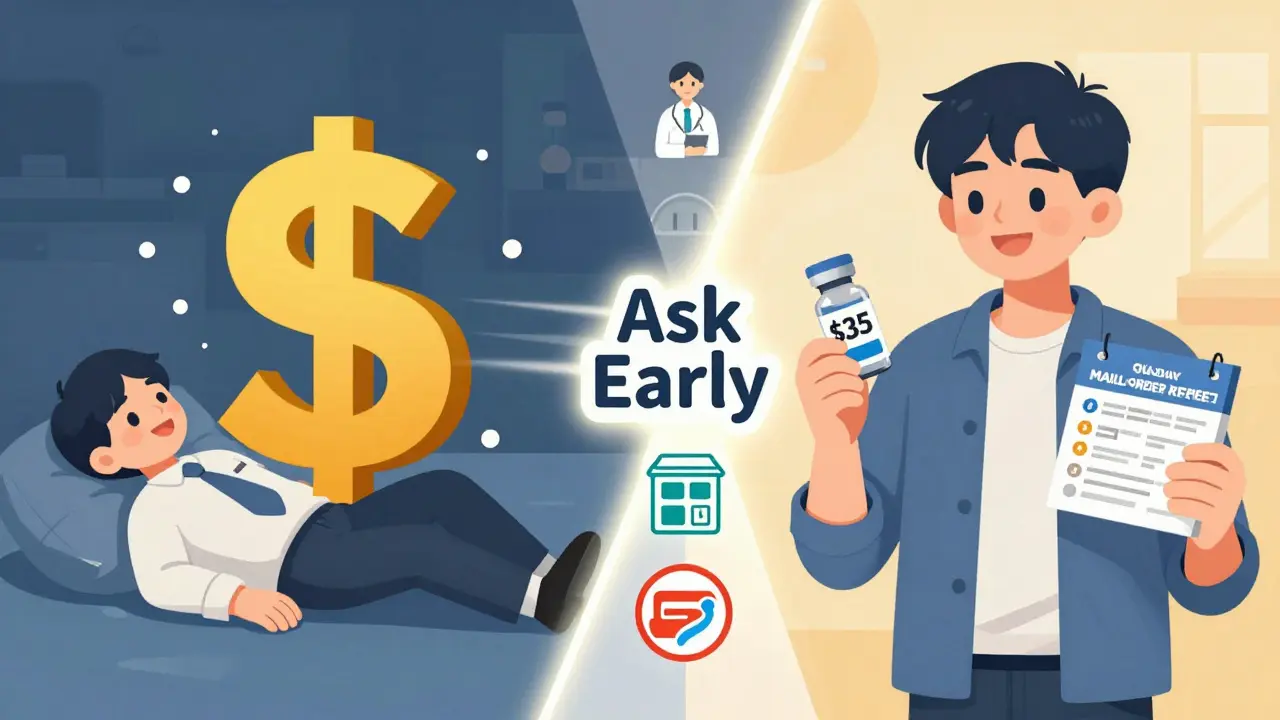
And don’t forget mail-order. Many plans offer 90-day supplies through mail-order pharmacies at lower costs. One patient saved $180 a month on his diabetes meds by switching from 30-day refills at CVS to 90-day mail-order. That’s $2,160 a year.
What If You’re Already at the Pharmacy?
It happens. You’re at the counter, the price is higher than you expected, and you’re stuck. Don’t walk away. Ask the pharmacist: “Can you check if there’s a lower price using a coupon or cash pay?” Many pharmacies will run the price through GoodRx or SingleCare in real time. If the cash price is lower, they’ll let you pay that instead.
Also ask: “Can you call my doctor and ask if there’s a generic or alternative?” Pharmacists can often send a message to your doctor’s office right then and there. In 2023, the American Pharmacists Association recommended pharmacists initiate cost conversations when a patient’s out-of-pocket cost exceeds 2% of their monthly income. That’s $80 for someone making $4,000 a month. If you’re over that, you have every right to ask for help.
Why This Matters More Than Ever
Drug prices keep rising. The U.S. spent $621 billion on prescriptions in 2023. Out-of-pocket costs made up 18% of that. And formularies are getting more complicated-more tiers, more restrictions, more surprises.
But the system is changing. The Inflation Reduction Act forced transparency. Medicare plans now have to show you your expected costs before you fill a prescription. EHR systems are required to show real-time cost data by 2026. This isn’t just a trend-it’s becoming the standard.
And when patients ask about cost, they’re 37% less likely to skip doses, according to the Journal of General Internal Medicine. That’s not just about money. It’s about health. It’s about living longer, feeling better, and avoiding emergency rooms.
You don’t need to be an expert. You don’t need to know insurance jargon. You just need to ask. “How much will this cost me?” That’s the first step. Everything else follows.
Can my doctor change my prescription if it’s too expensive?
Yes, absolutely. Doctors can switch you to a generic version, a different drug in the same class, or a lower-cost brand. They may need to check your formulary first, but they’re trained to do this. Many now use real-time tools that show them your exact copay before they write the script. Don’t be afraid to ask for alternatives-it’s part of their job.
Why is my copay higher at some pharmacies than others?
Insurance contracts with pharmacies vary. Some pharmacies get better reimbursement rates from your plan than others. Also, some pharmacies offer cash discounts that are lower than your insurance copay. That’s why using tools like GoodRx can save you hundreds. Always check prices at multiple locations-even if you prefer one pharmacy.
What if my drug isn’t on my plan’s formulary?
You can still get it covered through a prior authorization request. Your doctor can submit paperwork explaining why this specific drug is necessary. In 2023, 68% of specialty drugs required prior auth, and 43% of all cost issues were due to non-formulary drugs. Many of these get approved-especially if your doctor argues it’s medically necessary or you’ve tried cheaper options first.
Does Medicare cover all my prescriptions?
Medicare Part D covers most prescription drugs, but not all. Each plan has its own formulary. However, starting in 2025, Medicare beneficiaries will have a hard $2,000 annual cap on out-of-pocket drug costs, insulin will cost no more than $35 per month, and vaccines will be free. You still need to choose a plan that covers your specific medications-check the Medicare Plan Finder every fall during open enrollment.
Can I use GoodRx if I have Medicare?
Yes, but only if the GoodRx price is lower than your Medicare copay. You can’t combine them-you have to choose one. If GoodRx gives you a better price, you can pay cash and skip using your Medicare benefits for that fill. This is legal and smart. Many seniors use GoodRx to save on drugs not covered well by their Part D plan.
What if I can’t afford my meds even after all this?
Talk to your pharmacist or doctor. Many drug manufacturers offer free or low-cost programs based on income. Organizations like the Patient Advocate Foundation and NeedyMeds can help you apply. Some pharmacies have discount cards or charity programs. And in Canada, if you’re eligible, provincial drug plans may help cover costs. Don’t give up-there are resources, but you have to ask.
Amy Le
January 6, 2026 AT 04:57This is why America is broken. You have to be a financial analyst just to get your blood pressure med. 🤦♀️
Pavan Vora
January 7, 2026 AT 06:36in india, we dont even have access to these tools... my aunt took 3 weeks to get her insulin because the local pharmacy didn't have it, and the hospital said 'wait for the government supply'... i wish we had goodrx here... 😔
Indra Triawan
January 7, 2026 AT 14:53i just cried reading this. i skipped my antidepressant for 4 months because i couldn't afford it. i thought i was being strong. turns out i was just slowly disappearing. thank you for writing this. i'm going to ask next time. 💔
Susan Arlene
January 9, 2026 AT 10:49so basically just ask before they write it? wow. who knew? 🤷♀️ i thought doctors just knew everything. turns out they're just as lost as we are. good to know.
Ashley S
January 11, 2026 AT 01:47why is this even a thing? people are dying because they can't afford pills? this is a moral failure. we're the richest country on earth. fix it. 🙄
Leonard Shit
January 11, 2026 AT 03:00the fact that pharmacists can check goodrx prices on the spot and still get paid by insurance? that's wild. it's like the system is rigged to confuse you. but hey, at least we have tools. 🤫
Brian Anaz
January 12, 2026 AT 00:25goodrx is the american dream. cash beats insurance every time. if you're paying more than $20 for a generic, you're being scammed. period.
Venkataramanan Viswanathan
January 13, 2026 AT 08:58in india, we have no formularies, no tiers, no real-time pricing. we have a single pharmacy in town that sells everything, and the owner knows who can pay and who can't. he gives discounts based on how much he likes you. it's not fair, but it's honest.
Kiran Plaha
January 14, 2026 AT 07:03my mom used to say 'ask for help, no shame.' i didn't believe her until i needed insulin. now i tell everyone. it's not weak to ask. it's smart.
Matt Beck
January 15, 2026 AT 05:53the real tragedy? doctors don't get paid to talk about cost. they get paid to write scripts. so they write them. and we're left holding the bag. 💸 this isn't healthcare. it's a marketplace with a stethoscope.