
Medication errors kill thousands and injure hundreds of thousands every year. Many of these mistakes are preventable-not because doctors or pharmacists are careless, but because they’re working with outdated or incomplete safety information. The truth is, no single source gives you everything you need. If you’re relying on just one newsletter, one website, or one email alert, you’re leaving gaps in your safety net. This isn’t about being paranoid. It’s about building a system that catches errors before they reach patients.
Where the Real Safety Updates Come From
You don’t need to chase every article on social media or scroll through endless blogs. The most reliable, evidence-based medication safety updates come from a handful of professional societies and regulatory agencies. These aren’t marketing tools-they’re built from real incident reports, clinical data, and years of frontline experience.
The ISMP (Institute for Safe Medication Practices) is the gold standard. Since 1991, they’ve collected over 200,000 medication error reports from hospitals, pharmacies, and clinics. Their Medication Safety Alert! newsletter comes out every week. It’s not theoretical. Each issue starts with a real case: a nurse gave the wrong dose because the label looked like another drug. A pharmacist missed a dangerous interaction because the system didn’t flag it. Then they give you the fix-clear, actionable, and tested.
The FDA issues alerts too. But their timing is often too late. A 2022 analysis in the New England Journal of Medicine found that, on average, it takes 47 days from the time a dangerous drug pattern is noticed to when the FDA sends out a warning. That’s 47 days of patients being at risk. The FDA is authoritative, but it’s reactive. Use it, but don’t wait for it.
If you work in surgery or perioperative care, AORN (Association of periOperative Registered Nurses) is essential. Their latest Medication Safety guideline, updated in October 2023, added new sections on how hospitals should use technology like barcode scanning and automated dispensing cabinets. They also require leadership to actively monitor compliance-not just hand out a policy and forget it.
ASHP (American Society of Health-System Pharmacists) offers free and premium resources. Their Medication Safety Resource Center has tools you can use right away: checklists, self-assessments, and protocols you can adapt for your clinic or hospital. The free content alone is worth bookmarking. The paid tier adds continuing education credits and deeper analysis-but many clinicians find the free material enough to make real changes.
How to Subscribe Without Getting Overwhelmed
There’s a reason so many providers stop checking updates. You get three emails a week from ISMP, two from ASHP, a monthly FDA alert, and then AORN’s biannual revision drops like a brick. It’s too much. You can’t read it all. So here’s how to make it manageable.
- Start with ISMP’s newsletter. It’s the most actionable. Sign up at ismp.org. At $299 a year, it’s cheaper than one preventable error. You’ll get a digest every Monday. Spend 10 minutes reading it. Highlight one thing you can change this week.
- Set up FDA email alerts. Go to fda.gov/drugs/drug-safety-and-availability. Subscribe to “Drug Safety Communications.” You’ll get maybe one email a week. Don’t ignore it.
- Use ASHP’s free tools. If you’re in a hospital or clinic, use their Medication Safety Self-Assessment. It takes 20 minutes. It shows you where your system is weak. No login needed.
- For surgical teams: AORN’s guidelines. If you’re in an OR, download their October 2023 update. Put it in your staff meeting agenda. Don’t wait for annual training-review it quarterly.
Don’t try to read everything. Pick one priority each month. Maybe it’s switching from handwritten orders to electronic ones. Maybe it’s removing dangerous abbreviations like “U” for units (which looks like “0”). ISMP’s List of Error-Prone Abbreviations is updated every year. Print it. Tape it to your desk.
Why Redundancy Saves Lives
Dr. Michael Cohen, former president of ISMP, said it plainly: “Relying on a single source for medication safety updates is as dangerous as using a single verification step in medication administration.”
Think of it like seatbelts and airbags. One protects you. Two protect you better. Three? Even better. The same goes for safety updates. ISMP tells you what’s happening now. FDA tells you what’s been confirmed as dangerous. AORN tells you how to apply it in surgery. ASHP tells you how to build the system to prevent it.
One hospital in Ohio had a spike in insulin errors. They only checked the FDA. Then they started reading ISMP. They found a best practice: using only 10-unit insulin syringes in all units-not 5-unit or 20-unit. They switched. Within six weeks, insulin errors dropped by 78%. They didn’t find that in the FDA. They found it in ISMP’s weekly alert.
What to Do When Updates Change
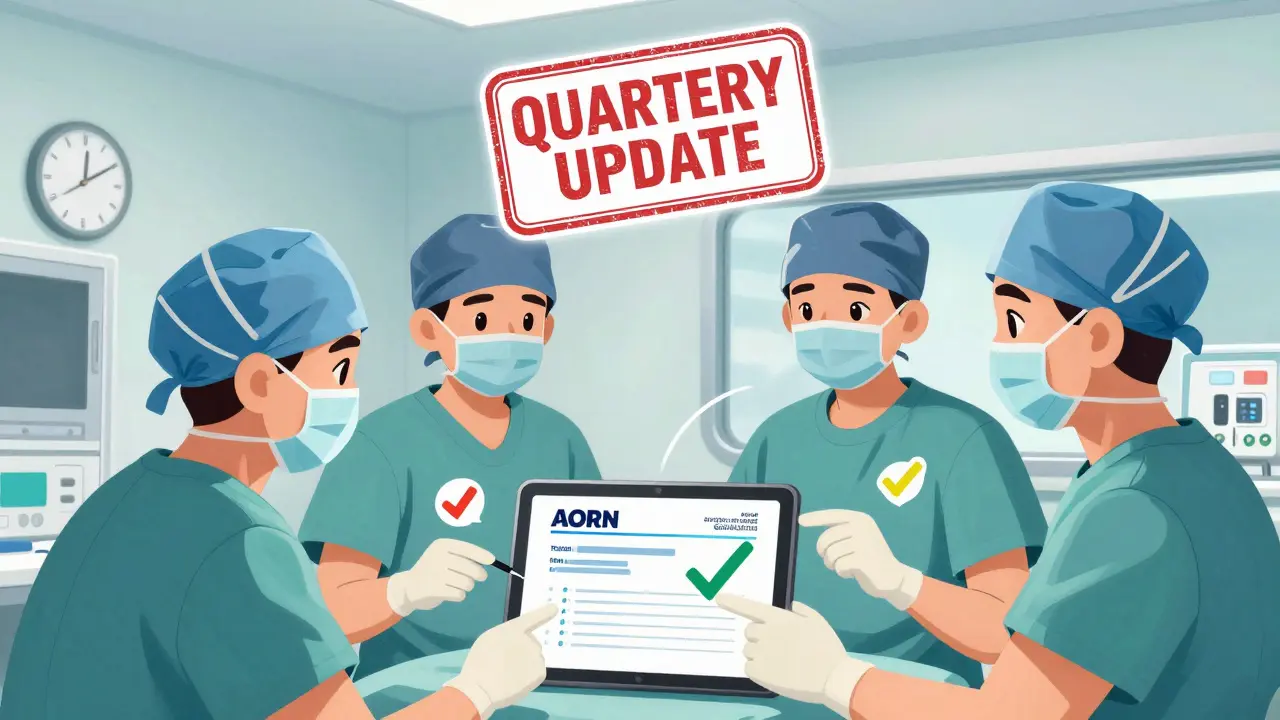
Updates aren’t static. In February 2024, AORN announced they’re moving from biannual updates to quarterly micro-updates. ISMP just released their 2024-2025 Best Practices, which now include guidance on AI-assisted medication systems and compounding pharmacy oversight. WHO launched a new toolkit for handoff communications in September 2023.
So what do you do when the rules change?
- Don’t wait for a training session. Update your protocols immediately.
- Tag your team: “New ISMP alert-change in labeling for high-alert meds. Let’s talk at huddle tomorrow.”
- Use the “What Changed” section in each update. ISMP and ASHP always list revisions. Use that as your checklist.
One pharmacy in Toronto started a 10-minute “Safety Spotlight” at the start of every shift. One person reads one tip from ISMP or FDA. No lecture. No slides. Just: “Here’s what changed. Here’s how we fix it.” Within three months, their near-miss reporting increased by 65%. People started speaking up because they knew their input mattered.
The Hidden Cost of Ignoring Updates
Medication errors cost the global healthcare system $42 billion a year. That’s not just money. It’s lost time. Lost trust. Lost lives.
A 2023 survey found that 38% of community-based providers don’t regularly check safety updates. Why? Time. They’re too busy. But here’s the twist: those who do check updates spend an average of 17 minutes per week. That’s less than two coffee breaks. And they prevent an average of one error per quarter.
That’s a return of 100x. You spend 17 minutes. You prevent one error. That’s one patient who doesn’t go to the ICU. One family who doesn’t lose a loved one. One hospital that doesn’t get fined.
The system isn’t perfect. Some guidelines are too vague. Some are too technical. Some cost money. But the best ones? They’re built from real mistakes. Real near-misses. Real stories from nurses, pharmacists, and doctors who saw it happen-and refused to let it happen again.
What You Can Do Today
You don’t need a big budget. You don’t need approval from administration. You don’t need to wait for a committee meeting.
Here’s your action plan:
- Go to ismp.org and sign up for Medication Safety Alert! today.
- Go to fda.gov and subscribe to drug safety alerts.
- Download ASHP’s free Medication Safety Self-Assessment and complete it by Friday.
- Print ISMP’s List of Error-Prone Abbreviations and put it where you write prescriptions.
- Next team meeting: Share one thing from ISMP or FDA that you’re changing this week.
That’s it. Five steps. Less than an hour. One life could change because of it.
Do I need to pay for all these updates?
No. ISMP’s newsletter costs $299/year, but the FDA and ASHP offer free resources that cover the most critical alerts. AORN’s guidelines are free for members, and many hospitals already subscribe. Start with what’s free. If you see a change that prevents even one error, the paid subscriptions pay for themselves.
What if my hospital doesn’t provide these updates?
You can still sign up individually. Many nurses, pharmacists, and doctors subscribe on their own. If your workplace won’t cover it, pay for it yourself. It’s one of the few professional expenses that directly protects patients-and protects you from liability. ISMP’s newsletter alone has been cited in legal cases as evidence of due diligence.
Are these updates only for hospitals?
No. ISMP, FDA, and ASHP updates apply to clinics, long-term care, home health, and pharmacies. AORN is specific to surgery, but ISMP’s best practices are used everywhere-from emergency rooms to outpatient clinics. Even small practices benefit. One family doctor in Manitoba reduced medication errors by 60% just by changing how he wrote insulin prescriptions after reading an ISMP alert.
How often do these updates change?
ISMP sends alerts weekly. FDA issues communications as needed-usually 1-3 per week. ASHP updates its tools every two years, but posts new tips monthly. AORN releases major updates every two years, but is moving to quarterly micro-updates. WHO releases new toolkits annually. Don’t wait for the big announcements. Check weekly.
Can I trust updates from WHO if I’m in North America?
Yes. WHO’s Medication Without Harm initiative is based on global data, but its recommendations are designed to be adaptable. Many of their best practices-like using standardized dosing, eliminating dangerous abbreviations, and improving handoff communication-are already used in top U.S. hospitals. Their guidelines are a global baseline, not a regional one.
What’s Next?
The future of medication safety is moving faster. Epic and Cerner are integrating ISMP’s best practices directly into their electronic health records. By 2025, your EHR might automatically block a dangerous combination before you click “order.” But until then, the human layer matters most. Technology helps. But only if you’re reading the updates that tell you what to fix.
Don’t wait for someone else to protect your patients. Start today. One alert. One change. One life at a time.
Virginia Kimball
February 14, 2026 AT 17:20Just signed up for ISMP today-best 10 minutes I’ve spent all week. Seriously, if you’re not reading this newsletter, you’re basically flying blind with a stack of prescriptions. I printed their error-prone abbreviations list and taped it to my monitor. Now my whole team teases me for it… but last week we caught a near-miss because of it. No drama. No lecture. Just a sticky note that saved someone’s kidney.
Also-FDA alerts? Subscribe. Even if you think you’re too busy. One email a week. That’s less time than you spend scrolling TikTok. Do it. Your patients will thank you. And so will your future self when you’re not explaining why you didn’t act.
Stop waiting for training. Start with one change. One. Then another. That’s how systems get better.
Kapil Verma
February 14, 2026 AT 23:23India has been doing this right for decades. You people in the US are still stuck in 2010 with your paper charts and handwritten scripts. We’ve had digital alerts in rural clinics since 2018. Your system is broken because you refuse to adapt. ISMP? Cute. We have AI-driven alerts that flag interactions before the doctor even types the script. You’re not behind because you’re busy-you’re behind because you’re lazy. Stop making excuses and upgrade your infrastructure. Or keep burying patients under avoidable errors. I’m sure your malpractice insurance loves that.
Michael Page
February 16, 2026 AT 03:08There’s a deeper epistemological issue here. The assumption that more information = better outcomes is empirically flawed. The proliferation of alerts creates cognitive overload, which paradoxically increases error rates. The real solution isn’t subscribing to more newsletters-it’s reducing noise through systemic simplification. We need fewer, higher-signal inputs, not more channels.
ISMP’s weekly digest may be actionable, but it’s also a symptom of a fragmented, reactive system. The goal shouldn’t be to consume more updates-it should be to engineer systems that don’t require constant human vigilance. Technology should absorb the burden, not the clinician.
Also, 17 minutes a week? That’s not sustainable. It’s a Band-Aid on a hemorrhage.
Mandeep Singh
February 17, 2026 AT 23:10You think this is hard? Try working in a public hospital in Uttar Pradesh with no internet, no automated cabinets, and 14 nurses sharing one printer that only works when you kick it. We don’t get ISMP alerts. We get handwritten notes passed around by interns who barely speak English. And yet-we still catch errors. Because we have each other. We talk. We double-check. We don’t wait for a newsletter to tell us not to give insulin in a syringe labeled ‘U’-we’ve been screaming that for 20 years.
So yes, subscribe if you want. But don’t act like this is some revolutionary insight. We’ve been doing this without your fancy tools. You’re just catching up. And you’re still overcomplicating it.
One tip: Stop reading. Start listening. To your nurses. To your pharmacists. To the person who’s been there longer than you have. They know. They’ve always known.
Josiah Demara
February 18, 2026 AT 23:37Let’s be brutally honest: 87% of these ‘safety updates’ are just corporate rebranding disguised as clinical wisdom. ISMP? Founded by a guy who got fired from a hospital for pushing too hard. FDA? They wait until someone dies before they act. ASHP? Their ‘free tools’ are just repackaged vendor brochures.
And don’t get me started on the ‘17 minutes a week’ myth. That’s the kind of number you pull out of your ass to make people feel better about doing nothing. You think a sticky note prevents errors? No. What prevents errors is a culture of psychological safety where a nurse can say, ‘I think this dose is wrong,’ without fearing retaliation.
Stop fetishizing checklists. Start fixing the system. Stop blaming clinicians for not reading enough emails. The system is broken. The emails are not the solution-they’re the distraction.
Kaye Alcaraz
February 20, 2026 AT 06:03Sarah Barrett
February 21, 2026 AT 12:41I’ve been reading ISMP since 2015. I used to print every alert. Now I just skim the headlines on my phone during lunch. I changed one thing last month: stopped using ‘QD’ in my notes. Just ‘daily.’ Simple. No one got confused. No one misread it. No one got the wrong dose.
That’s it. That’s the whole game. Not subscribing to everything. Not reading every word. Just noticing one thing that could go wrong-and fixing it. The rest? Noise. The quiet wins? Those matter.
Esha Pathak
February 21, 2026 AT 18:11Philosophically, isn’t it ironic? We’re told to ‘build systems’ to prevent errors… but the entire model relies on human attention-a resource that is fundamentally unreliable. We create 17 newsletters, 3 alert systems, 2 checklists… and then expect a tired nurse on a 12-hour shift to parse them all. We’re not fixing the system. We’re just adding more layers of expectation on top of a crumbling foundation.
Technology isn’t the savior. Culture is. If your team doesn’t feel safe speaking up, no newsletter will save them. If your manager doesn’t value near-miss reporting, no checklist will change behavior.
ISMP gives you tools. But tools don’t change culture. People do. And people need space. Not more emails.
Stop optimizing for alerts. Start optimizing for trust.