
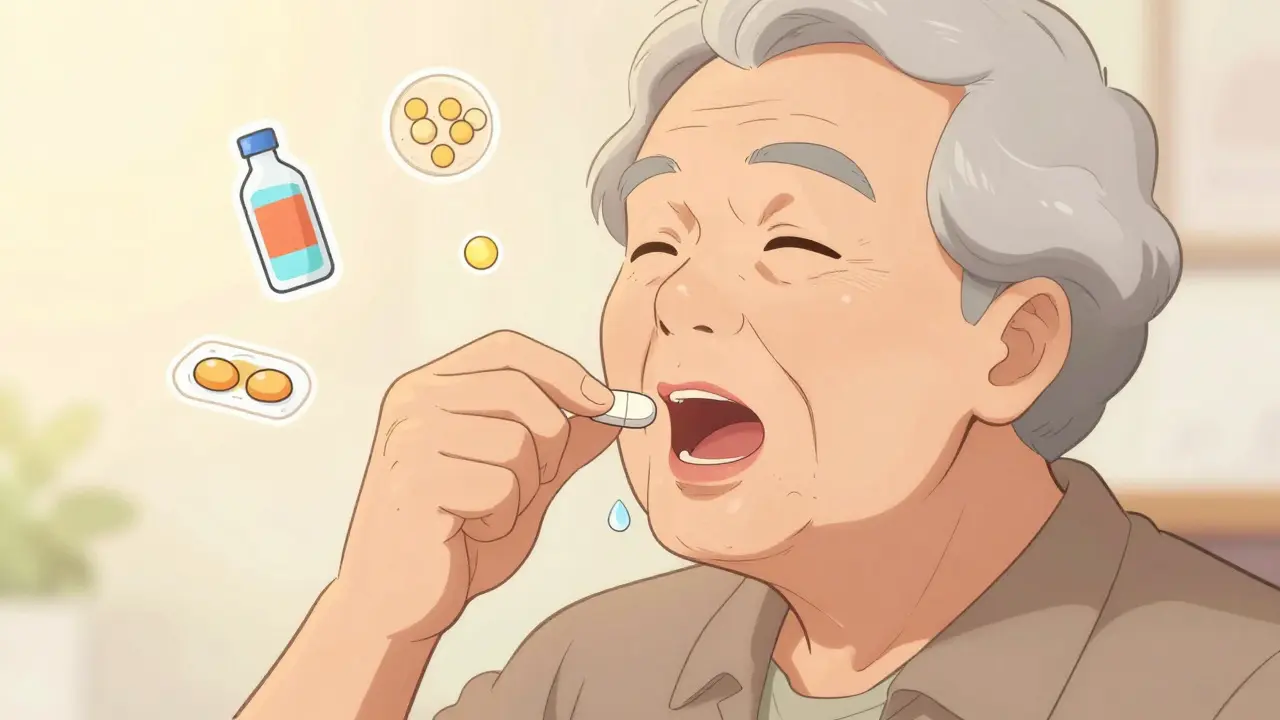
Swallowing a pill can feel impossible when your throat feels tight, dry, or just won’t cooperate. For many older adults and people with neurological conditions like Parkinson’s, stroke, or dementia, this isn’t just annoying-it’s dangerous. Skipping doses because you can’t swallow pills leads to worse health outcomes, hospital visits, and even death. The good news? There are real, safe ways to keep taking your medicine without choking, gagging, or risking your health.
Why Swallowing Pills Gets Harder with Age
About 15% of older adults living at home struggle with swallowing, and that number jumps to nearly 70% in nursing homes. It’s not just about being older. Conditions like Alzheimer’s, multiple sclerosis, or head and neck cancers can weaken the muscles and nerves that control swallowing. Even some medications-like anticholinergics or sedatives-can dry out your mouth and make it harder to move a pill down. When swallowing gets tough, people do what seems easiest: crush pills, open capsules, or mix them with applesauce. But here’s the problem: nearly half of these changes aren’t safe. A 2023 review found that 48% of altered medications had risks-some could cause overdose, others might not work at all. Time-release pills, for example, can become toxic if crushed. Enteric-coated tablets dissolve in the intestines, not the stomach. Crush them, and you risk stomach damage or drug failure.Safe Alternatives to Crushing Pills
Before you crush anything, ask your doctor or pharmacist: Is there a better form? Many medicines come in versions designed for people with swallowing issues:- Liquids-Often the safest choice. Some come in flavored versions to mask bitter tastes.
- Orodispersible tablets-These dissolve on your tongue in seconds. No water needed. Brands like Zofran and Risperdal have them.
- Effervescent tablets-Dissolve in water to make a drink. Good for people who can sip but not swallow solids.
- Topical patches-For pain, hormones, or nicotine. No swallowing required.
- Rectal suppositories-Used for nausea, fever, or some seizure meds.
How to Swallow Pills Without Choking
If you must swallow a pill whole, technique matters more than force. Try these proven methods:- The Lean Forward Method-Place the capsule on your tongue. Take a medium sip of water. Tuck your chin to your chest, then swallow. This opens your throat and helps the pill slide down. Studies show up to 75% success rate for people who use this.
- The Bottle Technique-Put the pill on your tongue. Close your lips tightly around a water bottle. Take a drink using suction, not just swallowing. The suction pulls the pill down with the water.
- The Pop-Bottle Method-Put the pill on your tongue. Fill a plastic water bottle halfway with water. Place your lips around the opening. Take a quick drink while keeping your head upright. The suction helps.
- Use a thick liquid-If you’re at risk of aspirating (breathing in food or liquid), use thickened water or pudding-like liquids. Thin liquids like plain water can slip into your lungs.
- Try ice chips-Suck on a small ice chip right before swallowing. It numbs your throat and triggers a natural swallow reflex.
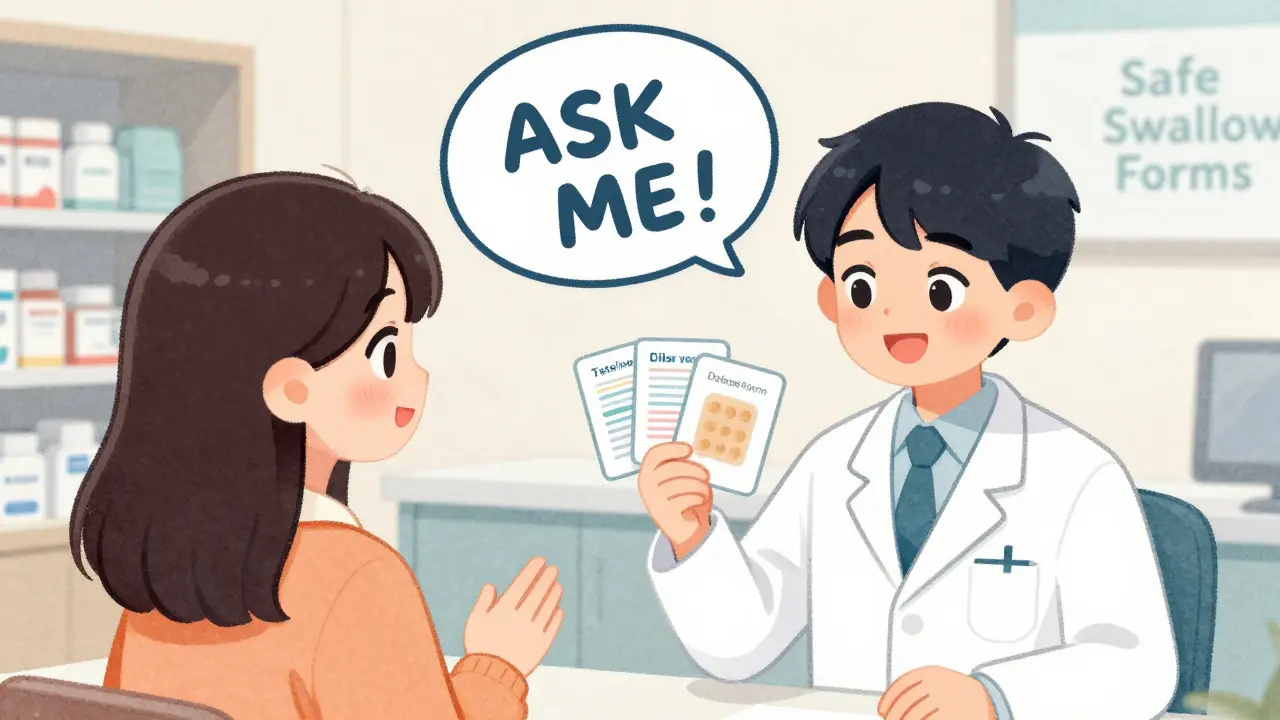
When You Need Help from a Team
This isn’t something you should handle alone. Swallowing problems need a team:- Speech therapist-They can test your swallowing and teach you safe techniques.
- Pharmacist-They know which pills can be split, crushed, or switched. Ask them to review your full list.
- Doctor-They can remove unnecessary meds or change prescriptions.
- Caregiver-If you live with someone, train them on the techniques and signs of choking.
Feeding Tubes and Other Last Resorts
If you’re on a feeding tube, crushing pills is often unavoidable. But even then, there are rules:- Give one drug at a time. Flush with at least 10ml of water between each.
- Never mix meds with feed formula-some drugs bind to it and stop working.
- Use liquid or dissolving forms whenever possible.
- Check if your tube is compatible with the drug. Some meds can clog small tubes.

What Not to Do
Avoid these dangerous habits:- Don’t crush time-release, enteric-coated, or extended-release pills-They can overdose you or stop working.
- Don’t mix meds with hot food-Heat can break down some drugs.
- Don’t use juice or soda-They can react with meds. Stick to water unless your pharmacist says otherwise.
- Don’t assume it’s fine because someone else does it-What works for your neighbor might be dangerous for you.
What to Ask Your Pharmacist
Next time you pick up a prescription, ask:- “Is there a liquid, dissolving, or patch version of this?”
- “Can this pill be crushed safely?”
- “Will it interact with my food or feeding tube?”
- “Can you check if I’m taking any meds that are hard to swallow?”
- “Do you have a list of medications that come in easy-swallow forms?”
Looking Ahead: Better Medicines Are Coming
The global market for swallowing-friendly meds is growing fast-projected to hit $2.9 billion by 2029. More companies are making dissolvable films, flavored liquids, and smaller pills. The European Medicines Agency just called for clearer labels on whether a pill can be crushed. The FDA is pushing drugmakers to test swallowing safety during clinical trials. But change takes time. Right now, your best tools are knowledge, communication, and asking the right questions. Don’t let a pill stop you from staying healthy. You have options. Use them.Can I crush my pills if I can’t swallow them?
Only if your pharmacist or doctor says it’s safe. Many pills-like extended-release, enteric-coated, or capsule forms-can become dangerous when crushed. Crushing them might cause overdose, reduce effectiveness, or irritate your stomach. Always check before crushing anything.
What if I don’t have water to swallow my pills?
Try the bottle technique: place the pill on your tongue, close your lips around a water bottle, and take a drink using suction. You can also try applesauce, yogurt, or pudding if the pill can be mixed safely. Avoid juice or soda unless approved by your pharmacist.
Are there pills that dissolve on the tongue?
Yes. These are called orodispersible tablets. Examples include Zofran for nausea, Risperdal for mental health, and some blood pressure and seizure meds. Ask your pharmacist if any of your prescriptions come in this form. They’re easy, fast, and don’t need water.
Can swallowing problems be fixed?
Sometimes. Speech therapists can teach you exercises to strengthen your swallowing muscles. They can also show you posture tricks, like tucking your chin, to make swallowing easier. But even if the problem doesn’t go away, you can still take your meds safely using alternative forms or techniques.
Why do some medicines make swallowing harder?
Some drugs, especially anticholinergics and sedatives, dry out your mouth and throat. This makes it harder to move food or pills down. If you notice your swallowing gets worse after starting a new med, tell your doctor. There may be alternatives with fewer side effects.
Josh Kenna
January 19, 2026 AT 06:45I used to crush my dad’s blood pressure pills till he almost ended up in the ER. Never again. That FDA stat about 48% being unsafe? Yeah. That’s real. I now use the bottle trick-works like magic. No water needed, just suck it down like a milkshake. My grandma even started doing it after I showed her.
Malikah Rajap
January 19, 2026 AT 11:10Have you ever considered that maybe the problem isn’t the pill… but the system? We’re told to swallow these little chemical bricks like they’re candy, but no one asks if our bodies can handle it… or if the medicine was even designed for humans who aren’t 25 and perfectly healthy? I mean… why aren’t we designing drugs for the people who need them most? Not the other way around?
Jake Rudin
January 20, 2026 AT 15:30It’s fascinating how we’ve outsourced our biology to pharmacology… and then punish ourselves when our bodies refuse to comply. Swallowing isn’t just a physical act-it’s a ritual of trust. We trust the pill, the doctor, the science… but what if the science forgot the human? The mouth, the throat, the fear… these aren’t bugs. They’re features of being alive. Maybe we need to stop seeing swallowing as a problem to solve… and start seeing it as a conversation to have.
Lydia H.
January 22, 2026 AT 03:13This post literally saved my mom’s life. She had dementia and would just skip her meds until she got sick. We tried the lean-forward trick-she hated it at first. Then we switched her to Zofran orodispersible tabs. Now she takes them like candy. No more hospital trips. Also, pharmacists are angels. Just ask them. They’ll help. Seriously.
Astha Jain
January 23, 2026 AT 09:30So like… you mean people cant swallow pills? Wow. In India we just mix em with chai or mango pickle. Works every time. Also, why do you guys need so many fancy terms? Just swallow. Life is hard. Stop making it harder.
Phil Hillson
January 25, 2026 AT 02:21Another overlong self-help article that makes you feel guilty for not being able to swallow a pill like a normal person. Newsflash: some people have neurological damage. You don’t need 12 techniques. You need better drug design. Or a feeding tube. Or to stop being so dramatic about it
Erwin Kodiat
January 26, 2026 AT 10:10My uncle in Florida uses the ice chip trick. He’s 84, had a stroke, and now takes 7 meds a day. He says the cold numbs the panic. And honestly? That’s the real issue-not the pill. It’s the fear. Once you calm that, the body follows. Also, ask your pharmacist for a med review. They’ll do it for free. Seriously. Do it.
Valerie DeLoach
January 27, 2026 AT 23:19As a speech therapist, I see this daily. The techniques listed here are evidence-based and life-changing. But the real tragedy? Most patients are never referred to us. Doctors write prescriptions. They don’t ask. We need systemic change. Until then, use the bottle method. Use dissolvable tabs. Ask for liquids. And if you’re a caregiver-learn the signs of aspiration. It’s not just choking. It’s silent. And deadly.
Jacob Hill
January 29, 2026 AT 04:12Just a quick note: if you’re using a feeding tube, always flush with water between meds. I saw a guy in rehab who mixed his anticoagulant with his formula… ended up with a clot in his tube. Took two weeks to fix. One mistake. One flush. Don’t be that guy.
Aman Kumar
January 29, 2026 AT 18:34Pathetic. You’re all treating symptoms, not root causes. The pharmaceutical-industrial complex doesn’t care about dysphagia-it cares about patent life and market share. Dissolvable films? Only for the privileged who can afford $200/month. Meanwhile, the elderly, the poor, the disabled-forced to crush, gag, or die. This isn’t innovation. It’s capitalism with a Band-Aid. Wake up.