

Dealing with a chronic kidney diagnosis is daunting, and for those with IgA Nephropathy is an autoimmune kidney disorder where immunoglobulin A immune complexes build up in the glomeruli, causing inflammation and progressive damage. Also known as Berger's disease, it is the most common primary glomerulonephritis worldwide., the uncertainty of the future is often the hardest part. For years, the standard approach was a "wait and see" method-trying blood pressure meds first and only moving to stronger drugs if things got worse. But the medical landscape just shifted. The KDIGO 2025 clinical practice guidelines issued by Kidney Disease: Improving Global Outcomes guidelines have changed the game, moving away from sequential treatment toward a simultaneous, aggressive strategy to stop kidney failure before it starts.
Understanding the Prognosis: What to Expect
The reality of IgAN is that it varies wildly from person to person. Some people live their entire lives with the condition and never see a significant drop in kidney function. Others face a steeper decline. Historically, data from the CheckRare 2025 analysis shows that up to 50% of patients with persistent proteinuria (protein in the urine) might progress to kidney failure within 10 to 20 years. That sounds scary, but it's important to remember that these stats are based on older treatment models.
Today, doctors don't just look at one number. They use a risk-based approach to predict the outcome. Your prognosis now depends on a combination of factors: your blood pressure, your estimated glomerular filtration rate (eGFR), and the Oxford Classification a histological scoring system known as MEST-C used to grade the severity of kidney biopsy findings . If you have high levels of protein in your urine (specifically over 1 g/day) and other risk factors, you're considered "high risk," but this is actually a good thing for your treatment plan-it means you qualify for the most aggressive, kidney-saving therapies immediately.
The New Treatment Paradigm: Simultaneous Therapy
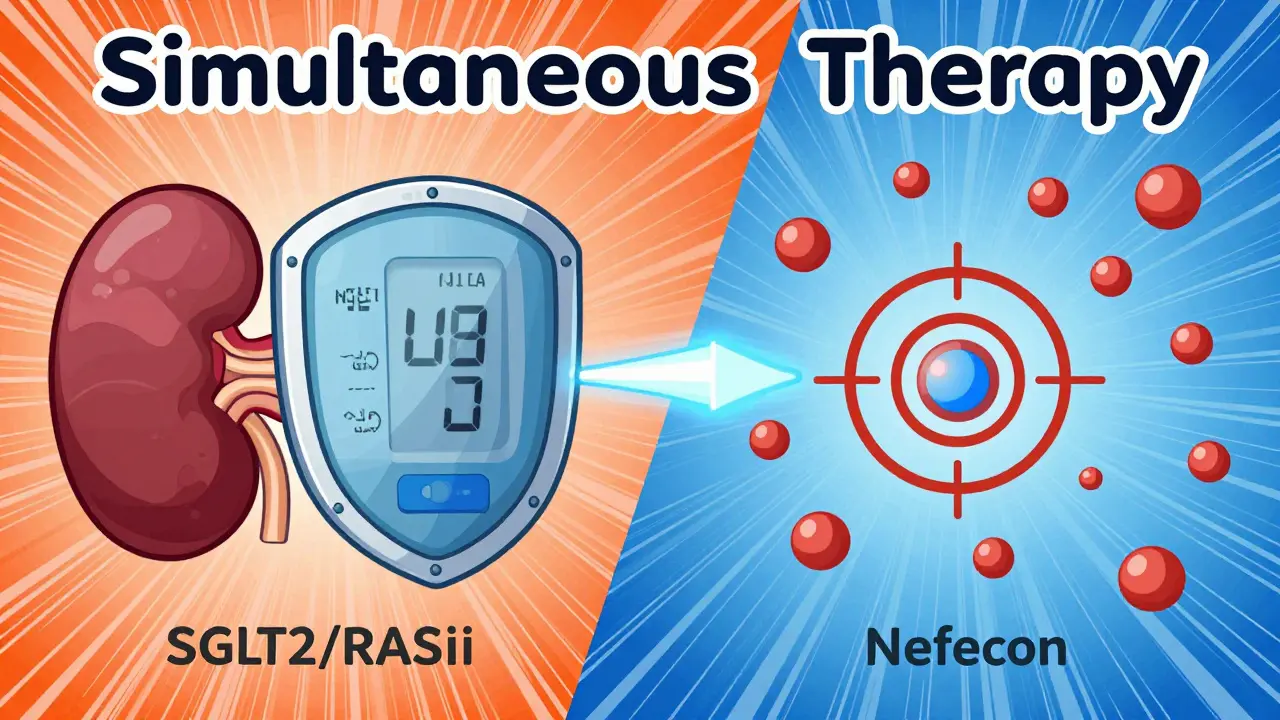
If you've been with a nephrologist for a while, you might remember the "90-day rule." Doctors used to give patients three months of supportive care before even considering immunosuppressants. The KDIGO 2025 guidelines have officially scrapped this. The new philosophy is that we shouldn't let the disease run wild while we wait for blood pressure meds to work.
Modern treatment now targets two different fronts at the same time:
- Disease-Specific Drivers: Stopping the production of the "bad" IgA antibodies and preventing them from attacking the kidneys.
- Generic Kidney Responses: Reducing the pressure inside the kidney (hyperfiltration) and controlling blood pressure to prevent scarring.
By attacking both the cause and the symptoms simultaneously, doctors aim to hit a much stricter target. While the old goal was to get proteinuria below 1 g/day, the new target is less than 0.5 g/day. Why the change? Because data from the Cleveland Clinic shows that even people with moderate protein levels still faced a significant risk of kidney failure over a decade.
Current Therapy Options and Medications
Depending on your risk level, your doctor might suggest a cocktail of the following medications. It's no longer about "one drug fits all," but rather a combination that fits your specific biology.
| Therapy Type | Key Examples | Primary Goal | Key Consideration |
|---|---|---|---|
| Targeted Immunosuppression | Nefecon | Reduce gut-produced pathogenic IgA | FDA approved (2023); targeted release |
| Blood Pressure/Proteinuria Control | RASi, SGLT2 inhibitors, Sparsentan | Lower glomerular pressure & proteinuria | Standard of care for almost all patients |
| Systemic Steroids | Glucocorticoids | Broad inflammation reduction | Higher side-effect profile than targeted drugs |
| Region-Specific Options | Mycophenolate mofetil, Tonsillectomy | Immune modulation | Strongest evidence in China/Japan |
Nefecon is a major breakthrough because it's a targeted-release budesonide. Instead of hitting your whole body with steroids, it focuses on the areas where the problematic IgA is produced. This means fewer of the "moon face" or weight gain side effects associated with traditional prednisone. However, the cost is a massive hurdle; with a list price around $125,000 annually in the US, insurance battles are unfortunately common.
Then there's Sparsentan a dual endothelin receptor antagonist (DEARA) designed to reduce proteinuria , which helps control the physical pressure within the kidney filters. When combined with SGLT2 inhibitors, these drugs create a powerful shield for the nephrons.
Regional Differences in Care
Depending on where you live, your treatment plan might look different. This isn't because one region is "better," but because different populations respond differently to certain treatments. In Japan, tonsillectomies are still frequently used to treat IgAN because the evidence in that population is very strong. In China, mycophenolate mofetil is more common. In North America and Europe, the focus has shifted heavily toward the combination of RAS inhibitors and new targeted agents like Nefecon.

The Road Ahead: Biomarkers and Personalized Medicine
We are moving toward an era of "precision nephrology." Right now, doctors use proteinuria as a surrogate for how the disease is doing. But protein levels don't tell the whole story. The next big leap is the use of biomarkers. Imagine a simple blood test that tells your doctor, "This patient will respond perfectly to Nefecon but won't benefit from steroids."
Studies like the TARGET-IgAN trial are currently working on this. By the time it concludes in 2027, we may stop guessing which drug to try first and start using a genetic or molecular profile to pick the right therapy from day one. This would drastically reduce the "treatment burden"-the exhaustion that comes from managing four or five different medications with complex dosing schedules.
What is the main goal of the new KDIGO 2025 guidelines?
The primary goal is to move from sequential therapy (trying one drug at a time) to simultaneous therapy. This means starting both blood pressure/proteinuria control and immunosuppressive treatments at the same time for high-risk patients to prevent kidney failure more effectively.
Is Nefecon better than traditional steroids?
Nefecon is a targeted-release budesonide, meaning it acts more locally in the gut where the problematic IgA is formed. Patient surveys indicate it generally has fewer systemic side effects than traditional glucocorticoids, though it is significantly more expensive.
What is a "safe" level of protein in the urine for IgAN?
While previous guidelines suggested staying under 1 g/day, the KDIGO 2025 target is now less than 0.5 g/day. This stricter threshold is based on data showing that patients with moderate proteinuria still had a significant risk of progressing to end-stage kidney disease.
Can I avoid dialysis with these new therapies?
While no treatment can guarantee a 100% cure, the goal of simultaneous therapy and targeted drugs is to delay or entirely prevent the need for dialysis by stopping the progression of nephron loss much earlier in the disease process.
Why do some patients get tonsillectomies for a kidney disease?
Because IgA production is often triggered by mucosal infections in the tonsils. In some populations, particularly in Japan, removing the tonsils has been shown to reduce the production of the pathogenic IgA complexes that damage the kidneys.
Next Steps for Patients and Caregivers
If you or a loved one has been diagnosed with IgAN, the first step is to ask your nephrologist about your risk stratification. Don't just ask "Is my protein down?" Ask "What is my MEST-C score from the biopsy, and where do I fall on the KDIGO risk calculator?"
For those already on treatment, keep a detailed log of your blood pressure and any side effects. If you are struggling with the cost of newer agents like Nefecon, look into patient assistance programs or work with your clinic to file prior authorization appeals, as many patients initially face denials before getting approval.
caesar simpkins
April 18, 2026 AT 14:04Absolute game changer to finally move away from that dreadfully slow "wait and see" approach. It is genuinely heartbreaking how many people suffered just because of a 90-day rule that basically served as a countdown to more damage. Seeing the shift toward simultaneous therapy feels like a massive victory for patient advocacy.