
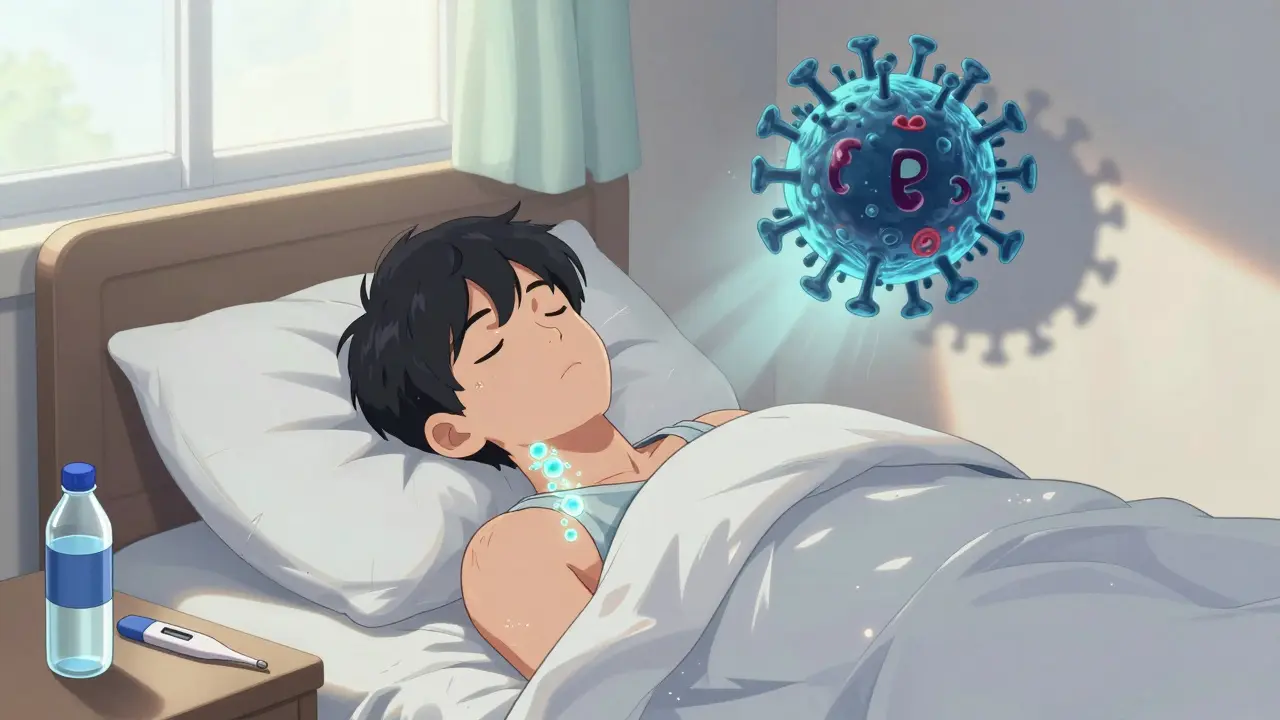
When you’re young, active, and suddenly can’t get out of bed without feeling like you’ve run a marathon - that’s often mononucleosis. It doesn’t come with a warning. One day you’re fine; the next, your throat is on fire, your lymph nodes feel like marbles under your skin, and even brushing your teeth leaves you drained. This isn’t just a bad cold. It’s mononucleosis, a viral infection mostly caused by the Epstein-Barr virus (EBV), and it’s more common than most people realize.
What Exactly Is Mononucleosis?
Mononucleosis - or "mono" - isn’t a new disease. Doctors started naming it in the 1920s, but it’s been around much longer. The main culprit? The Epstein-Barr virus, a type of herpesvirus. About 95% of all mono cases are linked to EBV. You don’t need to kiss someone to catch it, even though it’s nicknamed "the kissing disease." Sharing a drink, a fork, or even a toothbrush can spread the virus. It lives in saliva, and once you’re infected, the virus sticks around for life, hiding quietly in your B-cells.
Here’s the twist: most people get infected with EBV before age 35, but only about half of them ever show symptoms. Kids usually get mild cases - maybe a fever and a sore throat - and no one notices. But teens and young adults? That’s when the full version hits. Fever, swollen glands, extreme fatigue, and a throat so sore it feels like swallowing glass. It’s not just uncomfortable. It’s debilitating.
The Classic Symptoms - And the One Nobody Talks About
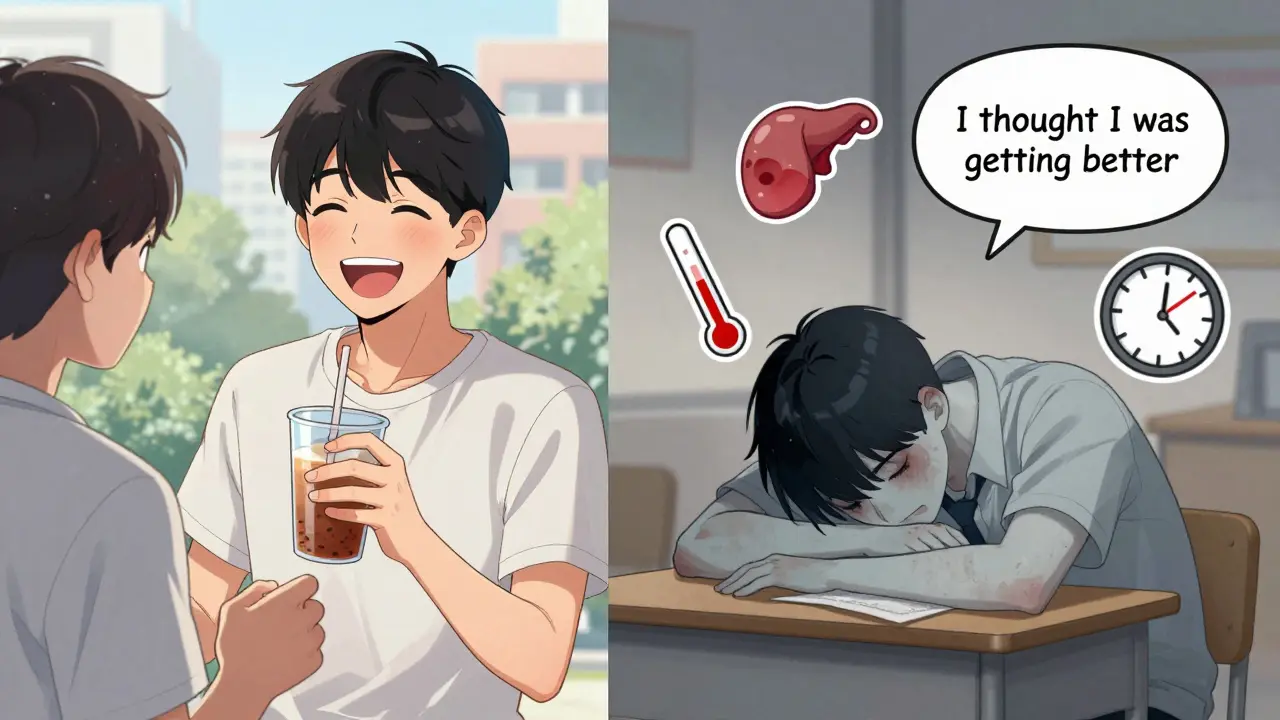
Doctors look for a classic trio: fever, sore throat, and swollen lymph nodes - especially in the neck. About 90% of people with mono have all three. But there’s a fourth symptom that’s almost universal: fatigue. Not just "I’m tired" fatigue. We’re talking about 98% of patients reporting exhaustion so deep it makes standing up feel impossible. One Reddit user put it this way: "I thought I was getting better at week three. Then week five hit. Just showering left me shaking. I didn’t go back to part-time work until week 11."
Other signs include:
- White patches on the tonsils (60% of cases)
- Enlarged spleen (50% of cases)
- Headaches and muscle aches (65-75% of cases)
- A rash - especially if you’re given amoxicillin or ampicillin (up to 90% of those patients develop it)
- Jaundice (yellowing of the skin or eyes) in about 10% of cases
That rash is a red flag. If you were diagnosed with strep throat and put on antibiotics, but broke out in a red, itchy rash? You likely had mono all along. Antibiotics don’t work on viruses - and they can make mono worse.
Why Does Fatigue Last So Long?
Most viral infections - the flu, a cold - clear up in a week or two. Mono doesn’t. Symptoms usually last 2-6 weeks. But fatigue? That can drag on for months. Why?
It’s not just the virus. It’s your immune system. EBV triggers a massive response. Your body floods your bloodstream with lymphocytes - a type of white blood cell - to fight the infection. That’s why your blood test shows "atypical lymphocytes." It’s not a sign of something going wrong. It’s your body doing exactly what it should. But this battle burns energy. Your body is running a marathon on a single cup of coffee.
Studies show that 63% of patients take 4-8 weeks just to return to normal school or work performance. And 78% say fatigue was worse than the sore throat. That’s the hidden cost of mono. You can’t see it. Your boss doesn’t get it. Your friends say, "You look fine." But your body is still healing from a war.
Diagnosis: What Tests Actually Work?
Doctors don’t just guess. They test. The first go-to is the Monospot test, which looks for heterophile antibodies. It’s 85% accurate by week two, but if you get tested too early - say, in week one - it can come back negative. That’s why some people get tested twice.
The gold standard? An EBV antibody panel. It checks three markers:
- VCA-IgM: Appears early. Positive means current infection.
- VCA-IgG: Shows up later and stays for life. Confirms past infection.
- EBNA: Only appears 2-3 months after infection. Confirms you’re past the acute phase.
This panel tells you if you’re in the middle of an active infection or if you had it years ago. It’s especially helpful if your symptoms don’t match up or if you’re not improving.
Recovery: What Actually Helps?
There’s no cure for mono. No antiviral that wipes it out. Treatment is about support - not speed.
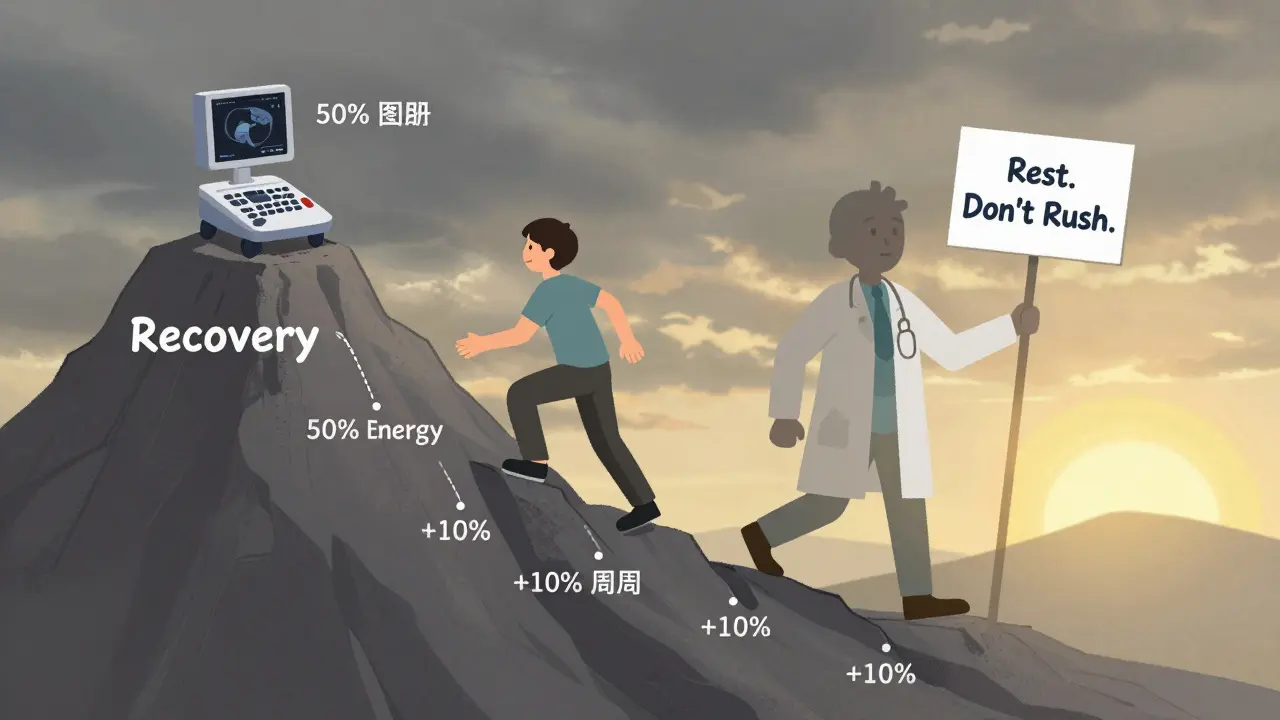
Rest is non-negotiable. But not just "sleep more." It’s about pacing. The Stanford Fatigue Clinic recommends the "Pacing, Prioritizing, Planning" method:
- Start at 50% of your pre-illness energy level.
- Log every activity - even showering or walking to the mailbox.
- Only increase activity by 10% per week - if you feel okay.
- Stop immediately if symptoms flare up.
One student in Toronto used the "20-20-20 rule": 20 minutes of light activity, 20 minutes of rest, 20 ounces of water. She passed her finals. She didn’t collapse.
Hydration matters. Fever and sore throat drain fluids. Drink water. Electrolytes help. Avoid alcohol - it stresses your liver.
Pain and fever? Use acetaminophen (Tylenol). Avoid NSAIDs like ibuprofen. Mono can lower your platelet count. NSAIDs increase bleeding risk. Stick to acetaminophen.
The Biggest Risk: Your Spleen
Half of people with mono have an enlarged spleen. It’s usually harmless - until it’s not. A ruptured spleen is rare (0.1-0.5% of cases) but dangerous. It can happen during contact sports, heavy lifting, or even a hard cough.
The American College of Sports Medicine says: No contact sports for at least 4 weeks. Some people need 8-12 weeks. The only safe way to know? An ultrasound. If your spleen is back to normal size, you’re cleared. If not? Wait.
One 18-year-old athlete in Ontario returned to hockey after 3 weeks. He took a hard hit. His spleen ruptured. Emergency surgery. Three months in recovery. Don’t be that person.
What Doesn’t Work - And Why
Antibiotics? Useless. They don’t kill viruses. Worse - they cause rashes in 80-90% of mono patients.
Corticosteroids? Sometimes used for severe throat swelling. But the American Academy of Pediatrics says they only cut symptom duration by 12 hours - and come with side effects like mood swings, high blood sugar, and weakened immunity. Not worth it for most.
Antivirals like acyclovir? Some European studies show they reduce viral shedding. But the Infectious Diseases Society of America reviewed 12 trials and found no improvement in how people feel. So no, don’t ask for it.
Long-Term Risks - And New Hope
EBV doesn’t just disappear. It hides. And in rare cases, it can trigger long-term problems:
- 0.5-1% risk of EBV-linked cancers like Hodgkin lymphoma (decades later)
- 1.3x higher risk of multiple sclerosis (MS) - confirmed in a 2022 Harvard study of 10 million military personnel
But here’s the good news: research is moving fast. In 2023, the NIH launched a trial testing valacyclovir + steroids for severe throat pain - early results show 35% faster recovery. In Toronto, a study found that low-dose naltrexone (LDN) reduced fatigue by 40% in patients with symptoms lasting over 6 months.
And the biggest breakthrough? A new EBV vaccine. Moderna’s mRNA-1189 entered Phase I trials in April 2023. Early data showed 92% of participants developed protective antibodies. If it works, mono could become a thing of the past.
What to Expect - Real Talk
You won’t feel like yourself for weeks. That’s normal. Don’t push. Don’t compare yourself to others. Recovery isn’t linear. You’ll have good days. Then bad ones. That’s the pattern.
Most people return to normal life within 2-3 months. A small number take longer. If fatigue lasts beyond 6 months, see a specialist. You’re not imagining it. And you’re not alone.
Mononucleosis doesn’t define you. But how you recover - with patience, not pressure - will shape how you bounce back. Listen to your body. It knows more than you think.
Is mononucleosis contagious after symptoms go away?
Yes. The Epstein-Barr virus stays in your body for life and can reactivate periodically. Even after you feel fine, you can still shed the virus in saliva for months - sometimes years. That’s why it’s called a "latent" infection. You’re not contagious in the same way as a cold, but sharing drinks or utensils with someone else can still spread it.
Can you get mono twice?
It’s extremely rare. Once you’ve had mono caused by EBV, your immune system usually prevents a second symptomatic infection. However, the virus can reactivate without causing symptoms. If you get sick again with similar symptoms, it’s more likely another virus - like CMV or even strep throat - being mistaken for mono.
Why does mono hit teens and young adults harder than kids?
Kids often get infected early and have mild or no symptoms because their immune systems respond differently. Teens and young adults, however, are more likely to encounter EBV for the first time during periods of high stress - college, sports, social changes. Their immune systems mount a stronger, more noticeable reaction, leading to the classic symptoms: fever, sore throat, swollen glands, and extreme fatigue.
How long should I avoid exercise after mono?
Avoid all contact sports and heavy lifting for at least 4 weeks. Light walking or stretching is fine if it doesn’t worsen fatigue. But if your spleen is enlarged - which it is in half of cases - even a minor bump can cause rupture. The safest path is an ultrasound to confirm your spleen has returned to normal size before returning to sports. Some people need up to 12 weeks.
Can mono cause long-term fatigue or chronic fatigue syndrome?
Mono doesn’t cause chronic fatigue syndrome (CFS/ME), but it can trigger it in a small number of people. Studies show about 5-10% of mono patients develop persistent fatigue lasting more than 6 months. This is more common in those who had severe initial symptoms or didn’t rest properly. If fatigue lasts beyond 6 months, see a specialist. New treatments like low-dose naltrexone (LDN) are showing promise in reducing symptoms.
Jesse Lord
February 8, 2026 AT 10:02Man i remember when i got mono back in college. Thought it was just a bad flu. Took me 3 months to feel like myself again. The fatigue? Like someone drained my battery and forgot to plug it in. No amount of coffee helped. Just rest. And i mean REAL rest. Not just sleeping 8 hours. Like lying on the couch watching Netflix without moving for days. Your body is fighting a war. Stop trying to be productive.
Paula Sa
February 9, 2026 AT 01:29I love how you mentioned pacing. So many people think recovery means waiting for the fever to break and then jumping back in. But it's not about time. It's about energy. I used the 20-20-20 rule too. Showered. Walked to the fridge. Sat down. Repeat. No guilt. No pressure. Your body isn't lazy. It's rebuilding. And that takes time. Trust the process. Even if it feels like you're moving backward. You're not.
Heather Burrows
February 10, 2026 AT 18:50Why are we even talking about this like it's some new thing? People have had mono for decades. The real problem is modern society doesn't let you rest. You're supposed to work through it. Go to class. Keep up. Like your body doesn't matter. They call it the kissing disease. I call it capitalism's way of punishing you for being young and alive.
Natasha Bhala
February 11, 2026 AT 15:46just wanted to say thanks for writing this. i had mono 5 years ago and still get tired sometimes. i thought i was broken. turns out i just needed to listen. you're not alone
Tola Adedipe
February 13, 2026 AT 12:55Wait. You said no NSAIDs? What about the studies showing ibuprofen reduces inflammation? You're telling me to take Tylenol when the virus is causing systemic inflammation? That's not evidence-based. That's just fearmongering. I've had mono twice. I took ibuprofen. I'm fine. Your advice is dangerous.
Lakisha Sarbah
February 15, 2026 AT 03:43Hey i get where you're coming from. But the spleen thing is real. I had mine rupture. Not fun. No hospital. No surgery. Just pain. And then silence. The docs said ibuprofen made it worse. It's not about being scared. It's about being smart. Your body's already fighting hard. Don't add to the damage.
Patrick Jarillon
February 15, 2026 AT 23:43Let me guess. The CDC and WHO are lying. Big Pharma doesn't want you to know the truth. EBV isn't a virus. It's a government bioweapon. The fatigue? That's your body rejecting the nanotech implanted during your last vaccine. They're testing it on young adults because they're easy to control. The spleen? It's a sensor. The ultrasound? A cover-up. The vaccine trial? A distraction. Wake up. They want you to believe in rest. Rest is control. Movement is freedom. Stop taking Tylenol. Start running. The truth is out there.
Marcus Jackson
February 16, 2026 AT 04:21you said 95% of cases are ebv. what about the other 5%? cmv? toxoplasmosis? you glossed over that. if you're gonna write a post like this, at least be thorough. half the people reading this will go to the er thinking they have mono. what if it's something else? you're doing more harm than good
Ashley Hutchins
February 16, 2026 AT 18:08Why do we even need to talk about this? If you're too weak to handle a virus then maybe you should've eaten better. Or slept more. Or stopped being so lazy. I got mono in high school. I went to prom. I aced my finals. You're just not trying hard enough. Rest? Nah. Just push through. That's what real people do
Gouris Patnaik
February 17, 2026 AT 17:48In India, we call this "viral fever." We don't overthink it. We drink ginger tea. We sleep. We don't run ultrasounds. We don't measure energy in percentages. We don't need a Stanford clinic to tell us to rest. Our ancestors knew. Your body knows. You just need to stop listening to Western overcomplicated nonsense. Less science. More silence.
Niel Amstrong Stein
February 18, 2026 AT 21:25Just read this whole thing. I'm crying. Not because I'm sad. Because I finally feel seen. I had mono 3 years ago. Took 14 months to recover. People thought I was faking. My boss said "just be more disciplined." I tried. I failed. Then I found LDN. It didn't fix me. But it gave me back 30% of my life. I'm not healed. But I'm not broken. Thank you for writing this. I needed to hear it. 🙏
Sarah B
February 19, 2026 AT 07:42mono is just a virus. stop making it a personality disorder. if you're tired rest. if you're not then get up. no one cares about your energy percentages. stop being so dramatic. this is not a memoir. it's a medical condition. get over it