
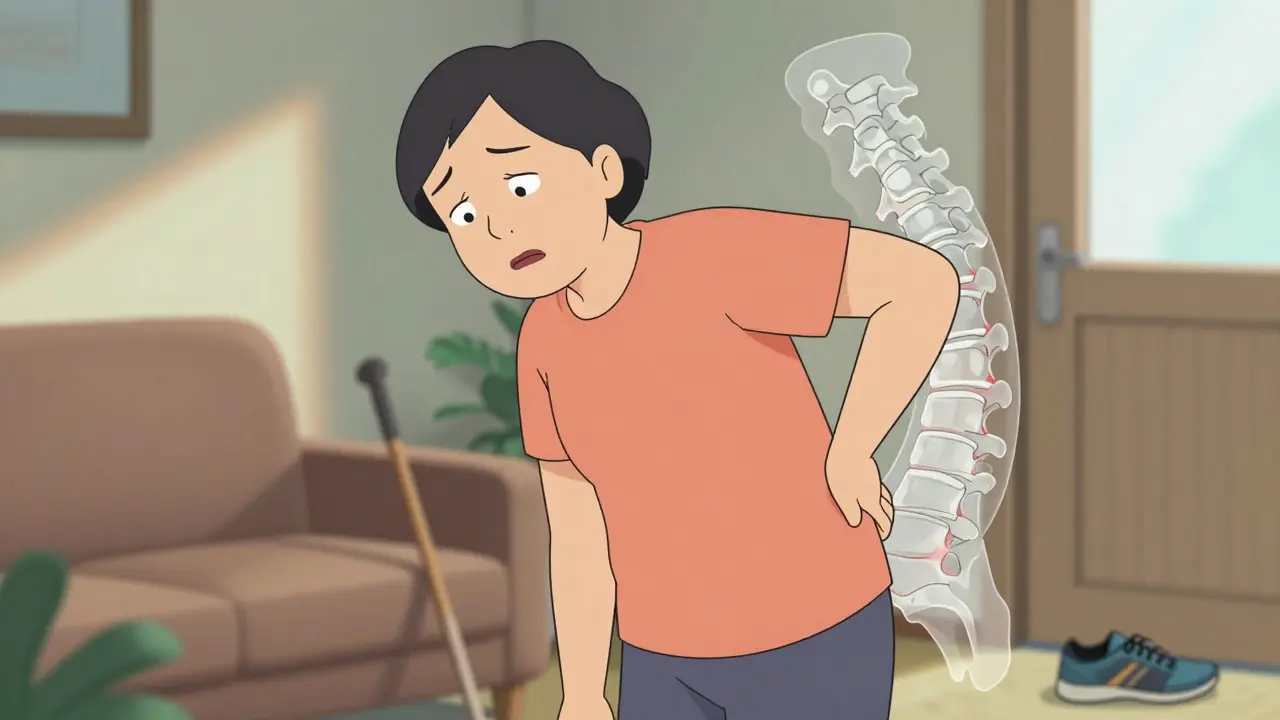
When your lower back aches after standing too long, and your hamstrings feel tight no matter how much you stretch, it might not just be a bad day. For about 6% of people, that persistent pain is caused by spondylolisthesis - a condition where one vertebra slips forward over the one below it. It’s not rare. It’s not always dramatic. But when it hits, it changes how you move, sit, and live.
What Exactly Is Spondylolisthesis?
Spondylolisthesis comes from Greek: spondylo means vertebra, and olisthesis means slip. So, it’s literally a slipped vertebra. Most often, it happens between the fifth lumbar vertebra (L5) and the first sacral bone (S1). That’s the spot where your lower spine meets your pelvis - the main weight-bearing joint in your back.
It’s not a fracture you can see on a X-ray and immediately fix. It’s a structural shift, usually slow, that puts pressure on nerves, muscles, and discs. The slippage is measured in grades - Grade I is mild (less than 25% slip), Grade IV is severe (75-100% slip). Most people have Grade I or II. Only about 1 in 4 people with spondylolisthesis ever need surgery.
Why Does It Happen? Not All Slips Are the Same
There are five main types, and knowing which one you have changes how you treat it.
- Degenerative - This is the most common in adults over 50. Arthritis wears down the joints and discs in your spine. Without that support, the vertebra slides forward. It accounts for about 65% of adult cases.
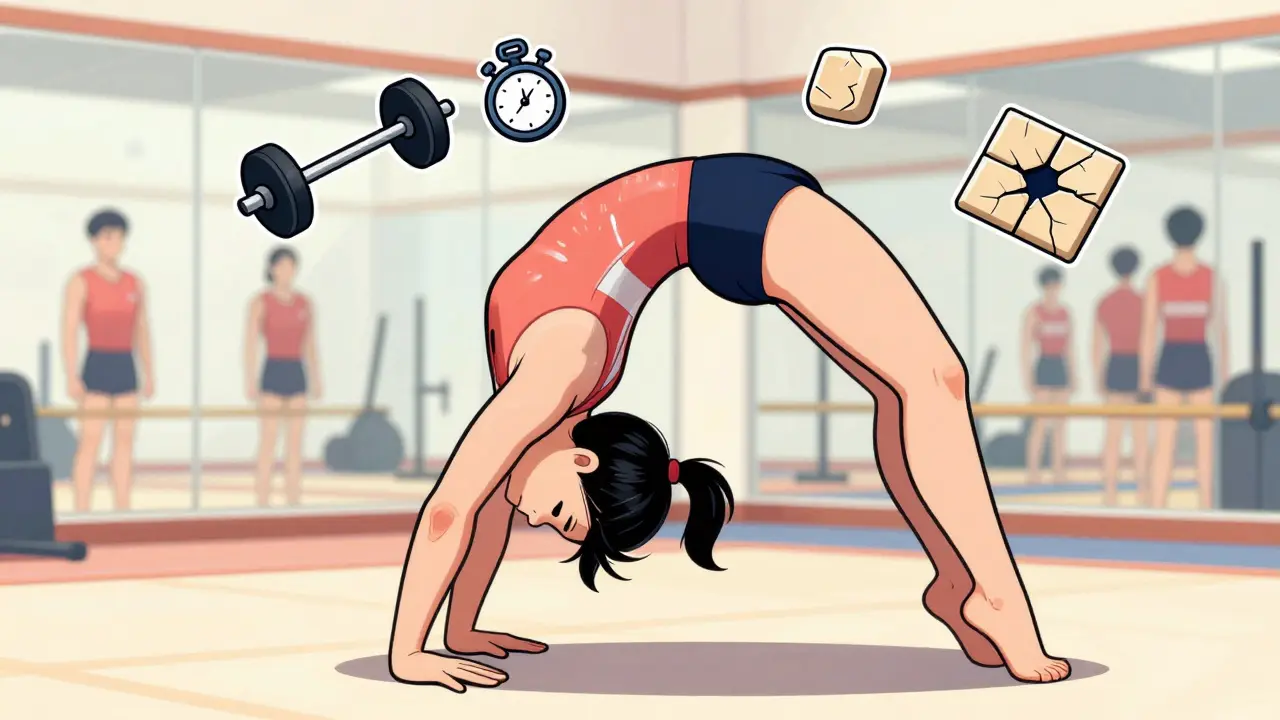
- Isthmic - This one starts with a tiny stress fracture in the pars interarticularis, a thin bone bridge between spinal joints. It often begins in childhood or teens, especially in gymnasts, football players, or weightlifters who repeatedly arch their backs. The fracture doesn’t heal right, and years later, the vertebra slips.
- Dysplastic - Rare. You’re born with malformed spinal joints that can’t hold the vertebra in place. Often found in kids under 6.
- Pathologic - Caused by diseases like bone cancer, osteoporosis, or infections that weaken the bone.
- Traumatic - From a direct injury - a fall, car crash, or heavy lift that breaks part of the vertebra.
If you’re over 50 and have lower back pain that gets worse when you stand, degenerative spondylolisthesis is the most likely culprit. If you’re a teen athlete with sudden back pain, it’s probably isthmic.
Do You Even Have Symptoms?
Here’s the surprising part: 40-50% of people with spondylolisthesis feel nothing. No pain. No numbness. No issues. It’s found by accident on an X-ray for something else.
But if you’re one of the people who do feel it, here’s what it usually looks like:
- Lower back pain that feels like a deep muscle ache - not sharp, but constant.
- Pain that radiates to your buttocks and back of the thighs - sometimes mistaken for sciatica.
- Worse when standing or walking - better when sitting or leaning forward.
- Tight hamstrings - about 70% of symptomatic people can’t touch their toes without discomfort.
- Stiffness in the lower back - especially in the morning or after sitting too long.
- Numbness, tingling, or weakness in one or both legs - signs of nerve compression. Happens in about 35% of Grade III-IV cases.
Over time, some people develop an exaggerated curve in their lower back (lordosis), or even a rounded upper back (kyphosis) as the spine tries to compensate. That’s a late-stage sign.
How Is It Diagnosed?
It’s not guesswork. Doctors use imaging - but not all at once.
- Standing lateral X-ray - This is the first step. It shows the exact amount of slippage. You have to stand upright for the image to be accurate - lying down hides the slip.
- CT scan - If they suspect a fracture (like in isthmic cases), CT gives a clear view of the bone structure.
- MRI - This shows the soft stuff: discs, nerves, ligaments. It tells you if a nerve is pinched, swollen, or irritated. Crucial if you have leg symptoms.
There’s no blood test for spondylolisthesis. No scan that shows pain. The diagnosis is based on what you feel, what the images show, and how it all fits together.
Conservative Treatment: What Works Before Surgery
Most people never need surgery. In fact, 80-90% find relief with non-surgical options - if they stick with them.
- Activity modification - Avoid activities that arch your back. That means skipping heavy lifting, sit-ups, or sports like gymnastics or football. Swimming and walking are usually fine.
- Physical therapy - This is the cornerstone. A good program focuses on core strengthening (transverse abdominis, obliques), hamstring stretching, and posture retraining. Studies show it takes 12-16 weeks of consistent sessions to see real change. Only about 65% of people stick with it long enough.
- NSAIDs - Ibuprofen or naproxen can help with inflammation and pain. But they don’t fix the slip - just make it bearable.
- Epidural steroid injections - If nerve pain is bad, a shot near the spinal nerves can reduce swelling and give you a window of relief to do PT. Effects last weeks to months.
Doctors usually recommend trying this for 6-12 months before considering surgery. If your pain hasn’t improved after 3-4 weeks, or if you can’t walk without discomfort, see a specialist.
When Surgery Becomes Necessary
Surgery isn’t about fixing the slip - it’s about stopping the pain and instability. You’re not trying to put the vertebra back perfectly in place. You’re trying to fuse it so it doesn’t move anymore.
The main procedure is spinal fusion. Three types are used:
- Posterolateral fusion (PLF) - Bone graft is placed along the back of the spine, outside the spinal canal. About 55% of fusion surgeries use this. Success rate: 75-85% for Grade I-II, drops to 60-70% for Grade III-IV.
- Interbody fusion (PLIF/TLIF) - The disc is removed and replaced with a spacer and bone graft from the front side of the spine. This restores disc height and opens up the space for nerves. Used in 35% of cases. Success rate: 85-92% across all grades.
- Minimally invasive fusion - Smaller incisions, less muscle cutting. Used in about 10% of cases. Recovery is faster, but not always suitable for severe slips.
Why does interbody fusion work better? Because it directly addresses the disc space - the root of instability in degenerative cases. It lifts the vertebra back into alignment, takes pressure off nerves, and gives the bone a better surface to fuse.
What Happens After Surgery?
Recovery isn’t quick. It’s not a weekend off work.
- First 6-8 weeks: No lifting, twisting, or bending. You’re in a brace sometimes.
- 3-6 months: Physical therapy to rebuild strength and mobility.
- 12-18 months: Full healing. Bone doesn’t fuse overnight.
Success rates are high - 85-92% for interbody fusion. Patient satisfaction at two years? 78-85%. But there are risks:
- Pseudoarthrosis - the bone doesn’t fuse. Smokers have 3.2 times higher risk.
- Adjacent segment disease - the levels above or below the fusion start wearing out faster. Happens in 18-22% of patients within 5 years.
- Revision surgery - needed in 12-15% of high-grade cases.
Before surgery, optimize your health: quit smoking, lose weight if your BMI is over 30 (complications jump 47%), and get your nutrition in order. Bone needs protein, vitamin D, and calcium to heal.

Newer Options: What’s Changing in 2025
Spinal fusion isn’t the only option anymore.
- Dynamic stabilization devices - These are implants that limit movement without fully fusing the spine. They’re being used for Grade I-II slips. Success rate: 76% at 5 years - lower than fusion’s 88%, but they preserve motion.
- Improved fusion devices - FDA-approved in 2022, newer interbody cages are designed for better correction and faster bone growth. Fusion rates hit 89% at 6 months.
- Bone morphogenetic protein (BMP) - A synthetic protein that triggers bone growth. A 2023 trial showed 94% fusion rates in high-risk patients using BMP-2, compared to 81% with traditional bone grafts.
- Stem cell therapies - Still experimental, but early trials are looking promising for boosting fusion in older patients with poor bone quality.
But here’s the catch: these newer tools aren’t for everyone. They’re expensive. Insurance doesn’t always cover them. And long-term data? Still limited.
Choosing the Right Path for You
There’s no one-size-fits-all answer.
If you’re 65, have mild pain, and your X-ray shows Grade I degenerative spondylolisthesis - stick with PT and activity changes. You’ll likely do fine.
If you’re 55, have constant leg numbness, Grade III slip, and PT hasn’t helped in a year - surgery is probably your best shot at getting back to normal.
And if you’re 16 and a gymnast with a stress fracture? Rest. Don’t rush back. A small fracture now can turn into a big slip later.
What matters most isn’t the grade on the X-ray. It’s how you feel. Your pain level. Your mobility. Your quality of life. The goal isn’t to make your spine look perfect on a scan. It’s to let you walk, sit, and live without pain.
What to Ask Your Doctor
- What type of spondylolisthesis do I have - degenerative, isthmic, or something else?
- Is my slip causing nerve pressure, or is it just structural?
- What’s my grade? How does that affect my options?
- Have you tried PT? How long should I give it before considering surgery?
- What’s your success rate with fusion? Which technique do you recommend and why?
- What are the risks of not doing anything? What are the risks of surgery?
Don’t let fear push you into surgery. Don’t let hope delay it. Get the facts. Make the choice that fits your life - not just your scan.
Can spondylolisthesis heal on its own without surgery?
The slipped vertebra itself won’t move back into place naturally. But the pain and symptoms often improve significantly with conservative care - physical therapy, activity changes, and pain management. Many people live without surgery for years, even decades, especially with mild slips. The goal isn’t to reverse the slip - it’s to manage the symptoms so they don’t control your life.
Is walking bad for spondylolisthesis?
No - walking is usually one of the best activities. It’s low-impact, improves circulation, and strengthens core muscles without stressing the spine. Avoid long walks if you’re in pain, but short, regular walks (20-30 minutes) are encouraged. If walking causes leg numbness or weakness, that’s a sign of nerve compression, and you should talk to your doctor about other treatments.
Does spondylolisthesis get worse with age?
Yes, especially in degenerative cases. As discs wear down and joints become arthritic, the slip can gradually increase over time. But worsening doesn’t always mean worsening pain. Some people’s slips get bigger but stay pain-free. Others have stable slips but develop more pain due to nerve irritation or muscle imbalance. Age affects the spine - but not always in predictable ways.
Can I still exercise with spondylolisthesis?
Yes - but you need to choose wisely. Avoid exercises that hyperextend your back: heavy squats, deadlifts, sit-ups, and backbends. Safe options include swimming, cycling on a recumbent bike, walking, and core-strengthening exercises like pelvic tilts and bird-dogs. A physical therapist can design a program that keeps you active without risking more damage.
How do I know if I need surgery?
You might need surgery if: your pain hasn’t improved after 6-12 months of consistent physical therapy, you have numbness or weakness in your legs, you can’t walk more than a few blocks without stopping, or your daily life is severely limited. Surgery isn’t about the X-ray grade - it’s about your quality of life. If non-surgical options aren’t working and your pain is controlling you, it’s time to talk about fusion.
Emma Duquemin
December 31, 2025 AT 10:08Okay but have you ever tried doing PT and then your physical therapist just says 'just walk more' like you're a golden retriever with a bad back? I had Grade II and thought I was doomed until I found a therapist who actually knew what the pars interarticularis was. Took me 14 weeks but I can now lift my kids without wincing. Also, stop doing yoga backbends. Just stop.
Also, if your doctor says 'it's just aging' and hands you a pamphlet - run.
And yes, I still do bird-dogs every morning like a ritual. My spine thanks me.
Also, BMP-2? That stuff’s wild. My cousin got it and his fusion looked like a concrete sculpture after 3 months. Insurance denied it though. Classic.
Also, walking isn't the enemy. Sitting in a recliner watching Netflix while your spine collapses is the enemy.
Also, if you're 16 and a gymnast - rest. Your spine doesn't care about your state championship.
Also, I cried in the parking lot after my first epidural. It wasn't magic, but it was the first time in 8 months I didn't feel like my lower back was being slowly crushed by a sumo wrestler.
Also, don't let anyone tell you 'it's all in your head.' It's not. It's in your L5-S1.
Also, I'm still here. 5 years later. No fusion. Just discipline, dumb luck, and a really good foam roller.
Also, I'm not a doctor. But I play one on Reddit.
Also, if you're reading this and you're scared - you're not alone. We've all been there.
Also, you're not broken. You're just misaligned. And that's fixable.
Also, I still can't touch my toes. But I can carry groceries. And that's victory.
Also, I love my spine. It's been through hell. It deserves better than a pill and a shrug.
Kevin Lopez
January 2, 2026 AT 04:29Grade I degenerative spondylolisthesis at L5-S1 is not a diagnosis - it’s a radiographic finding with variable clinical correlation. Conservative management is first-line per AANS guidelines. PT targeting core stabilization and proprioceptive retraining yields 70-80% symptomatic improvement over 6–12 months. Surgical indication requires neurologic deficit, refractory pain, or progression beyond Grade II. PLIF/TLIF superior to PLF due to load-sharing biomechanics. Pseudoarthrosis risk elevated with smoking, obesity, and osteopenia. BMP-2 increases fusion rates but carries ectopic bone and inflammatory risks. Dynamic stabilization remains investigational. Long-term adjacent segment degeneration occurs in 20% at 5 years. No evidence supports stem cell efficacy in humans. Avoid hyperextension. Avoid NSAIDs as monotherapy. Do not conflate radiographic slip with pain generation.
Henriette Barrows
January 3, 2026 AT 11:51I just want to say - if you’re reading this and you’re scared, you’re not alone. I had this for years and thought I’d never walk without pain again. My PT told me to stop trying to 'fix' my back and start listening to it. It’s not about being strong - it’s about being smart. I started with 5 minutes of walking a day. Then 10. Then I stopped doing sit-ups (RIP abs). I cried a lot. I got mad. I felt guilty for not being 'normal' anymore.
But then one day, I picked up my dog without thinking about it. And I didn’t flinch.
That’s the win. Not the X-ray. Not the grade. Just that moment.
You’re not broken. You’re adapting. And that’s brave.
Also, if your doctor doesn’t listen - find another one. You deserve better.
I’m still here. And I’m not giving up.
Thank you for writing this. It felt like someone finally understood.
Teresa Rodriguez leon
January 3, 2026 AT 15:11I’ve had this since I was 19. Now I’m 42. I’ve had three epidurals, two years of PT, two chiropractors who promised miracles, and one surgeon who told me I was ‘too young’ for fusion. I’ve been told it’s psychosomatic. I’ve been told I’m lazy. I’ve been told I need to ‘just lose weight.’ I’ve lost 50 pounds. I’ve done everything. I still can’t sit in a car for more than 20 minutes. My husband says I’m a different person now. He’s right. I’m quieter. I’m tired. I don’t laugh as much. I don’t go out. I don’t travel. I don’t even go to the grocery store without planning my route like a military operation. I’m not asking for pity. I’m just saying - this isn’t just ‘back pain.’ It’s a life sentence. And no one talks about the loneliness.
So if you’re reading this and you’re in the same boat - I see you. And I’m sorry it’s this hard.
Manan Pandya
January 4, 2026 AT 05:18Thank you for this comprehensive overview. As a physiotherapist in India, I encounter many young athletes with isthmic spondylolisthesis, often misdiagnosed as simple muscle strain. The emphasis on early activity modification is critical - many continue training until they develop Grade III slips. I recommend the McGill Big 3 for core stabilization and avoid lumbar extension exercises. Also, for patients with hamstring tightness, I use dynamic neural mobilization techniques rather than static stretching. The data on interbody fusion outcomes is reassuring. However, access to advanced imaging and surgical options remains limited in low-resource settings. Education and early referral are our most powerful tools.
Aliza Efraimov
January 5, 2026 AT 03:18Let me tell you something - if your doctor tells you 'it's just degenerative' and gives you a pill, they're not your doctor. They're a vending machine. I had Grade II, went to three specialists, and the fourth one looked at my MRI and said, 'You're not just aging - you're being ignored.'
I did PT for 18 months. I did every exercise. I did them right. I didn't skip a day. And guess what? I still had pain. But then I got the epidural - and for the first time in 5 years, I could bend over to tie my shoes without crying.
Surgery wasn't the end. It was the beginning. I'm 6 months post-TLIF. I walk 5 miles a day. I play with my grandkids. I don't take painkillers anymore.
Don't let fear keep you stuck. If your life is shrinking - fight back. You deserve to move without pain.
Also - stop doing yoga. Just stop.
Also - your spine doesn't care about your Instagram. It cares about your core. Train it like your life depends on it. Because it does.
Nisha Marwaha
January 5, 2026 AT 23:31From a biomechanical standpoint, the interbody fusion’s superiority lies in its restoration of disc height and restoration of the sagittal balance. Degenerative spondylolisthesis is a three-dimensional pathology involving facet joint degeneration, ligamentous laxity, and disc collapse. Posterolateral fusion alone fails to address the anterior column collapse, hence higher pseudoarthrosis rates. The use of endplate preparation and oversized cages in modern TLIF improves load distribution and fusion kinetics. Additionally, BMP-2’s osteoinductive properties enhance bone formation in osteopenic patients, though cost-benefit analysis remains contentious. Dynamic stabilization devices, while promising, lack long-term durability data beyond 5 years. For young patients with isthmic defects, early surgical intervention may prevent progression to high-grade slips. Always correlate imaging with clinical symptomatology - asymptomatic radiographic findings are not pathological entities.
Paige Shipe
January 7, 2026 AT 01:30So I read this whole thing and I'm like - okay, but what if you just don't care? Like, I have spondylolisthesis, I know it, I saw the X-ray, I got the diagnosis, I did the PT, I did the injections, I even tried acupuncture. And guess what? I still can't sit in a chair for more than 15 minutes without feeling like my spine is trying to escape my body. So I just... stopped. I don't do PT anymore. I don't go to the doctor. I take ibuprofen when I remember. I watch Netflix. I eat ice cream. I'm 52. I'm tired. I don't want to be a hero. I just want to be comfortable. And if that means living with a little pain - fine. I've earned it. You want to fix it? Fix your life. Not your spine. My spine is fine. It's doing the best it can. So am I.
Tamar Dunlop
January 9, 2026 AT 00:40It is with profound respect for the clinical nuance presented herein that I offer this reflection. Spondylolisthesis, as a structural and biomechanical phenomenon, represents not merely a pathological deviation but a profound adaptation of the human axial skeleton to cumulative mechanical stress. The narrative of conservative management - particularly physical therapy - is not one of passive endurance but of active re-education of neuromuscular control. The notion that fusion constitutes a 'fix' is a misapprehension; it is, rather, a stabilization - a surrender to the inevitability of degenerative change. One must not conflate radiographic severity with functional impairment. The patient’s lived experience, not the radiologist’s measurement, is the true compass. I commend the author for foregrounding quality of life over anatomical perfection. In an era of surgical escalation, this is a rare and necessary voice.
David Chase
January 10, 2026 AT 06:05AMERICA IS BROKEN. THIS IS WHY WE CAN’T HAVE NICE THINGS. YOU WANT TO KNOW WHY PEOPLE HAVE BACK PAIN? BECAUSE WE’RE TOO FAT, TOO LAZY, AND TOO DEPENDENT ON DRUGS. I’VE SEEN THIS 1000 TIMES. 80% OF THESE PEOPLE COULD FIX IT WITH 30 MINUTES OF WALKING A DAY AND STOPPING EATING CEREAL FOR BREAKFAST. YOU THINK YOUR SPINE IS SPECIAL? IT’S NOT. YOUR BODY IS A MACHINE. IF YOU DON’T MAINTAIN IT, IT BREAKS. YOU WANT SURGERY? THEN QUIT SMOKING. LOSE WEIGHT. STOP BEING A BABY. I’M A VETERAN. I HAD A BACK INJURY IN AFGHANISTAN. I DID 3 YEARS OF PT. I DIDN’T GET A SINGLE INJECTION. I DIDN’T GET FUSED. I DID PUSH-UPS. I DID PLANKS. I DIDN’T COMPLAIN. YOU WANT TO FIX YOUR BACK? STOP BLAMING THE SYSTEM. FIX YOURSELF. AND IF YOU’RE TOO LAZY TO DO THAT - THEN YOU DESERVE THE PAIN. #AMERICA #BACKPAIN #NOEXCUSES #FUSEITORFLEXIT
Himanshu Singh
January 11, 2026 AT 08:44Hey i read this whole thing and i just wanted to say thanks. I'm 28 and got diagnosed with isthmic spondylolisthesis after a fall at the gym. I thought i was done with sports forever. But i started doing bird-dogs and pelvic tilts like the doc said. I still can't do squats but i can ride my bike again. I'm not fixed. But i'm not broken either. I just need to be smarter. Also i typo a lot sorry. But i'm trying. And i'm not giving up.