
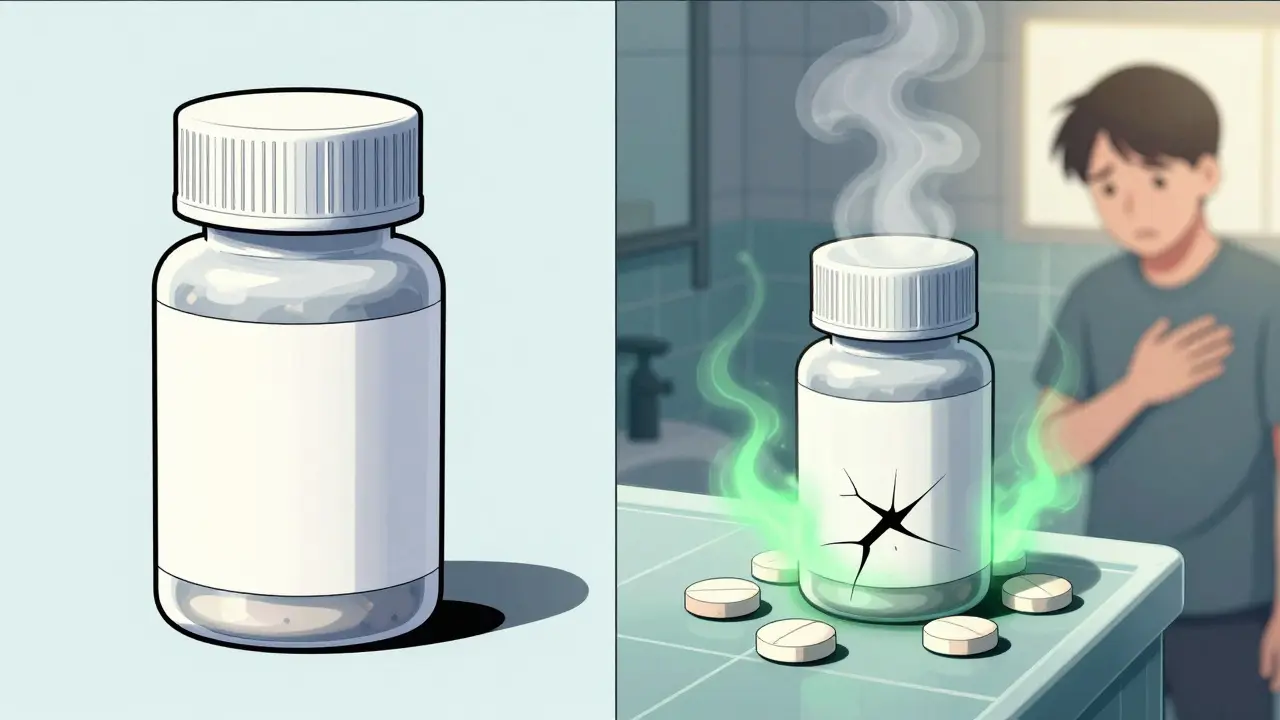
When you pick up a generic pill from the pharmacy, you assume it works just like the brand-name version. But what happens when that pill sits on a shelf for months-or years? Not all generics are created equal when it comes to stability and shelf life. And the difference isn’t just about potency-it’s about safety.
What Shelf Life Really Means
Shelf life isn’t just a date printed on the bottle. It’s the period during which a drug maintains its chemical, physical, microbiological, and functional integrity under specified storage conditions. The U.S. Food and Drug Administration (FDA) requires that expiration dates reflect when the product is guaranteed to meet its approved specifications. After that date, there’s no guarantee the drug will work as intended-or that it won’t break down into something harmful.For pharmaceuticals, stability testing isn’t optional. It’s mandated under 21 CFR 211.166. Manufacturers must prove, through real-time studies, that their product won’t degrade beyond acceptable limits over its labeled shelf life. This isn’t guesswork. It’s science.
How Drugs Break Down: The Four Types of Degradation
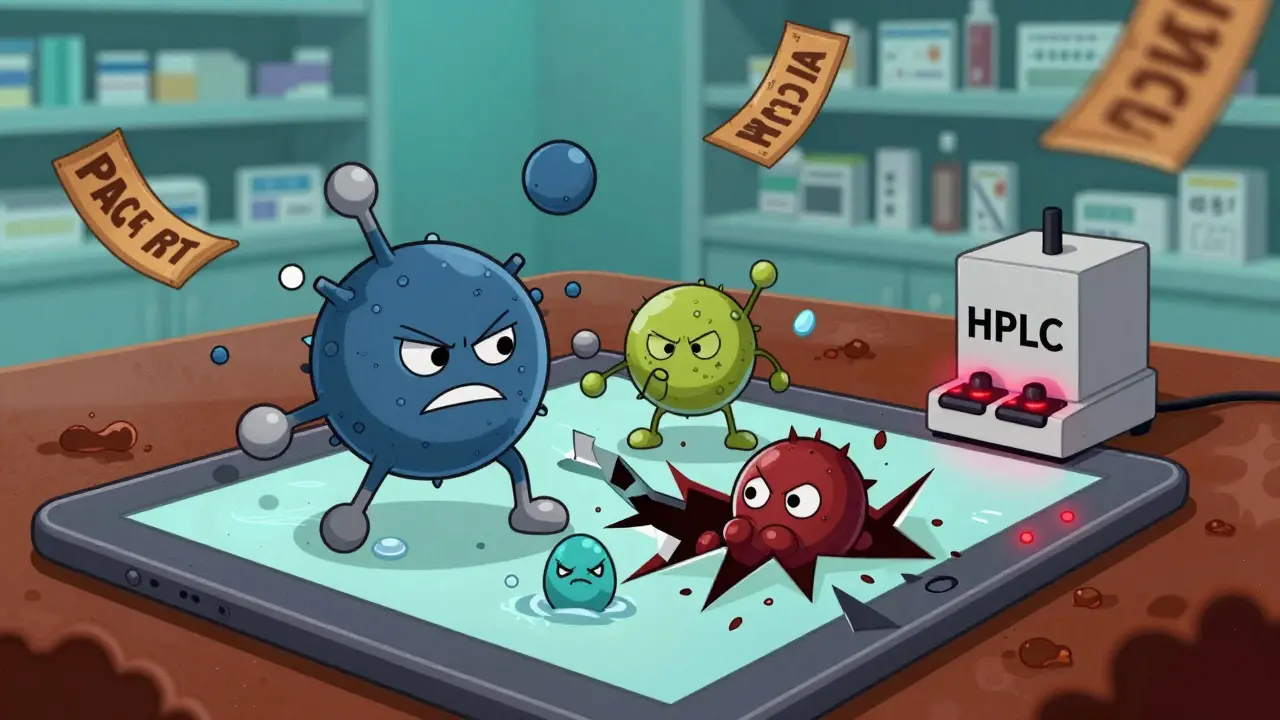
Drugs don’t just expire-they degrade. And degradation comes in four main forms:- Chemical degradation: Active ingredients break down into impurities. High-performance liquid chromatography (HPLC) detects these changes. ICH Q3B sets the bar: unknown impurities must stay under 0.1%. Even tiny amounts can be toxic over time.
- Physical degradation: Tablets crack, capsules soften, suspensions separate. For nanoparticles used in treatments like cystic fibrosis drugs, agglomeration above 200nm makes them useless. The surface area that lets them target cells vanishes.
- Microbiological degradation: Bacteria and mold grow if preservatives fail. USP <61> says non-sterile products must have fewer than 100 colony-forming units per gram. Water activity changes in liquid formulations are a silent killer-62.7% of stability-related recalls in 2022 traced back to this.
- Functional degradation: Inhalers lose dose accuracy. Eye drops stop delivering the right amount. USP <4> requires metered-dose devices to deliver 90-110% of the labeled dose. If they don’t, the patient gets too little-or too much.
One 2020 FDA study found that 17.3% of generic levothyroxine products had stability issues not seen in Synthroid. Why? Moisture. Different excipients in the generic versions didn’t protect the active ingredient as well. That’s not a small gap. For thyroid patients, even 5% potency loss can cause serious symptoms.
Accelerated Testing: A Shortcut That Can Backfire
To save time, companies run accelerated tests: 40°C and 75% humidity for six months. The idea? If the drug holds up under stress, it’ll last years at room temperature.But that’s not always true.
A quality assurance professional on the American Pharmaceutical Review forum lost $250,000 and 18 months because their accelerated test showed no degradation. The real-time study? Crystallization at 24 months. The culprit? A polymorphic transition-something that only happens slowly at normal temperatures. Accelerated tests don’t catch everything.
Dr. Kim Huynh-Ba, a stability expert with 25 years at the FDA, warns: "Performing accelerated testing at very high temperatures for a short time and expecting to extrapolate to long-term stability? That’s dangerous. The degradation mechanism at 40°C might be completely different than at 25°C."
ICH Q1A(R2) allows extrapolating shelf life up to twice the length of real-time data-but only if changes are minimal. Many companies push that limit. Regulators are catching on. In 2022, 80% of FDA Form 483 observations in stability programs were about poor documentation-not the science, just the paperwork.
Why Generic Drugs Are Riskier
Generics are cheaper because they don’t repeat expensive clinical trials. But they also don’t always replicate the exact formulation of the brand-name drug. Excipients-fillers, binders, coatings-can be different. And those differences matter.Take a capsule. The brand uses a moisture-resistant polymer. The generic uses a cheaper cellulose derivative. Over time, humidity gets in. The active ingredient degrades faster. The shelf life drops from 36 months to 24. No one notices until the patient’s blood levels are off.
WHO reported in 2021 that 28.7% of medicines in low-income countries failed stability tests-not because of poor manufacturing, but because of storage. Warehouses hit 35°C. Trucks sat in the sun. Refrigeration? Nonexistent. In high-income countries? Only 1.2% failed.
That’s not just a global health issue. It’s a safety gap. And it’s widening.
What’s Changing in 2026
The ICH Q12 guideline, effective since late 2023, lets companies make post-approval changes to stability protocols without re-filing. That’s good for innovation-but risky if not monitored closely.The FDA’s 2023 pilot for Continuous Manufacturing Stability Testing (CMST) cut shelf-life determination time by 40% for drugs made in continuous lines instead of batches. That’s a game-changer.
But the biggest shift? Predictive modeling. The IQ Consortium predicts that by 2027, 75% of new drug applications will use AI-driven stability models. These tools simulate degradation pathways using real-world data-temperature, humidity, light exposure-instead of just one fixed stress condition.
Companies using these tools reduced time-to-market by 8.2 months. That’s $147 million in extra revenue per product. But regulatory acceptance? Still slow. The FDA hasn’t fully defined what makes a predictive model "scientifically justifiable." That’s a gray zone.
What You Can Do
If you’re a patient:- Check the expiration date. Don’t use pills past it.
- Store meds where it’s cool and dry. Not the bathroom. Not the dashboard of your car.
- Ask your pharmacist: "Is this generic stable? Has it been tested for long-term storage?"
If you’re a healthcare provider:
- Know that generic bioequivalence doesn’t mean generic stability.
- Monitor patients on narrow-therapeutic-index drugs (like warfarin, levothyroxine, cyclosporine) more closely when switching generics.
- Report suspected stability issues to MedWatch. A single case can trigger a review.
And if you’re in the industry? Don’t cut corners on storage documentation. "Room temperature" isn’t enough. You need to log actual temperatures. The FDA doesn’t accept assumptions. They want data.
The Bottom Line
Shelf life isn’t about how long a pill lasts on the shelf. It’s about how long it stays safe and effective in your body. Generic drugs save money-but they don’t always save lives if they degrade. The science is clear: stability testing is not a box to check. It’s a lifeline.Climate change is making this harder. By 2050, rising temperatures could shorten average drug shelf life by nearly five months. That’s not science fiction. It’s a projection from MIT.
Stability isn’t glamorous. It’s not flashy. But it’s the quiet guardrail that keeps millions of people safe every day.
How is shelf life determined for generic drugs?
Shelf life for generic drugs is determined through real-time stability studies under ICH Q1A(R2) guidelines. Manufacturers test three batches over time-at 0, 3, 6, 12, 24, and 36 months-at controlled temperature and humidity. They measure chemical purity, physical appearance, microbial growth, and functional performance. Accelerated testing (40°C/75% RH for 6 months) may support extrapolation, but real-time data is required for final expiration dating.
Can expired generic drugs be dangerous?
Yes. While some expired drugs may simply lose potency, others can degrade into toxic compounds. For example, tetracycline antibiotics break down into nephrotoxic substances. Levothyroxine can lose potency, leading to hypothyroidism. Insulin can clump, causing inconsistent dosing. The risk varies by drug, but the FDA advises against using any medication past its expiration date.
Why do some generics have shorter shelf lives than brand-name drugs?
Differences in excipients, manufacturing processes, and packaging can affect stability. A brand-name drug may use a specialized moisture barrier or stabilizer that a generic version omits to cut costs. For instance, a 2020 FDA study found generic levothyroxine products had higher moisture sensitivity than Synthroid, leading to faster degradation. Even small formulation changes can reduce shelf life by months.
Is accelerated stability testing reliable?
Accelerated testing is useful for early screening but isn’t always reliable for predicting long-term behavior. It can miss degradation pathways that only occur slowly at room temperature, like polymorphic transitions or slow hydrolysis. One case study showed a product passed accelerated testing but crystallized at 24 months in real-time storage. Regulatory agencies allow extrapolation only when minimal changes are observed over long-term data.
What should I do if I find a generic drug that looks different or smells odd?
Stop using it immediately. Note the lot number, expiration date, and manufacturer. Contact your pharmacist and report it to the FDA’s MedWatch program. Changes in color, texture, odor, or dissolution can signal degradation. Even if it’s within the expiration date, unusual appearance is a red flag. Don’t assume it’s safe just because it’s generic.
How does storage affect generic drug stability?
Storage conditions are critical. Heat, humidity, and light accelerate degradation. A pill stored in a hot bathroom or a car in summer can degrade months ahead of schedule. The FDA requires manufacturers to define storage conditions on labels-usually "store at 20-25°C (68-77°F)." But if you store it at 30°C, you’re shortening its life. For liquids and suspensions, temperature fluctuations can cause separation or microbial growth.
Are there regulations for storing generic drugs in pharmacies?
Yes. Pharmacies must store drugs according to manufacturer specifications. This includes temperature-controlled environments for refrigerated products and humidity control for moisture-sensitive items. The USP <659> guidelines outline storage standards for pharmaceuticals. Pharmacies are inspected for compliance-failure to maintain proper conditions can lead to recalls or citations. Always ask your pharmacist how they store medications.
Can I trust a generic drug that’s been on the shelf for years?
Not without verification. Even if the expiration date is far off, the drug may have been stored improperly before reaching the pharmacy. Temperature excursions during shipping or warehouse storage can compromise stability. If you’re unsure, ask your pharmacist for the lot number and contact the manufacturer. For critical medications like insulin, seizure drugs, or heart medications, it’s better to replace an old stock than risk failure.
Oluwapelumi Yakubu
January 6, 2026 AT 00:01Man, this post hit different. I used to think generics were just as good as brand-name stuff-until my cousin’s thyroid meds stopped working after a year in her bathroom cabinet. Turns out, moisture doesn’t care if it’s ‘FDA-approved’-it just eats through cheap cellulose like it’s popcorn. We’re not talking about a little potency loss here; we’re talking about people going into cardiac arrest because their levothyroxine turned into a fancy sugar pill. The system’s broken, and nobody’s paying attention until someone dies.
Mandy Kowitz
January 7, 2026 AT 00:20Wow. A 12-page essay on pill chemistry. Who asked for this? I just want my blood pressure med to not turn into poison before I can finish my coffee.
saurabh singh
January 8, 2026 AT 01:24Bro, in India we’ve been dealing with this for decades. My uncle’s diabetes meds? Stored in a tin box on a rooftop in Jaipur. 45°C all summer. No AC. He didn’t know his insulin was clumping until he passed out. The system doesn’t care about you or me-it cares about profit margins. But hey, at least the generics are cheap, right? That’s the whole point. We’re not in a lab, we’re surviving.
Enrique González
January 8, 2026 AT 23:11Thanks for breaking this down. I’m a nurse, and I’ve seen too many patients on warfarin get flagged for INR spikes after switching generics. No one tells them the packaging changed-or that the new batch came from a warehouse with no climate control. We need better labeling. Not just ‘store at room temp’-tell us what room temp means. And maybe a QR code that shows storage history? Just a thought.
melissa cucic
January 9, 2026 AT 00:31The real tragedy isn’t the degradation-it’s the normalization of it. We’ve accepted that pharmaceuticals are disposable commodities, not life-sustaining tools. We don’t ask about storage conditions at CVS. We don’t question why the same pill looks different every time. We trust the label, the price, the brand. But science doesn’t care about trust. It cares about data-and the data says: we’re gambling with human lives, one expired capsule at a time.
Abhishek Mondal
January 10, 2026 AT 10:03Let’s be honest: the FDA doesn’t regulate stability the way it should. They approve generics based on bioequivalence-i.e., blood levels at a single time point. But what about 18 months later? What about when humidity spikes? What about when the warehouse gets flooded? They don’t test for real-world chaos. They test for paperwork. And if you think that’s not dangerous-you’re not paying attention. I’ve seen the reports. The red flags are all there. They’re just buried under 300 pages of ‘compliance.’
Aaron Mercado
January 10, 2026 AT 14:59AI models predicting degradation? That’s cute. But who’s training them? Big Pharma? The same companies that paid off regulators to skip real-time studies? And now they want us to trust an algorithm that’s trained on their own sanitized data? No. No. No. This isn’t innovation-it’s a Trojan horse. They want to eliminate human oversight. One day, your insulin will be recalled because an AI said ‘no risk,’ and you’ll be dead before your family finds out why.
Clint Moser
January 11, 2026 AT 21:03Did you know the FDA’s stability guidelines were written in the 1980s? And they’ve barely changed. Meanwhile, climate change is cooking our medicines in warehouses. The real reason generics fail? They’re not being stored-they’re being abandoned. And the government? They’re too busy arguing about TikTok bans to fix this. It’s all connected. The same people who cut funding to public health are the ones who let drug companies skip testing. This isn’t negligence. It’s a deliberate plan to make us dependent on expensive brand-name drugs again. Wake up.
Akshaya Gandra _ Student - EastCaryMS
January 13, 2026 AT 00:42so i was wondering if the temp changes during shipping affect the pills too? like when they sit in a truck for 3 days in summer? i mean, my cousin got her meds delivered and the box was hot to touch…
Justin Lowans
January 15, 2026 AT 00:30What’s missing from this conversation is the human cost behind every degraded tablet. A child with epilepsy who has a seizure because their generic phenytoin lost 8% potency. A diabetic who doesn’t know their insulin is clumped until their blood sugar spikes to 500. A grandmother on warfarin whose INR skyrockets because her pill’s coating dissolved too fast. These aren’t statistics. These are people. And the system treats them like afterthoughts. We need transparency-not just in testing, but in labeling. Every bottle should come with a temperature history. Not because it’s fancy. Because it’s necessary.