

Medication Tinnitus Risk Checker
Check Your Medication Risk
Enter a medication name to see if it's associated with tinnitus as a side effect.
Have you started a new medication and suddenly noticed a ringing, buzzing, or hissing in your ears? You’re not alone. Thousands of people experience tinnitus as a side effect of common drugs - and many don’t realize it’s linked to what they’re taking. The good news? In many cases, it’s not permanent. The key is knowing which medications to watch for, how to spot the signs early, and what to do next.
What Exactly Is Medication-Induced Tinnitus?
Tinnitus isn’t a disease. It’s a symptom - the perception of sound when no external noise is present. For some, it’s a faint hum. For others, it’s a loud, distracting ring that won’t go away. When it shows up after starting a new pill, patch, or injection, it’s likely ototoxicity - damage to your inner ear caused by a drug.
More than 600 prescription and over-the-counter medications are known to trigger or worsen tinnitus, according to Sound Relief’s 2025 review. That includes everything from painkillers to antibiotics to antidepressants. The damage happens in the cochlea or the auditory nerve, disrupting how sound signals reach your brain. Sometimes, the effect is temporary. Other times, it sticks around even after you stop the drug.
Which Medications Are Most Likely to Cause Ringing in the Ears?
Not all drugs carry the same risk. Some are high-risk. Others rarely cause issues. Here’s a breakdown of the most common culprits:
- Aminoglycoside antibiotics - Drugs like gentamicin and tobramycin, often used for serious infections, carry the highest risk. Up to 25% of patients on long-term IV treatment develop permanent hearing damage. Even topical versions (like ear drops) can cause issues if used for extended periods.
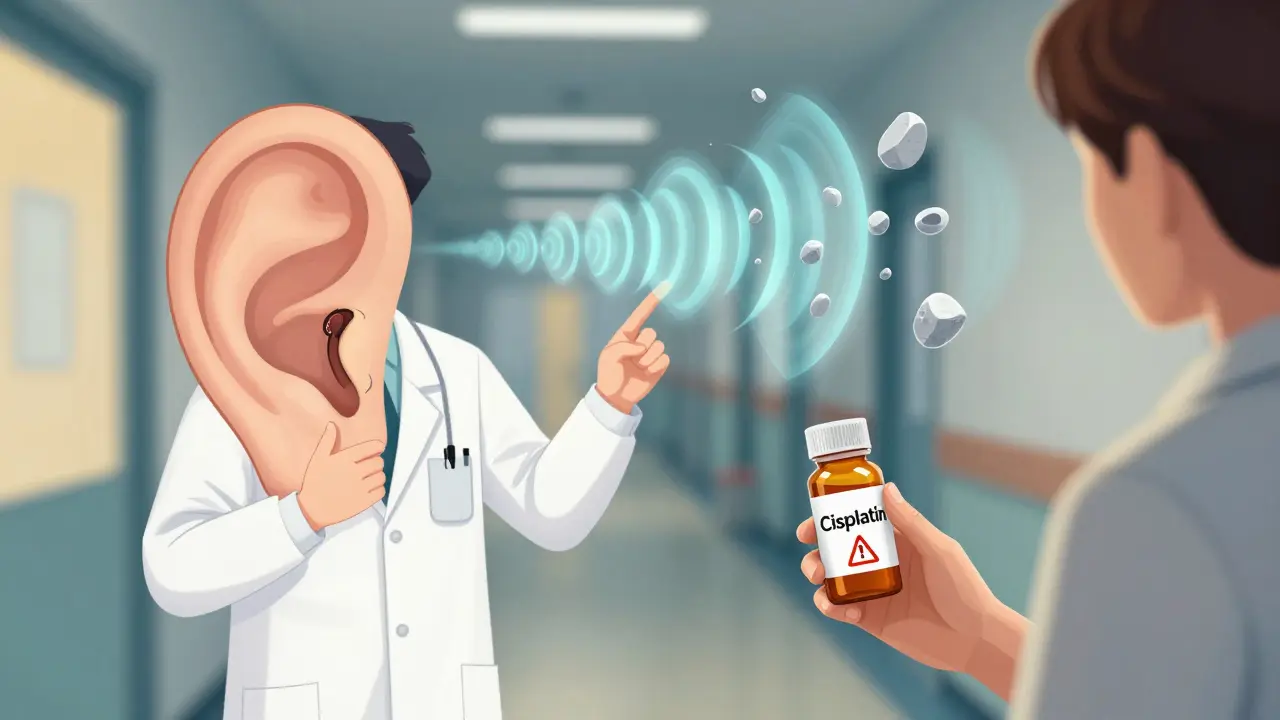
- Chemotherapy drugs - Cisplatin, used for lung, ovarian, and testicular cancers, causes tinnitus in 30-70% of patients. Hearing loss often starts with high-pitched sounds you can’t hear anymore - like birds chirping or a phone ringing - before affecting speech.
- Loop diuretics - Furosemide (Lasix) and bumetanide, used for heart failure or fluid retention, can cause temporary tinnitus and hearing loss, especially at high doses or in people with kidney problems.
- High-dose aspirin and NSAIDs - Taking more than 4,000 mg of aspirin daily (far above typical headache doses) can cause ringing in the ears. At standard doses (325-650 mg), risk is very low. But some people are unusually sensitive - even 81 mg can trigger symptoms in rare cases.
- Isotretinoin (Accutane) - Used for severe acne, this drug causes tinnitus in about 5% of users, though the manufacturer reports less than 1% in clinical trials. The discrepancy suggests individual sensitivity plays a big role.
- Quinine - Found in some malaria treatments and, historically, in tonic water, it can cause tinnitus within 24-72 hours of use. Symptoms usually fade within weeks after stopping.
On the lower-risk side: most antidepressants (SSRIs like sertraline or fluoxetine) cause tinnitus in less than 1% of users. Beta blockers like atenolol rarely cause issues, but carvedilol has been linked to ringing in rare cases. Benzodiazepines like Xanax or Valium are more likely to cause tinnitus after long-term use (6+ months).
Is the Tinnitus Permanent?
This is the biggest worry for most people. The answer? It depends.
For about 60% of cases, tinnitus fades within days or weeks after stopping the drug. This is common with NSAIDs, diuretics, and even high-dose aspirin. The inner ear cells recover once the drug clears your system.
But for drugs like aminoglycosides and cisplatin, damage can be permanent. These drugs destroy hair cells in the cochlea - and those don’t grow back. If you’re on one of these for a life-threatening condition, your doctor will monitor your hearing closely. Baseline hearing tests before treatment and regular follow-ups are standard in hospitals that use these drugs.
There’s also a weird twist: sometimes tinnitus starts when you stop a medication. People have reported ringing after quitting sertraline (Zoloft) or other antidepressants. This is called withdrawal tinnitus. It’s rare, but real. If you’re planning to stop any medication, talk to your doctor first - don’t quit cold turkey.
How Soon After Starting a Drug Does Tinnitus Show Up?
Timing matters. Most people notice ringing within the first two weeks of starting a new medication. For drugs like quinine or high-dose aspirin, symptoms can appear in under 48 hours. With chemotherapy or long-term antibiotics, it might take weeks or even months.
One Reddit user from Toronto described ringing in both ears after taking 800 mg of ibuprofen three times a day for dental pain. Symptoms started on day two. After stopping the drug, the ringing faded completely in six days. That’s the classic pattern for NSAID-induced tinnitus: fast onset, fast resolution.
But delayed reactions happen too. A 2024 case study documented tinnitus appearing 90 days after starting a new antibiotic. So if you’ve been on a drug for months and suddenly notice ringing, don’t assume it’s unrelated.
What Should You Do If You Notice Ringing After Starting a New Drug?
First: do not stop your medication on your own. Even if you think the pill is the cause, stopping suddenly could be dangerous - especially for blood pressure meds, antidepressants, or antibiotics.
Instead, call your doctor. Say: “I started [drug name] and now I have ringing in my ears. Could this be a side effect?” They’ll likely ask you:
- When did the ringing start?
- Is it constant or comes and goes?
- Do you have dizziness or trouble hearing?
Your doctor may:
- Switch you to a different drug with lower ototoxic risk
- Lower your dose
- Order a hearing test
- Check your kidney function (since many ototoxic drugs are cleared by the kidneys)
If you’re on a high-risk drug like cisplatin or gentamicin, your care team should already be monitoring your hearing. If they’re not - ask why. Early detection is your best defense against permanent damage.

Can You Prevent Medication-Induced Tinnitus?
Prevention starts with awareness. If you’re about to start a new medication, ask your doctor or pharmacist:
- “Is this drug known to affect hearing?”
- “Are there alternatives with less risk?”
- “Should I get a hearing test before or during treatment?”
For high-risk drugs, baseline audiometry (hearing test) is standard in many hospitals. Some clinics now use genetic testing to find people who are more likely to suffer ototoxic damage - a promising development, though still not widely available.
Stay hydrated. Avoid loud noise while on ototoxic drugs. Limit alcohol and caffeine - they can make tinnitus worse. And if you’re on multiple medications, review them all with your pharmacist. Drug interactions can increase ototoxic risk.
What If the Tinnitus Doesn’t Go Away?
If your tinnitus sticks around after stopping the drug, it’s not your fault. You did everything right. Now it’s about managing it.
Sound therapy - using white noise machines, fans, or apps - helps many people by masking the ringing. Cognitive behavioral therapy (CBT) for tinnitus has been shown to reduce distress in 60-70% of patients, even if the sound doesn’t disappear.
There’s no cure yet, but research is moving fast. The NIH is funding $12.5 million in new studies on otoprotective agents - drugs that could shield your ears from damage without reducing the effectiveness of antibiotics or chemo. Clinical trials are already underway.
For now, focus on what you can control: protect your hearing, avoid loud environments, and work with your doctor to find the best path forward.
Bottom Line: Know the Risks, Speak Up
Medication-induced tinnitus is more common than most people realize. But it’s also one of the most preventable forms of hearing damage - if you catch it early.
You don’t need to memorize a list of 600 ototoxic drugs. You just need to know: if a new pill makes your ears ring, it might be the cause. Don’t ignore it. Don’t panic. Talk to your doctor. And remember - most cases are reversible. The sooner you act, the better your chances of getting your quiet back.
Karen Droege
January 25, 2026 AT 04:23Okay, I need to scream into the void because I didn’t know ibuprofen could do this. I took 800mg three times a day for a week after wisdom teeth removal - and my ears sounded like a broken Bluetooth speaker. I thought I was going crazy. I stopped it cold turkey and the ringing vanished in five days. Why isn’t this on the damn label?!? I’m telling every friend I know. You’re not weak if your ears ring after Advil. Your body’s just screaming at you to listen.
Also - if you’re on antibiotics and suddenly hear crickets in your skull? That’s not your imagination. It’s your cochlea throwing a protest. Don’t wait. Call your doctor before you lose your favorite song forever.
Simran Kaur
January 26, 2026 AT 13:12In India, we call this 'kana kana' - the sound that lives inside your head when nothing’s playing. My aunt took a strong antibiotic for a kidney infection and started hearing bells. She thought it was divine. We thought she was losing it. Turned out it was the medicine. She stopped it, and after three weeks, the bells went quiet. But she still says she misses them sometimes - like a ghost lullaby.
So many of us don’t know this is a thing. We blame stress. We blame age. We blame the gods. But it’s often just a pill we swallowed without asking. Please, if you’re reading this - ask your doctor: ‘Will this hurt my ears?’ It’s a simple question. It could save your silence.
Neil Thorogood
January 26, 2026 AT 19:04So let me get this straight - you’re telling me that my daily Tylenol headache cure is secretly a tiny ear ninja? 😱
Meanwhile, my psychiatrist just switched me from Zoloft to Lexapro because ‘the tinnitus might be withdrawal.’ Bro. I didn’t even know I HAD tinnitus until you said that. Now I’m sitting here in a silent room listening to my own skull hum. Thanks, science.
Also, if you’re on chemo and your ears start ringing? Congrats. You’re basically a human soundwave. 🎵 Stay hydrated. Avoid loud concerts. And maybe don’t listen to Metallica on headphones while getting infused. Just a thought.
Jessica Knuteson
January 28, 2026 AT 15:40It’s not the drugs. It’s the narrative. You’re assigning agency to pharmaceuticals. You’re anthropomorphizing molecules. The ear doesn’t care about your intention. The cochlea doesn’t have feelings. Tinnitus is just noise in the system. A glitch. A signal error. Not a betrayal. Not a conspiracy. Just physics. Your brain is interpreting randomness as meaning. That’s the real problem. Not the pill.
Stop romanticizing side effects. Stop turning medication into villains. The body is a machine. Machines break. You don’t blame the wrench for the bent nail.
Robin Van Emous
January 28, 2026 AT 21:23Hey, I just want to say thank you for writing this. I really appreciate how clear and kind this is. I’ve had tinnitus for two years now, and I didn’t know it was from my blood pressure meds. I was blaming stress, noise, aging, everything except the pills. I finally called my doctor after reading this - and we switched me. It’s been three weeks, and it’s quieter. Not gone, but quieter. That’s enough. I’m not mad. I’m just glad I found this. Please keep sharing stuff like this. It helps more than you know.
Also, hydration. I drink water now. Every hour. I’m not a robot, but I’m trying.
Angie Thompson
January 30, 2026 AT 13:11OMG I JUST REALIZED - my morning coffee + daily naproxen + that new acne cream I started = my ears are doing a techno remix 24/7. 🤯
I thought I was just tired. I thought I was ‘hearing things.’ But no. It’s the combo. I stopped the cream first - no change. Stopped the naproxen - still ringing. Then I cut caffeine for 48 hours… and the high-pitched whine? GONE. Like, poof. Magic.
So if you’re on meds AND drinking coffee AND using new skincare? Take a step back. Your ears are not your Spotify playlist. They’re your body’s emergency alarm. Listen. Please.
eric fert
February 1, 2026 AT 10:51Look, I’ve read this entire thing, and I’m still not convinced this isn’t just a marketing ploy by hearing aid companies to scare people into buying devices. You say 600 drugs cause tinnitus - but how many of those are actually proven in double-blind studies? How many are just anecdotal Reddit posts from people who think their ear is haunted? And what about the fact that tinnitus is common in people who’ve never taken a single pill? Stress, aging, genetics - these are the real villains. Not aspirin. Not ibuprofen. Not even cisplatin. It’s the modern human condition. We’re all just buzzing now. The drugs didn’t make us noisy - we made the drugs noisy because we’re loud inside.
Also, why do you assume everyone wants their silence back? I’ve learned to love the hum. It’s my personal white noise. My inner DJ. My soundtrack. Maybe the real problem isn’t the ringing. Maybe it’s our cultural obsession with quiet. We’ve forgotten how to live with noise. We think silence is peace. But silence is just the absence of sound. It’s not healing. It’s empty.
Aishah Bango
February 2, 2026 AT 15:07So you’re telling people to ask their doctors about ototoxicity? That’s cute. But let’s be real - most doctors don’t know this stuff. They’re overworked. They’re paid to prescribe. They’re not trained to ask, ‘Does this make your ears ring?’ They’re trained to check the box: ‘Prescribed.’
And if you’re on antidepressants? Good luck. Your doctor will say, ‘It’s probably anxiety.’ Even if you’ve never had anxiety before. Even if you’ve never heard a sound in your head until you started taking it. They’ll blame your mind. Not their prescription.
Stop asking for permission. Start documenting. Record your symptoms. Take notes. Bring them your pharmacy printout. If they brush you off? Get a second opinion. Or better yet - stop taking it. Your ears matter more than your doctor’s schedule.